Before we embark on the history of the Barrand/Barraud family, let us take a quick tour of the areas of London where the Barrand families lived, starting in the far south-west. Close to the river Thames was the notorious slum near Westminster Abbey called Old and New Pye Streets. It lay next to Tothill Fields, on the very edge of London in 1800, and many knew it as the ‘Devil’s Acre’. Houses there were thought to date back to the time of William Caxton. Further north were two old pockets of notoriety around St Martin-in-the-Fields at the west end of the Strand, and at the east end of Piccadilly. To the west was St Giles, the most notorious of all, a City suburb by the 1670s. By 1800 this was known as ‘Little Dublin’ or ‘Little Ireland’ a comment on the obstreperous Irish population. At the eastern end of Oxford Street, even by then a fashionable shopping centre for the west end of town, St Giles was an ever-present risk to the shopper, the wagoner or the parcel-carrier. Nearby lay Seven Dials and the dirty streets off Drury Lane such as Coal Yard and Feather Court. Then we reach the notorious Clare Market area, then from High Holborn down to the Strand and even further down to the river, a nest of seventeenth and eighteenth century streets, courts and alleys with an evil reputation. Still, moving east, touching the north-west border of the City, lay the teeming thieves’ quarter of Saffron Hill, Chick Lane and Snow Hill, at the back of the foul and stinking River Fleet. In these streets, freshly washed silk handkerchiefs, loot from an army of pickpockets, would hang on poles and lines as thick as oak leaves in summer. Now comes the impenetrable nest of courts and alleys around Turnmill Street, Clerkenwell, and south of this came Smithfield, older than St Giles or Saffron Hill with its barbaric cattle market. We will see that all these areas at some time were the haunts of the Barrand and Barraud families..........Welcome to the lives of the Barrands.
-oOo-
So, now to the details of John Barraud, the youngest son of Philip Barraud and his 2nd wife Frances Prevost.
Miss. E. M. Barraud in her book gave only the briefest of details of John and his family. For some reason, she did not pursue his life but consentrated on the other members of the family.
We know for certain that John Barraud, the youngest son, was born in born in 1729 in Greenwich and he was baptised on the 16th January, 1729 at St. Alphege Church, Greenwich. Nothing is known about the early education of John, or in fact any of the other children of Philip Barraud and Frances Prevost, but it is more than likely that they were educated privately, as this was the preferred method by the Huguenots. Following Philip Barraud’s untimely death in 1732, his widow, Frances (nee Prevost) remained in Greenwich for a further 10 years or so, but then moved the family to King Street, Soho in 1743, by which time John would have been 14 years old, and would have been either employed, or certainly looking for employment. The Barraud family, after moving from Greenwich to London in 1743 were, in general, important members of the community, well respected, relatively wealthy and seem to have lived comfortable lives. Having said that, as the evidence seems to suggest, by the time of the grand-children of John Barraud in particular, the family appears to have fallen on hard times, and they lived in the poorest areas of London clearly struggling over the years.
It is known that John Barrand and his family had regular contact with the rest of the Barraud family from the time he married, and certainly as John’s family first lived in the Soho area of London and also in the same streets as the other Barrauds, it seems inevitable that they kept in contact. It is also known for instance, that Herbert Rose Barrand, the renowned photographer (and a great grandson of Francis-Gabriel Barraud and Magdelaine Crespin) took many photos of both his own family of Barrauds and also many of the Barrands in the 1870s and 1880s.
John Barraud’s wife, Mary Turpin was not of a Huguenot family, so it certainly broke with the tradition of Barrauds marrying into other Huguenot families, and it may well be the case that some members of the Barraud family possibly frowned upon John Barraud and Mary Turpin somewhat from the time of their marriage in 1752 and, as a result, the family became virtual outcasts and exceptionally poor. There are certainly no positive records of John Barraud as a watchmaker or engraver on his own account in the Barraud family of watchmakers or engravers, although it seems clear that John was either working with his brother Francis-Gabriel, or was most possibly in business with him in some way from about 1752 until his death. It is quite astonishing that, although John's family were extremely poor, by 1900 this part of the Barrand/Barraud family were again affluent and with good occupations.
As far as is known, John is the only son of Philip Barraud and Frances Prevost (apart from Daniel who emigrated) that did not follow the family tradition by becoming either a watchmaker or engraver on his own account and certainly his elder brothers, Philip and Francis-Gabriel were, although John’s half-brother, Michael (son of Philip Barraud and Catherine Strang) was also not involved with watchmaking or engraving in any way. Frances Prevost, (John’s mother) stayed in King Street, Soho, almost certainly at the address of her brother William Prevost who was a well-respected silver engraver until her death on 3rd January, 1778, and she was buried on the 12th January, 1778. She died however at the address of her son, Francis-Gabriel Barraud which was in Shoe Lane, Holborn at that time, almost opposite St. Andrews Church (see map) and she was buried in this church in 1778. Frances Prevost made a will however in 1772, six years before her death, and this will is vitally important to the Barraud family history, as it mentions all her four sons, the wife’s of three of them, and two of her grandchildren – to her, probably the most significant members of the family. In particular, this will, as far as John is concerned, although it does not give any clues as to his employment or life, does mention that he had certainly died by 1772, had a widow Mary and at least one daughter, Frances. That is as far as the will goes, and no further mention of John or his family is given, but what the book by Ms. E. M. Barraud says about John Barraud in his mother, Frances Prevost’s will is this:
“This was John, baptised at Greenwich on the 16th January, 1729. All we know of him is that he was dead by the time his mother made her will (1772) but had married a woman named Mary and had at least one child, a daughter named Frances. It was to “Mary the widow of my late son John” that his mother left “All my woollen petticoats” and five pounds to be paid immediately after her mother-in-law’s death. To John and Mary’s daughter Frances, she left £100 in 4 percent annuities on attaining her majority, or at her marriage should that occur first – so long as the girl had the written consent of her uncles Philip and Francis-Gabriel as executors. This means that the young Frances was still a minor in 1772 and must have therefore have been born after 1752. Her grandmother also left her all her shifts and a crape gown and a silk narrow-striped half mourning gown.
I know no more of John’s daughter, but he and Mary may also have had a son. John, son of John and Mary was baptised at St. Anne’s Soho on 4th November, 1752. If this was the same family, then John senior was alive as late as 1752 and lived in the Soho district, but the rest is silence. I can find no will or administration order and no more of John junior either.”
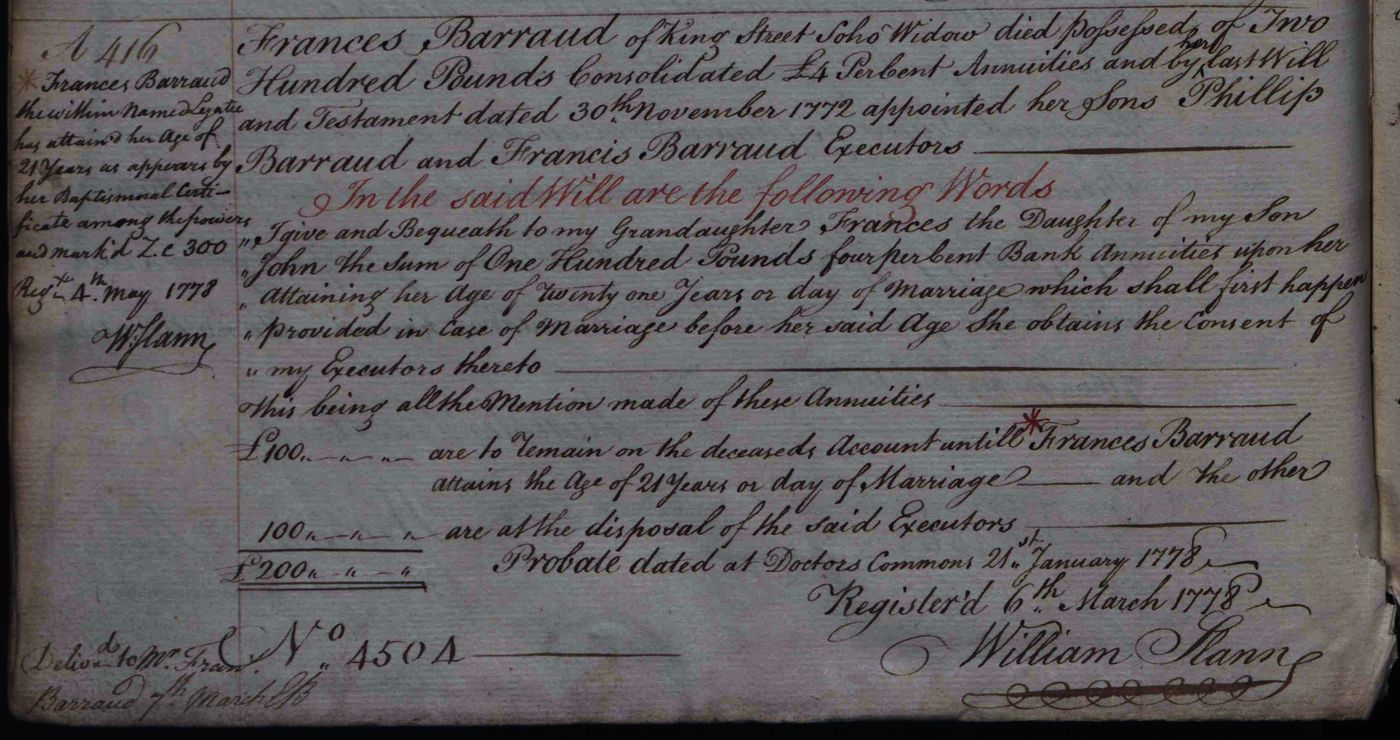
The Will of Frances Barraud
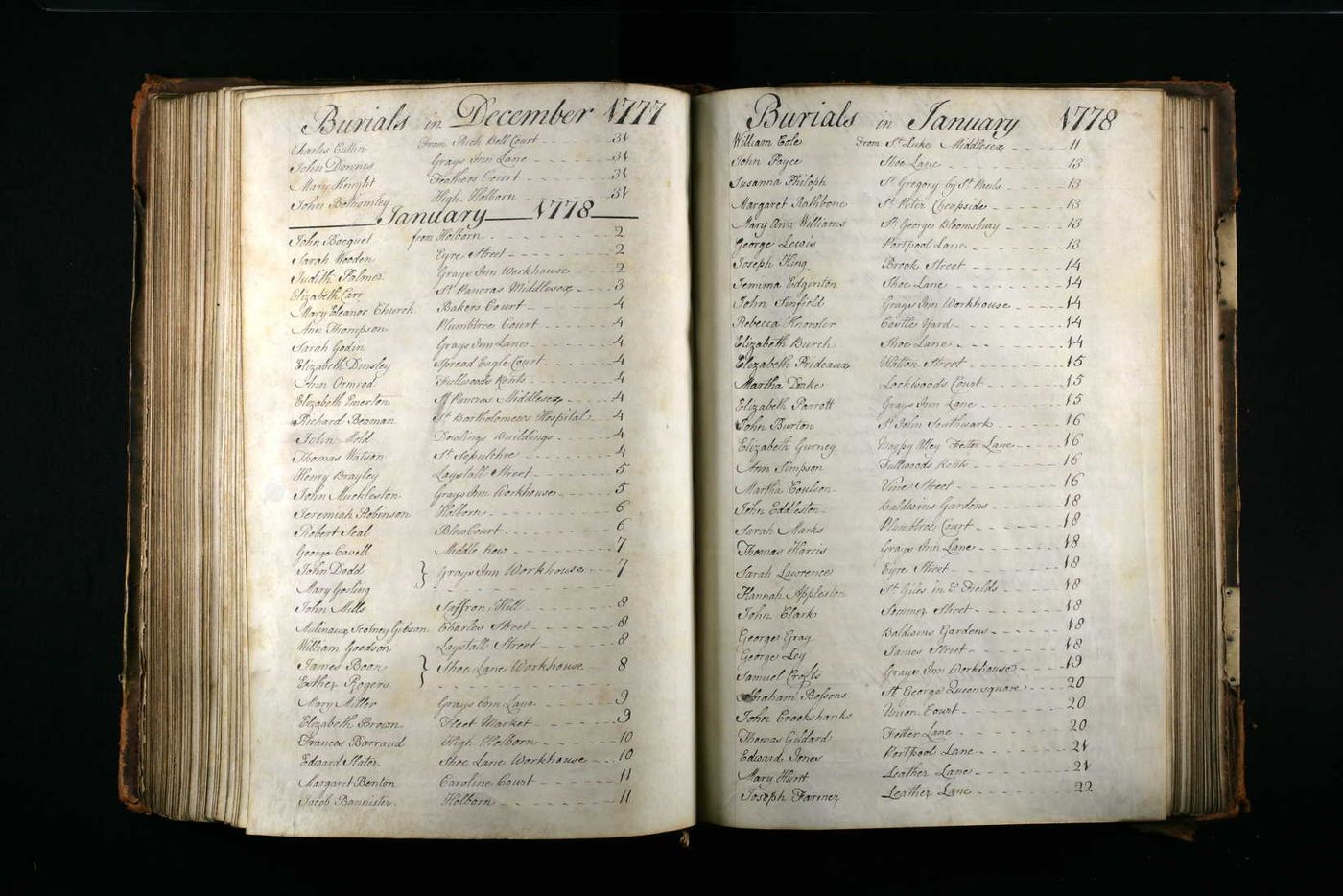
Burial Record of Frances Barraud (nee Prevost) 10th January, 1778
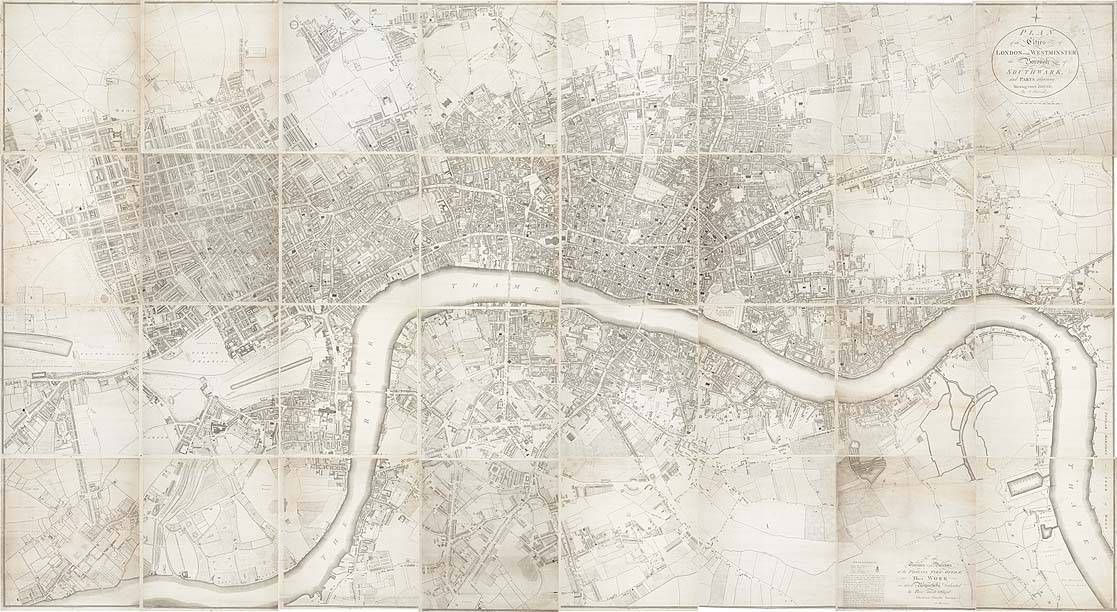
Oxford Street
7 – Dials where Thomas Barrand lived 1815----
King Street – Barraud Family moved in 1743---------
Clare Market – John Barrand lived 1820 – 1840------------
Coal Yard where George Barrand lived 1850-1870--------
Shoe Lane where Francis-Gabriel lived 1780----------------------
Richard Horwoods Map of 1792-99
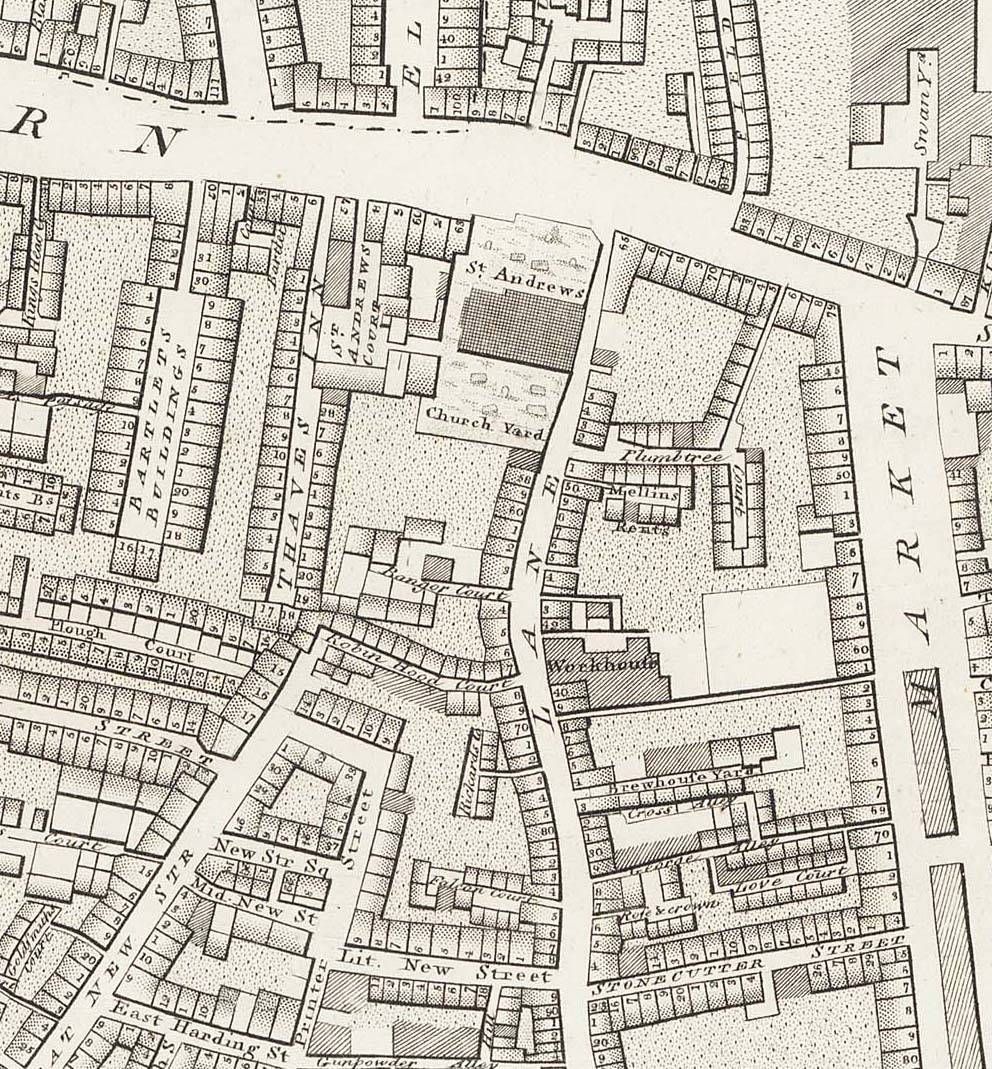
Shoe Lane St. Andrews Church
Whatever the occupation of John, in the years from the time the family moved to Soho in 1743 until his marriage in 1752 is unclear, but to continue with his life, we know he certainly married Mary Turpin on the 27th November, 1752 in Westminster, London, and there are several records of this marriage:
Parish Records Collection - marriage Year: 1752
Supplied Surname: TURPIN
Full First name: Mary
Spouse Surname: BURRARD (OR BARRAUD)
Spouse Full First name: John
Spouse First Name: Jn
Place: WESTMINSTER (GROSVENOR CHAPEL, MAYFAIR)
County: London
Record source: Boyd's Marriage Index 1538-1840 Data provider: Society of Genealogists
Parish Record of Marriage – John Barraud and Mary Turpin

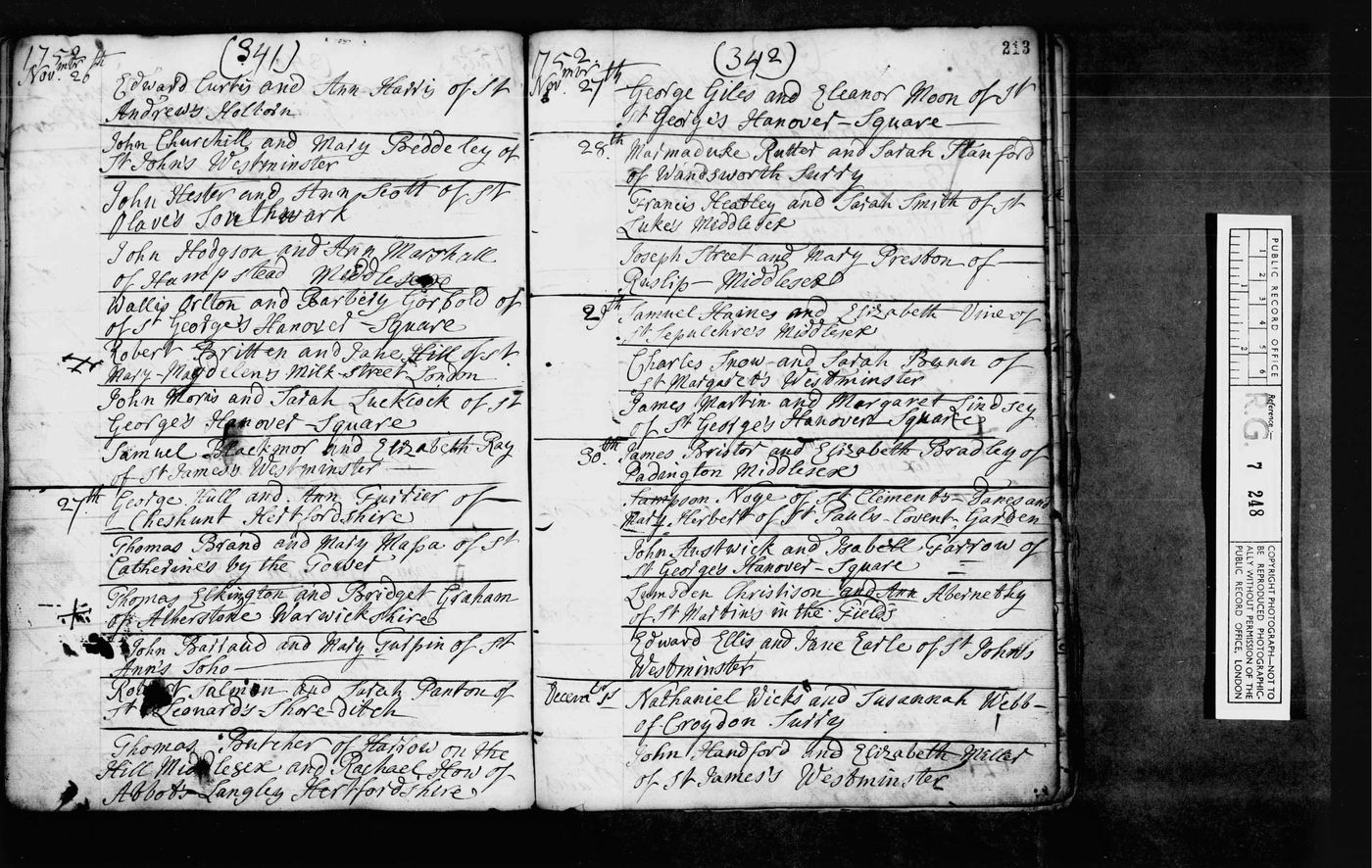
Parish Record of marriage of John Barraud + Mary Turpin – date 27th November, 1752.
London, England, Clandestine Marriage and Baptism Registers, 1667-1754
MARY TURPIN Female
Marriages:
Spouse: JOHN BURRARD (Barraud)
Marriage: 27 NOV 1752 Saint George Mayfair, Westminster, London, England
Source Information: IGI
Batch No.: Dates: Source Call No.: Type: Printout Call No.: Type:
M019021 1728 - 1754 942 B4HA V.15 Book 6904134 Film
IGI Record of Marriage – John Barraud and Mary Turpin
John Barraud Male
Marriages:
Spouse: Mary Turpin
Marriage: 27 NOV 1752 Westminster, London, England
Source Information: IGI
Batch No.: Dates: Source Call No.: Type: Printout Call No.: Type:
I010465 No Information Film
IGI record of Marriage – John Barraud and Mary Turpin – different source record
Piece Description Marriages and Baptisms from the May Fair Chapel Register performed according to the Rules of the Fleet, London from 1749 to 1753
TNA Reference RG7 / Piece 248 / Folio 213 [Chapel/Registry]
Groom Name John Barraud
Bride Name Mary Turpin
Date of Marriage: 27 November 1752
Registration Town/County: May Fair, London
Groom's Abode St Anns Soho Bride's Abode St Anns Soho
Parish register of marriage John Barraud and Mary Turpin
The Turpin Family
John Barraud's wife, Mary Turpin was born in 1732, and baptised on the 27th April, 1732, a daughter of John Turpin, born in 1694 (a sailmaker) and Elizabeth Little who were married on 6th October, 1730 (IGI Ref: M001442) At the time of Mary Turpin's marriage to John Barraud in 1752, the Turpin family also lived in King Street, Soho, the same street as John Barraud and the other members of the Barraud family. From the marriage bond and allegation records of John Turpin and Elizabeth Little, it clearly shows that John Turpin was already a widower when he married Elizabeth Little, and from other records it would appear that Elizabeth Little was in fact his 3rd wife. On his 3rd marriage to Elizabeth Little, his age is shown as 36, making his DOB around 1694, and Elizabeth's age as 28, making her DOB around 1702. It seems that John Turpin had previously married Elizabeth Wilmot on the 30th May, 1726 in St. Katherines Church by the Tower (IGI Ref: M00144-2), in the same church as his marriage to Elizabeth Little. On this marriage to Elizabeth Wilmot however, the records show again that John Turpin was a widower, so again it appears he had been married previously. There are records to show that John Turpin did indeed marry previously to a Martha Shivers (a widow) on the 8th August, 1714 and again at the same church - St. Katherines Church by the Tower (IGI Ref: M00144-1). Martha, it seems died in 1719 and was buried on the 19th June, 1719. I do not think there were any children to either of these marriages.
Mary Turpin was the eldest of three daughters, as she also had two younger sisters, Hannah born in 1733 and baptised on the 27th January, 1733, and Sarah born in 1735 and baptised on the 14th March, 1735. I can find no records to show whether Hannah Turpin ever married or indeed reached adulthood, but certainly in 1772, Sarah Turpin was a witness to Mary Turpin's 2nd marriage to William Pether after the death of John Barraud. Sarah signed her name Sarah Turpin, so it seems she was still unmarried at that time at the age of 37, and her burial is recorded as 20th February, 1781, and died at Grays Inn Lane in Holborn at the age of 46 as Sarah Turpin.
John Turpin had his own business on the riverside near to London Docks and employed 30 people. He imported, sail canvas from France and Holland and considering that much of that canvas was sold to the Navy to fight the wars with France, the Government decided to end British reliance on continental canvas, and by mid-century, production of British sailcloth had multiplied several times over. The factory contained 14 weaving looms, several starching frames, a large double screw packing press, a calender (for finishing the surface) and a warping mill. John Turpin’s name is recorded as a canvas and sailmaker in textiles in the Wapping Merchants records and also noted as a sail cloth warehouseman.
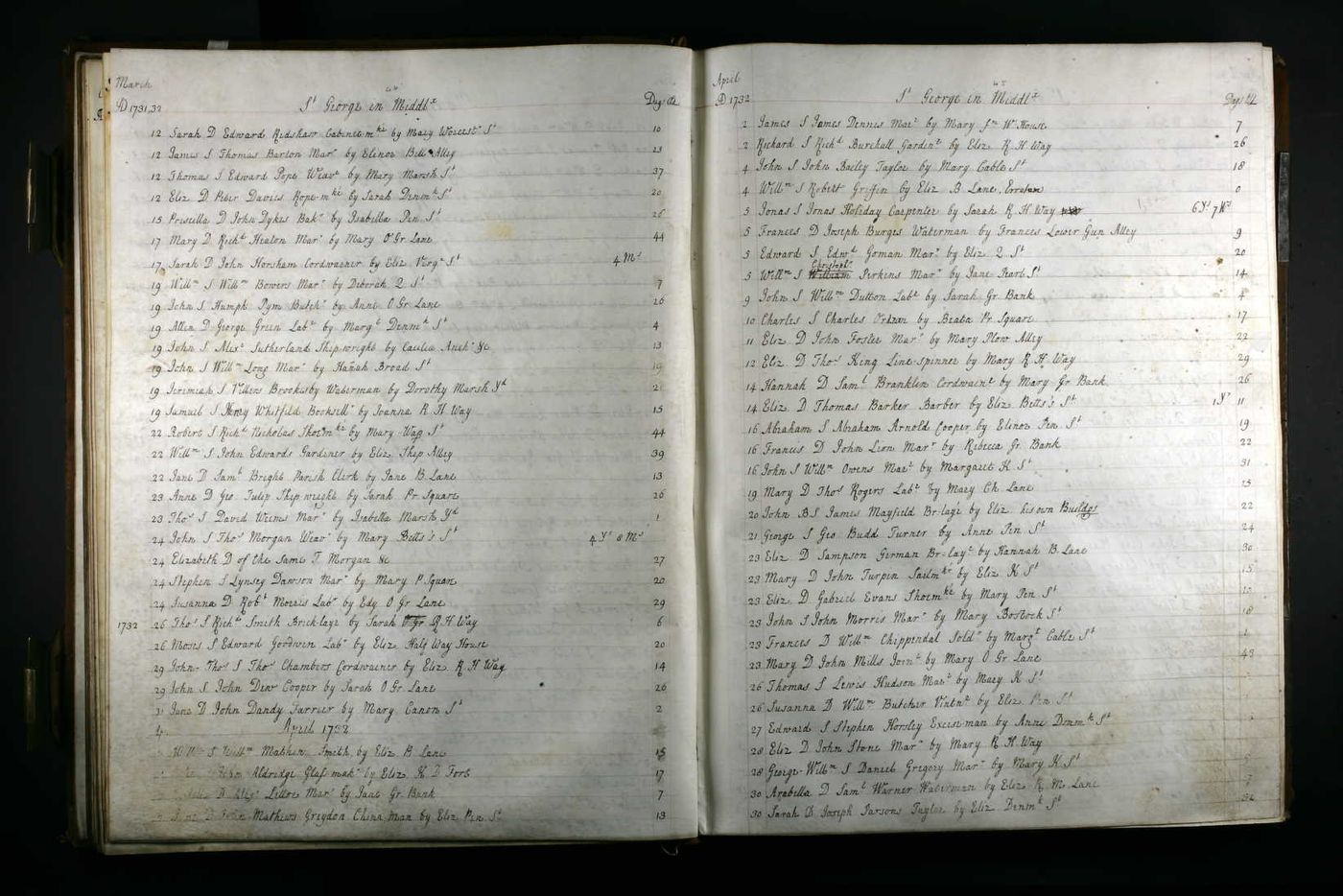
The baptism record of Mary Turpin from the IGI
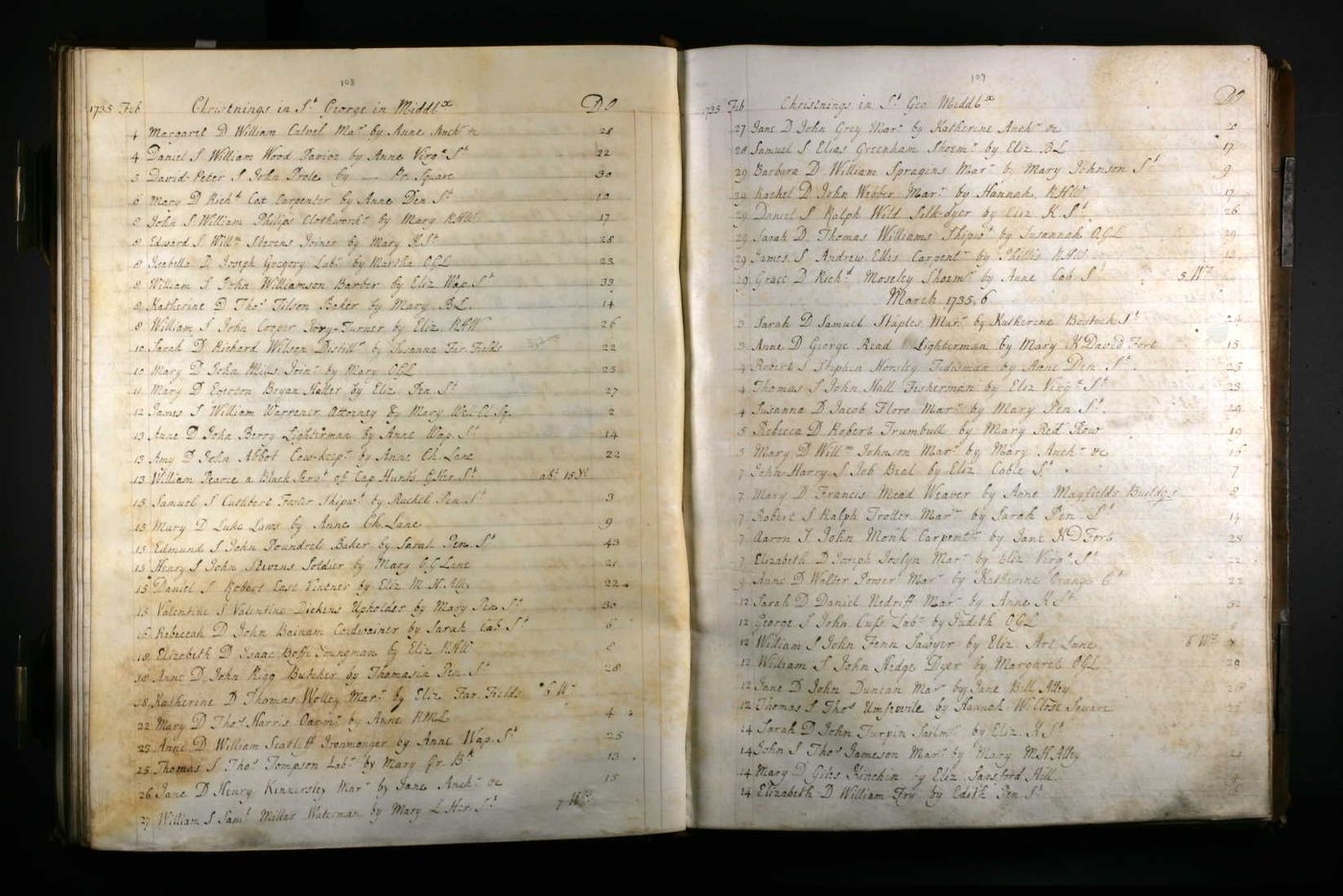
Baptism of Sarah Turpin
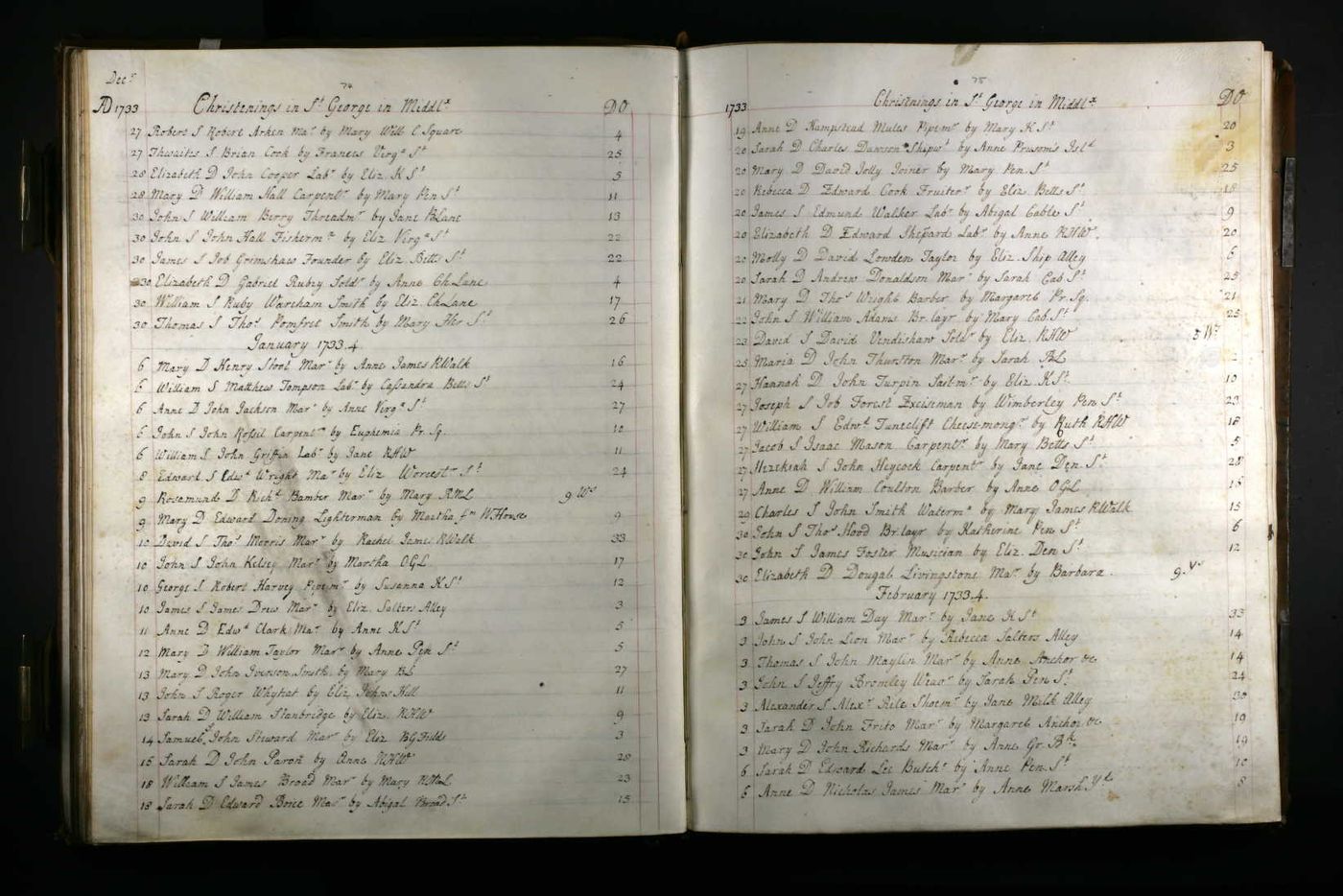
Baptism of Hannah Turpin
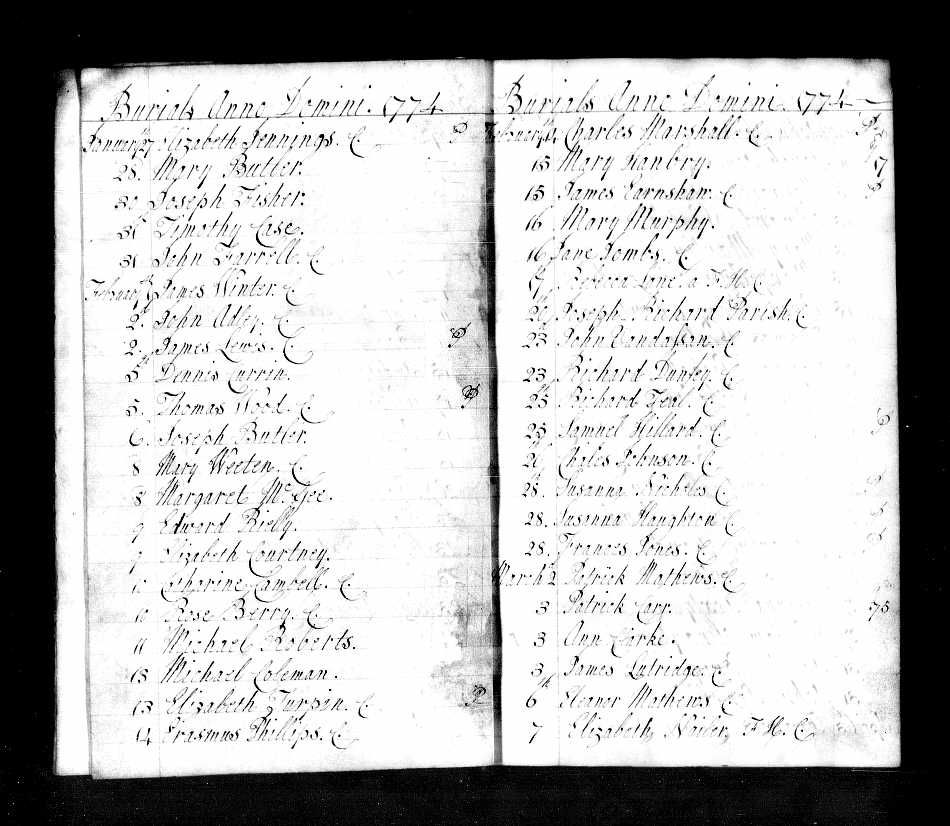
Death of Elizabeth Turpin– Mary’s mother
| Name: | Elizabeth Turpin |
| Burial Date: | Feb 1774 (13th February) |
| Parish: | St Pancras Old Church |
| County: | Middlesex |
| Borough: | Camden |
| Record Type: | Burial |
| Register Type: | Parish Register |
In the book by Ms. E. M. Barraud, she mentions the possibility that John and his wife Mary (that we now identify as Mary Turpin) may also have had a son, John, and she mentions the christening date of 4th November, 1752. John and Mary Turpin certainly did have a son John, but he was actually born on 4th November, 1752 and not christened until 30th November, 1752 and the record from the IGI clearly shows this date. The christening took place at St. Anne’s Church, Soho, and it is also in Soho, that the rest of the Barraud family lived.
JOHN BARRAUD Male
Event(s):
Birth: 04 NOV 1752
Christening: 30 NOV 1752 Saint Anne Soho, Westminster, London, England
Parents:
Father: JOHN BARRAUD
Mother: MARY TURPIN
Source Information:
Batch No.: Dates: Source Call No.: Type: Printout Call No.: Type:
C062368 1743 - 1762 0918606 Film 6900173 F
IGI Christening Record of John Barraud
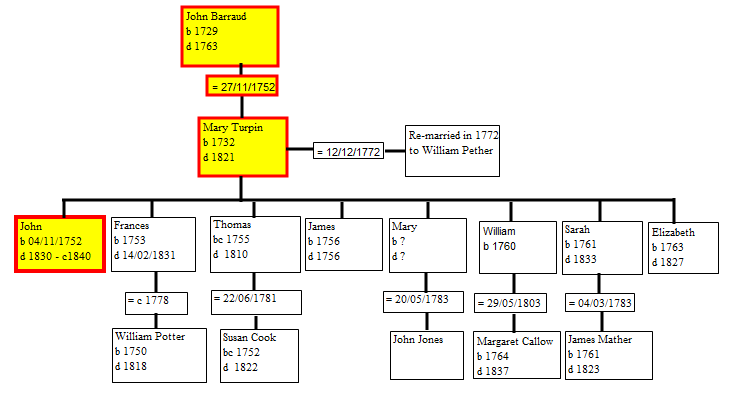
It must be noted that John Barraud and Mary Turpin were married on the 27th November, 1752, but their son John was born on the 4th November, 1752, which was 3 weeks before the marriage. John (junior) was christened however 3 days after the marriage date of his parents. There is no record of a death date for John (junior) as a child, and therefore it is quite possible that this John was the “Barrand” who was a distiller of Food and Drink at Clare Market from before 1778 until after 1783, although other records from “Kent’s Directory for the years 1778-1883” and also “The New Complete Guide to all persons who have any trade or Concern within the City of London”, and "Merchants & principal traders in the City of London 1779-1782" all suggest the name was perhaps Noah Barrand. No records exist for any Noah Barrand at any time in London or any part of England, and therefore it is possible that the name Noah was incorrectly transcribed and it should be John Barraud. The transcription of the name “JOH” (Joh) may have been wrongly interpreted as Noah. There are however, records of a John "Barnard" as a distiller living at No: 1 Gilbert's Passage, Clare Market prior to 1770 although he died in 1774 and his will does not mention any of the Barraud family, so this is not likely to be the same person as mentioned 1779-1782. Gilbert's Passage is at the east end of Clare Market and also known as part of the Clare Market. Also as we will later see, a grand-son of John Barrand (below) lived at 3 Gilbert's Passage.
What reinforces this idea is that John Barrand (b 1790), a son of Thomas Barraud (John’s younger brother) and his wife Susan Cook was also in business in Clare Market from 1818 until about 1846.
There is a record of a marriage of John Barrand in 1770 (probably the son of John Barraud and Mary Turpin), and there is also a record of a John Barrand’s birth in 1770 and his baptism on the 28th October, 1770 and the birth record shows the parents as “John Barrand and Mary.”
John Barraud it seems married a “Mary Hays” on the 22nd January, 1770 and they had a son, John born in 1770 and baptised on the 28th October 1770 at St. Botolph’s Church. If this is the same “John” then he must have married at the age of 17 and fathered a child at the age of seventeen also. Most likely, Mary Hays was born in 1753, and was the daughter of George and Mary Hay of St. Clement Danes. This being so, she would have only been 16 when John was born. There are records of a Mary Barrow (sic) buried in St. Andrews, Holborn on 6th June 1774 (age 21).
There are records to show that a John Barrand was a tenant, living in Colebrook Row, Islington in 1799 (see description below) and there are also records of a John Barraud living in Pimlico (London) in 1831, and in particular, newspaper records of the time mention a John Barraud aged 80 (approx) in 1831, and that would suggest that this is the John Barraud born in 1752. There are two other John Barraud’s in the London area but neither of these would fit this criteria, as both are direct members of the Barraud family who are known and well documented (see Page 79) No known will for John Barraud (b 1752) has been found, but he must have died between 1831 and 1841 as he is mentioned in three of the London Newspaper records of 1831, but he does not show on the 1841 census for London or elsewhere. He describes his occupation in one of the newspaper records as “holding very high office” and it is known he was a senior member of the London Stock Exchange.
In the 1st newspaper article, a mention is made that John Barraud refused to pay a carriage fare and had disputed the fare. He was found guilty however, and ordered to pay.
The 2nd Newspaper article mentions that he had thrown out his partner and her children and forced them to seek support from the parish. This case was adjourned and re-tried.
In the 3rd newspaper article of 1831, it mentions that John Barraud, aged about 80 was the father of four illegitimate children to a Mary Bagley (aged about 30) but, unfortunately there are no definite baptism records of the children, or indeed any positive records of Mary Bagley. If she was aged 'about' 30 in 1831 as mentioned in the newspapers, it is possible she is the Mary Bagley, born on the 3rd July, 1797 in St. Anne’s Soho (IGI Ref: C15051-2) and baptised on the 2nd August, 1797, the daughter of John Bagley and Mary (Not Known). John Bagley lived in Ryders' Court in St. Annes, Soho, and this is shown on the London Land Tax Records of 1803-1805. There were only 12 houses in Ryders' Court and of these, many were the homes of watchmakers, goldsmiths and engravers. It is perhaps of some relevence to note that Ryders' Court is very near Soho Square, 7-Dials and King Street where the Barrands and Barrauds lived. No Parish Baptisms exist for any of the four children with the Bagley, Barraud or Barrand name but, if Mary Bagley was indeed aged about 30 in 1831, and the youngest child was aged seven in 1831, then the children would have been born between about 1818 and 1824 and John Barraud would have been between 66 and 70 years old. I presume the children would have taken the Bagley surname, and the only Bagley marriages I have found without mentioning a father by name is James Bagley who married Anne Clarke on the 1st May, 1836 in Marylebone, a William Bageley who married Elizabeth Pitman in Bishopsgate on the 12th December, 1841 and a Harriett Beageley who married John Greville in St. Anne’s Soho on the 8th November, 1840. (Harriet's father is just known as Beagley)
On the 1841 census, there is mention of a Mary Begley, born in 1797 and living in Sandford Street near Lisson Grove in Marylebone.
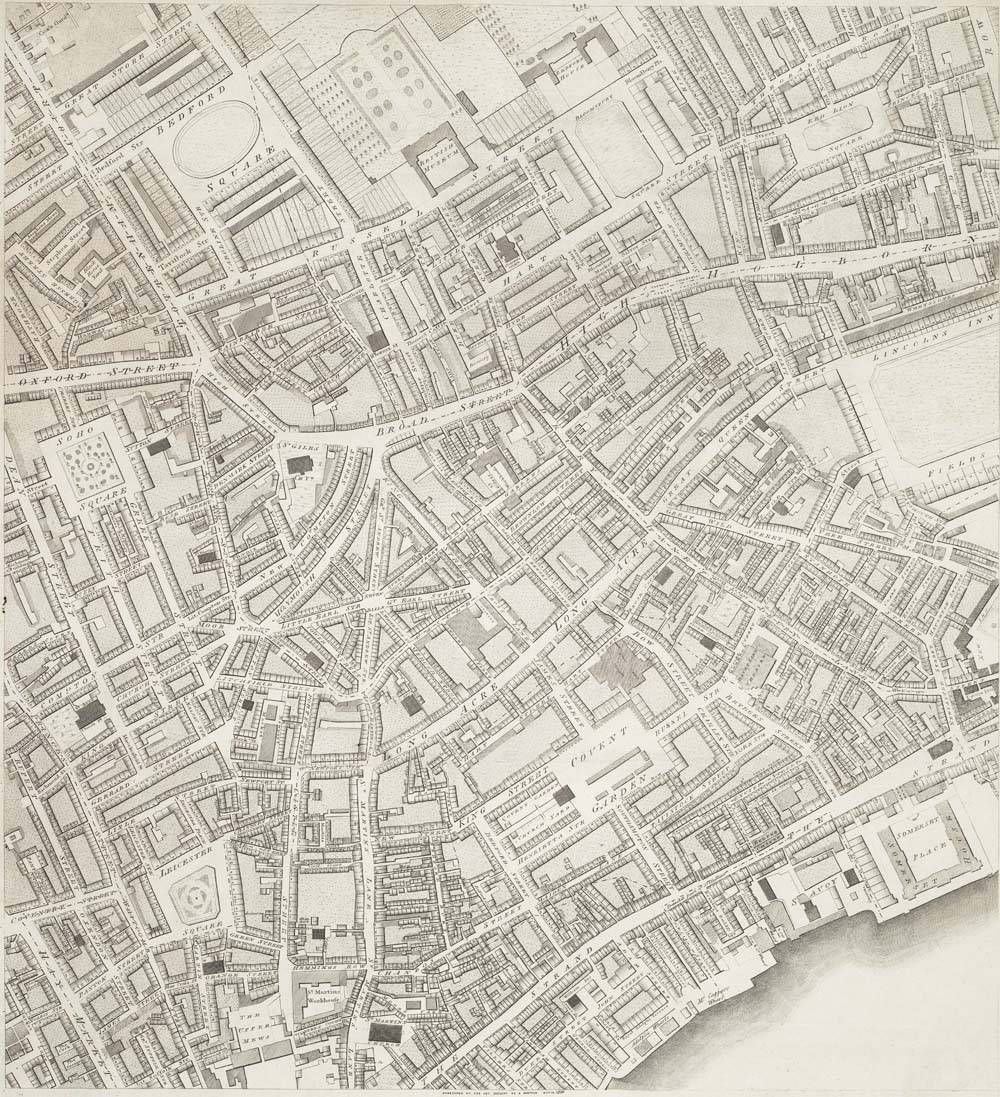
Soho Square King Street Ryder’s Court 7-Dials
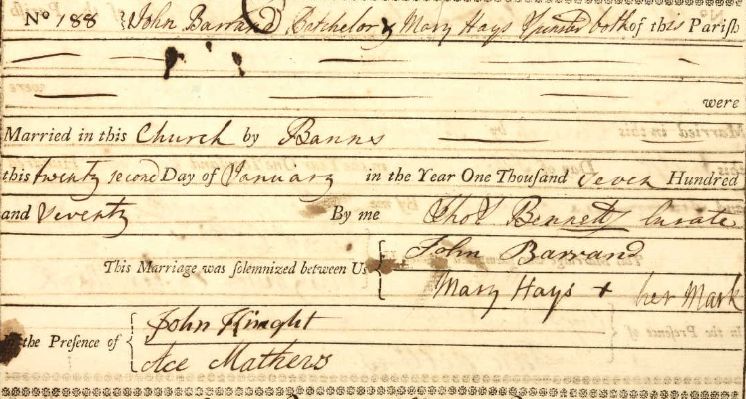
Marriage certificate of John Barrand and Mary Hays 1770
St John the Evangelist, Smith Square, London, Westminster, England
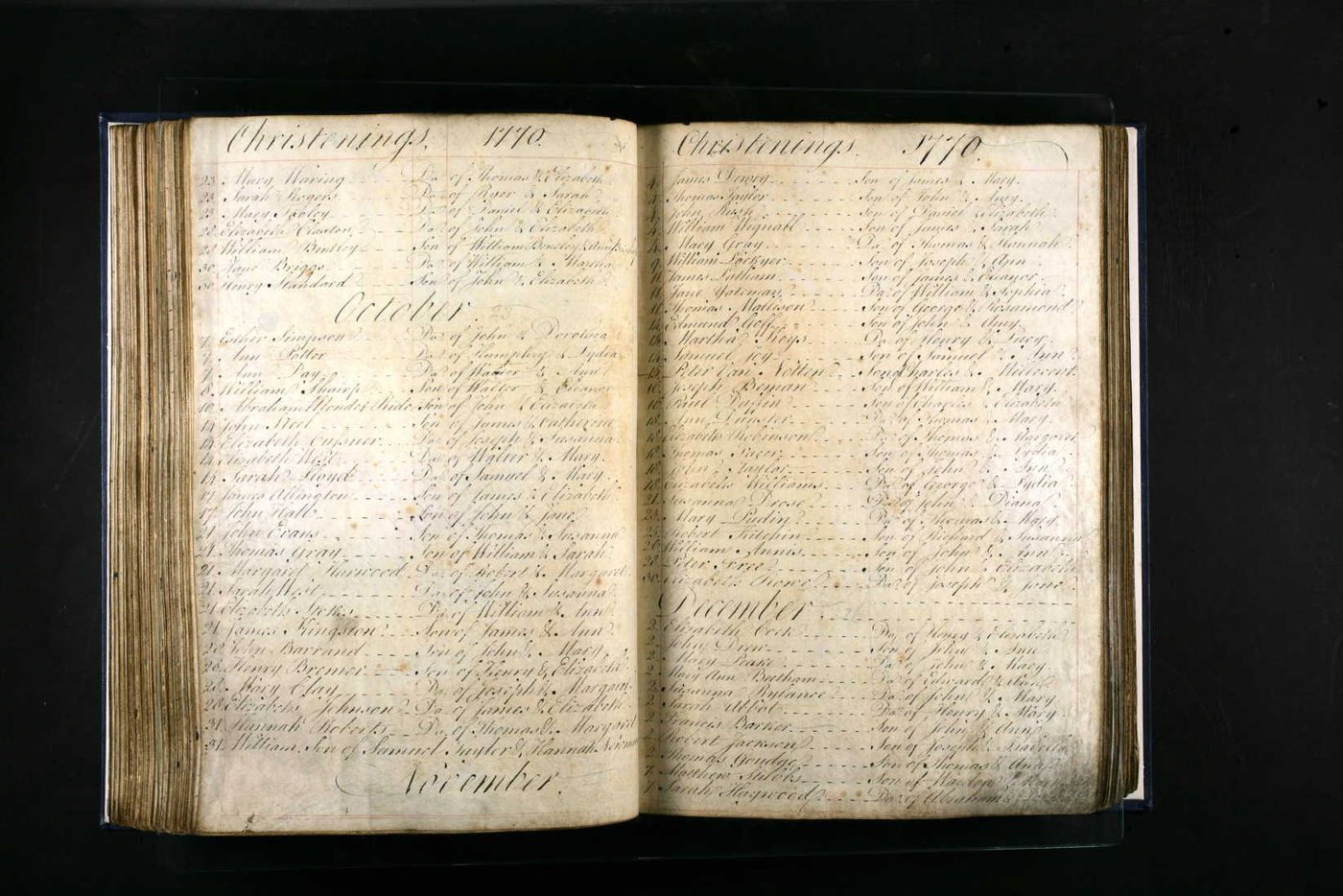
John Barrand Christening 28 Oct 1770 St Botolph, Bishopsgate, London Parents – John + Mary
Name: John Barrand
Baptism Date: 28 Oct 1770
Parish: St Botolph, Bishopsgate
County: London
Borough: City of London
Parent(s): John,
Mary
Record Type: Christening
Register Type: Parish Register
Indexing Project (Batch) Number: C00161-6 , System Origin: England-ODM , GS Film number: 380143
Parish Transcript of birth of John Barraud 1770 (IGI)
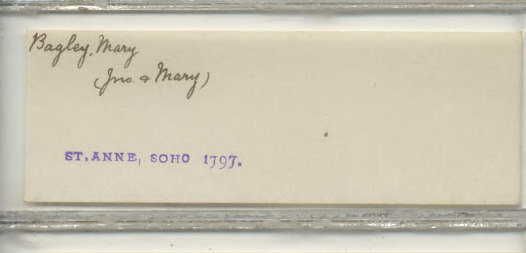
Pallots Baptism Record of Mary Bagley 1797
John Barraud (b 1752) lived in Colebrooke Row in 1799 and today, Colebrooke Row in Islington is one of the most sought after addresses in London, but in the early 18th century it was covered in fields and farm land. Most particularly, it was also the path of the New River, which ran down the centre of the street and the only homes were small river side cottages. The building of the familiar terraced rows began in the 1760s, however, and like much of the building at this time, it appeared in stops and starts with a number of different builders. Slowly, building continued to extend down Colebrooke Row throughout the late 18th century, but even by the 1790s much of the west side of the New River (that still ran down the centre of the street) was undeveloped.
Building continued along Colebrooke Row during the 19th century, with much of the street completed by the 1830s and 1840s, at which point new streets, such as Elia Street, Vincent Terrace and Noel Road began to appear off Colebrooke Row. Although the New River was eventually filled in (giving Colebrooke Row the unusual long central gardens) today, Colebrooke Row still retains many of the original Georgian homes.
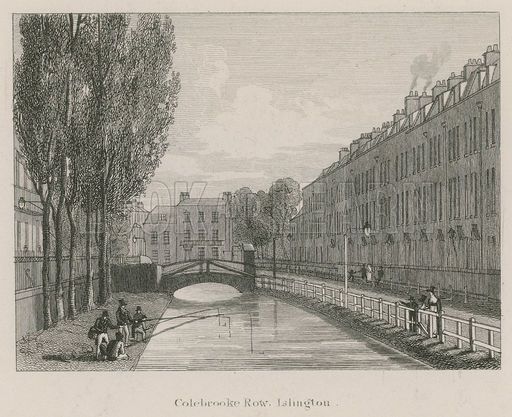
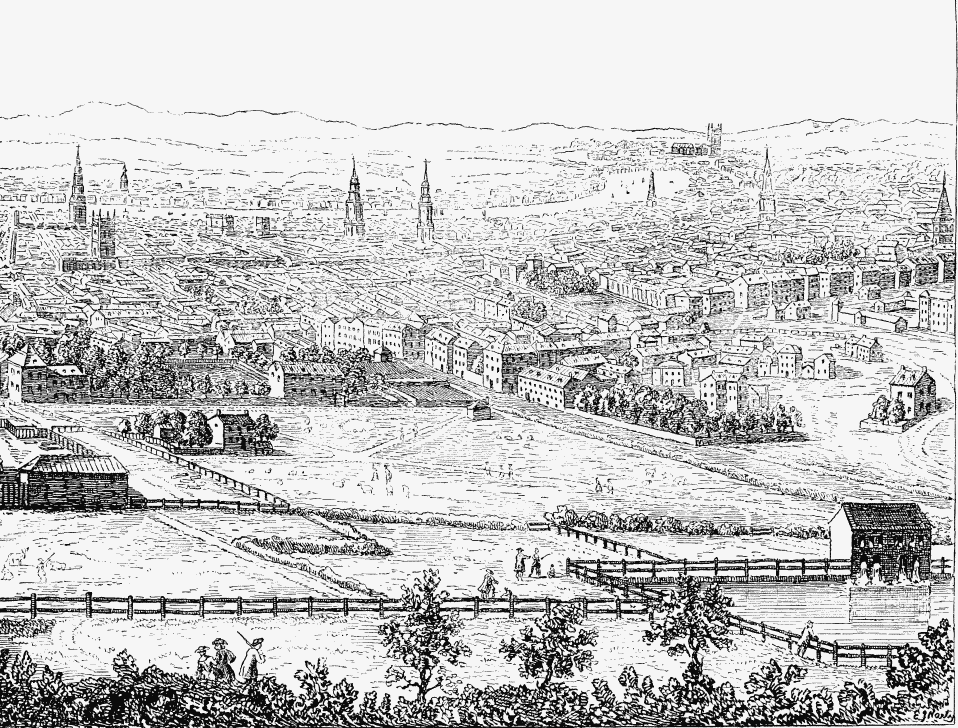
LONDON FROM ISLINGTON (WEST END). (From a View by Canaletti, published in 1753.) Colebrooke Row
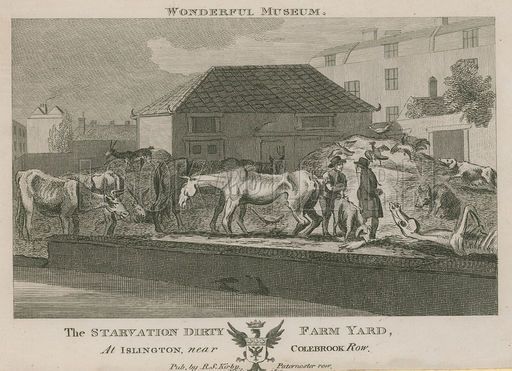
Starvation Dirty Farm Yard Islington Colebrook Row - Animals Knacker Yard
As mentioned, there are two other John Barrauds in London (both part of the Barraud family), one of these died in 1840, but this John Barraud is positively identified as being the son of Paul Philip Barraud and Harriett Chapman, (see page 72) and he was certainly born in 1790 and, as his place of residence is well documented, he is not the John Barraud mentioned in the newspapers in 1831. This John Barraud was a known clockmaker, the son of Paul Philip Barraud, a grand-son of Francis-Gabriel Barraud (Son of Philip Barraud), and therefore a great-grandson of Philip Barraud.
The other John Barraud was born in 1758, the youngest son of Francis-Gabriel Barraud and who was also connected with clockmaking. His death was noted as the 7th June, 1832 in Weston Street, Somerstown, and his estate was administered by his daughter, Anne Elizabeth Barraud.
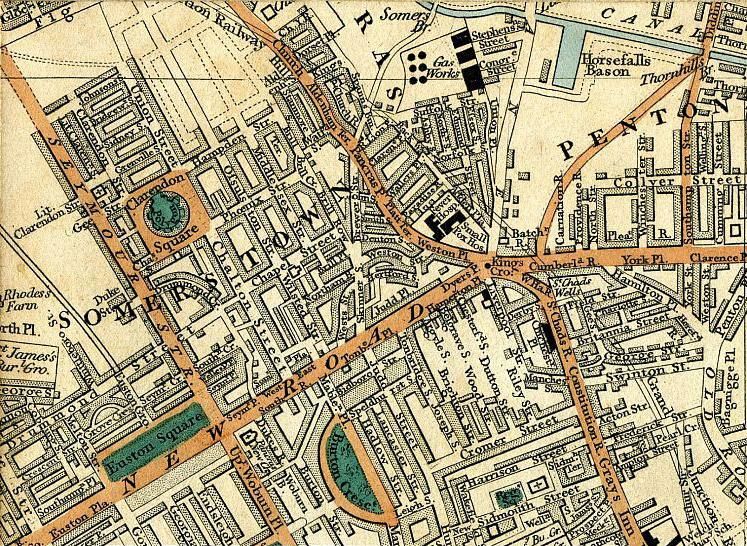
Map of Somers Town 1837 showing Weston Street where John Barraud, son of Francis-Gabriel lived.
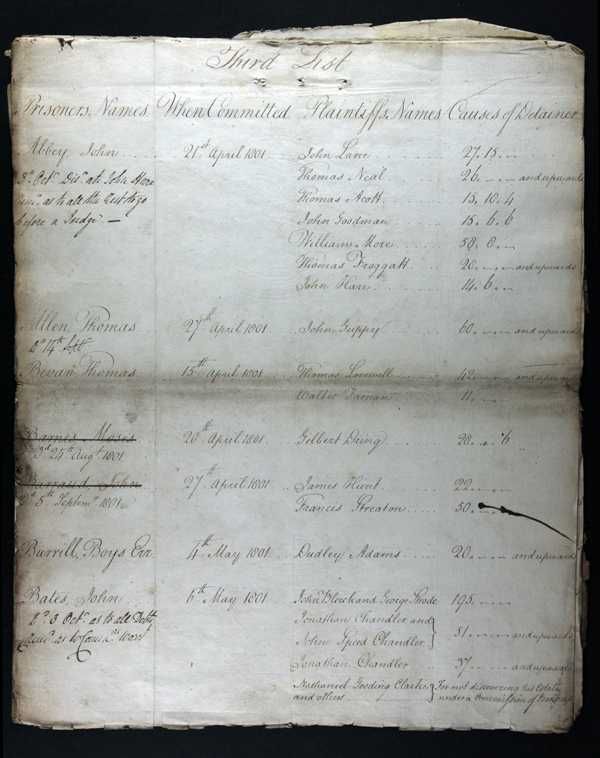
John Barrand (b 1752) was committed to the Fleet Prison for 6 months on the 27th April, 1801 and discharged on the 5th September, 1801. It appears the prison sentence was for goods supplied by Francis Streaton for which John Barraud did not pay. Francis Streaton was a Tailor and merchant living at 38, Basinghall Street, London and he was made a Freeman of the City of London but was declared bankrupt, the case being heard at the Guildhall. All his personal goods were sold by auction including furniture, book, china, clothes and business items, buttons, threads etc. by Winstanley’s and reported in the London World Newspaper. The bankruptcy was also mentioned in the “General Magazine and Impartial Review Newspaper.” and “The Universal Magazine”. Francis Streaton died in 1812.
John Barraud is mentioned in Boyd’s “Inhabitants of London” in the family units (1200-1946) covering a single family. It also seems that John Barraud was again committed to prison and released from the Fleet Prison on 3rd August, 1807.
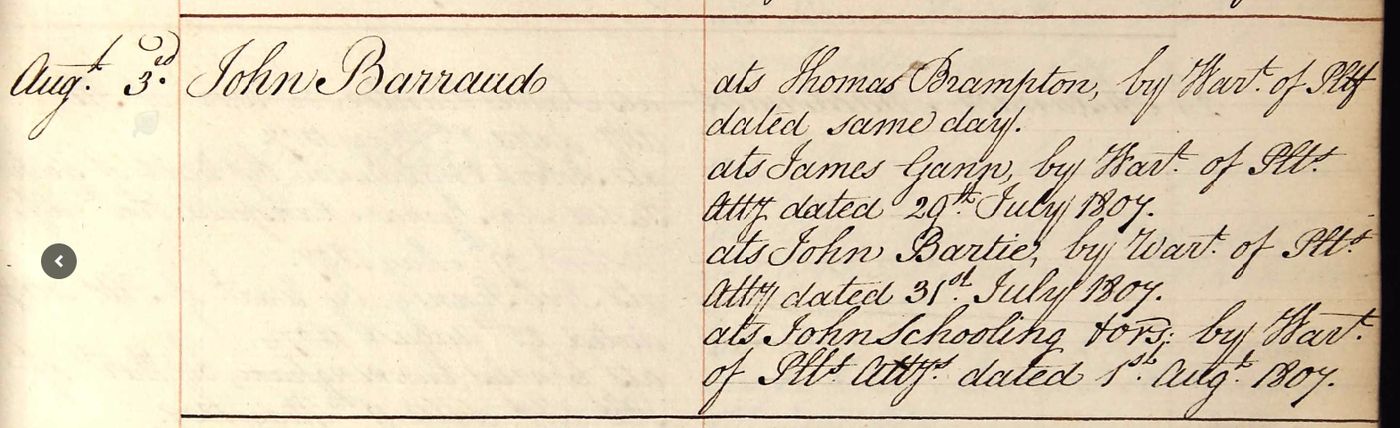
John Barraud 1807
King's Bench and Fleet Prison Discharge Books and Prisoner Lists, 1734-1862
Name: John Barraud
Committed Prison Place: London, England
Discharge Date: 3 Aug 1807
Discharge Prison Place: London, England
Prison: Fleet Prison
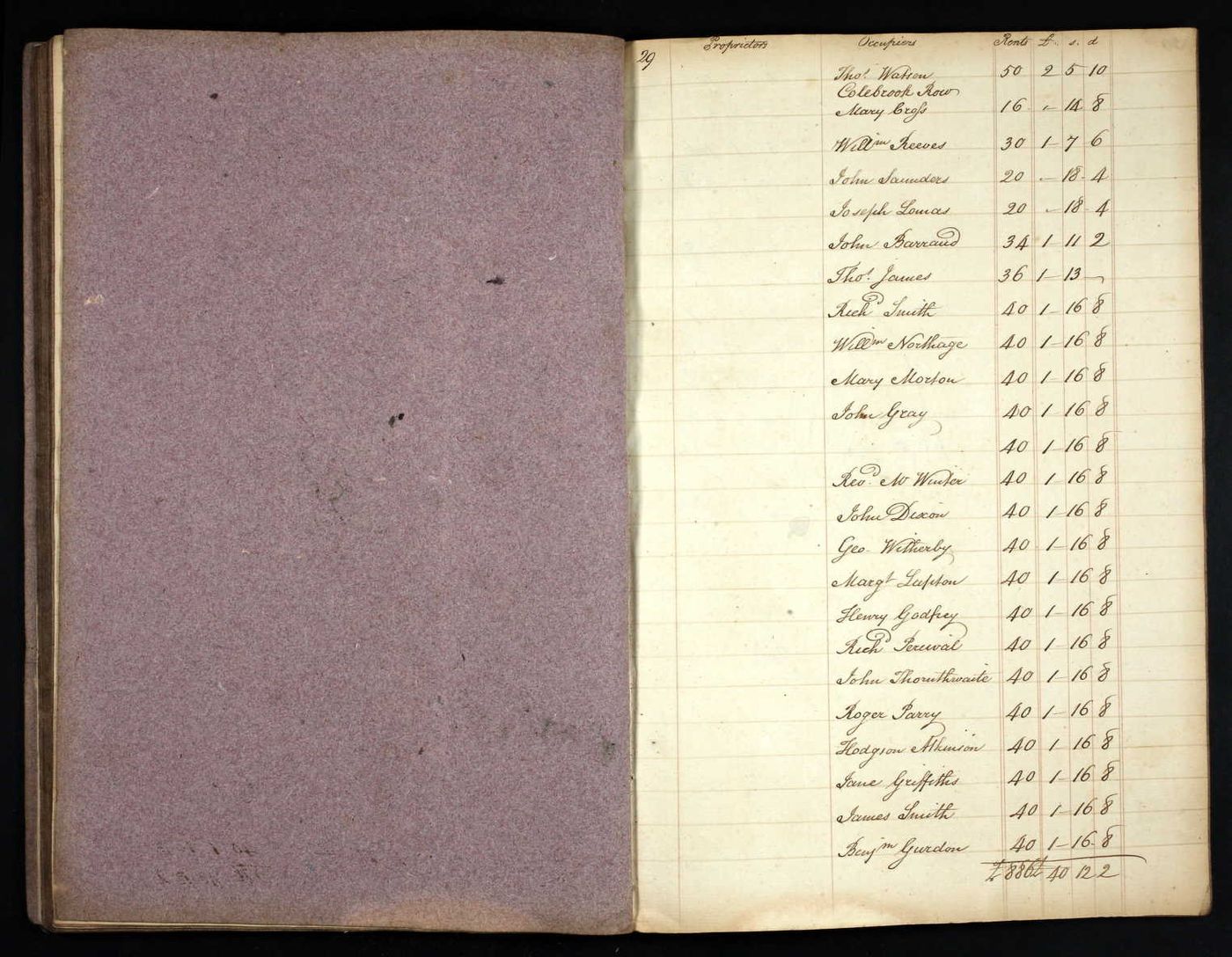
Colebrook Row: Tenant: John Barrand - First Year of Section: 1799 Civil Parish or Ward: St Mary Islington Borough or County: Islington
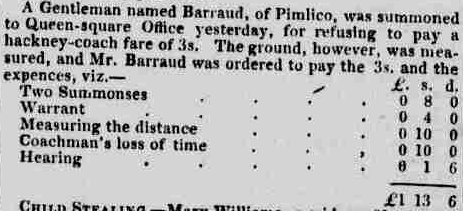
Morning Chronicle - Saturday 26 February 1831
In one newspaper, John Barrand or John Barraud a stockbroker, refused to support his wife and children; pleading that the, woman was not his wife, and to throw them for support on the parish. An inquiry was instituted, and evidence adduced to show that the man had previously supported both woman and children. The case came before the Worship Street Magistrates and adjourned.
Spectator 29th March, 1830
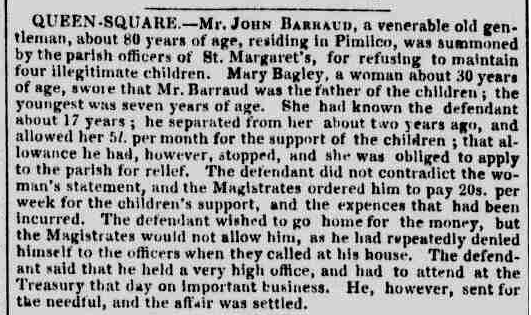
Morning Chronicle 25th April, 1831