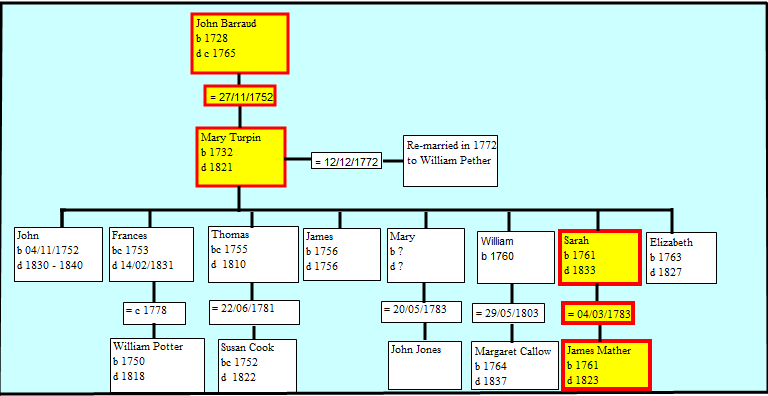
John Barraud and Mary Turpin’s next child was Frances, who was named after John's mother and (who was mentioned in the bequests from her grandmother, Frances Prevost). I cannot find any positive record of the birth nor a baptism but it is possible she was baptised as Frances Barraud, the daughter of John Barraud and Mary on the 12th July, 1756 in St. Giles in the Field.
There is also another possible baptism record however - Frances, daughter of John and Mary Barrow (sic), bapt 9 January 1757 in Old Church, St. Pancras.
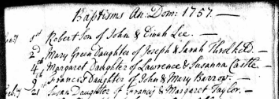
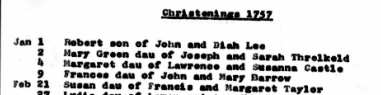
Frances daughter of John and Mary Barrow (sic), bapt 9 January 1757 in Old Church, St. Pancras.
It would seem she married a William Potter and there is a burial record of 1831, (as Frances Potter) it gives her age at the time of death as 78, making her date of birth 1753. This would exactly match the dates as mentioned in the will. It seems logical however that John Barraud and Mary Turpin would have used St. Anne’s Church in Soho for a baptism, but no records exist for them in this church. We know that in 1772, in the will of Frances Prevost, that Frances Barraud was still a minor (under 21 years of age), and that her father had already died and, to receive her bequest, it is mentioned if she married before attaining full age of 21, she had to obtain the permission of her uncles Frances-Gabriel Barraud and Philip Barraud. That would make her date of birth about 1753 and her age of 19 at the time of the will. This would exactly match the dates as mentioned in the will.
It seems therefore most likely that Frances Barraud may have married a William Potter around 1778, but I cannot locate any actual marriage record. The date of 1778 is purely a guess, as William Potter and Frances had 9 children, the first being born in 1780. The first child was Frances Potter and she was born on the 10th September 1780 and baptised on 1st October, 1780.
Frances Potter (b 1780) married Robert Knight, a labourer, in London on the 17th February, 1805 in St. Mary's Church, Marylebone, and the fact that Thomas Barrand (a son of John Barraud and Mary Turpin) and therefore (Frances Potter’s uncle) was the witness to the marriage, would clearly suggest that this is the correct family. The banns were read in the church on the 13th, 20th and 27th January, 1805.
It is strange however that the marriage certificate of Robert Knight and Frances Potter has the name “Peter Knight” and his mark “X” alongside his name.
According to the "David Jones" family tree on Ancestry, Robert Knight and Frances Potter had 4 children: Frances (born 5th May, 1806 - 1815), James (b 12/06/1810 - ?), Frances (b 1815 - ?) and William (b 1817 - ?) Robert Knight’s occupation was as a labourer. There were in fact a further 2 children, Thomas born on the 8th December, 1814 and Jane, born 23rd September 1820 and baptised October 10th 1820.
Both Thomas and William were baptised on the 20th February, 1820.
When James Knight was born (1810), the family was living in the Marylebone Workhouse. Frances, born in 1815 appears to have married a Richard Fowler, a carpenter on the 9th July, 1841. Their marriage certificate shows Frances's father as Robert Knight (decd) and the address for Frances is shown as "Workhouse" Richard Fowler and Frances then emigrated to Australia in 1842 and had 4 children.
Name: Frances Potter
Baptism Date: 1 Oct 1780
Parish: St James Garlickhithe
County: London
Borough: City of London
Parent(s): William Potter, Frances Potter
Record Type: Christening
Indexing Project (Batch) Number: C02249-2 , System Origin: England-ODM , GS Film number: 374450, 374451
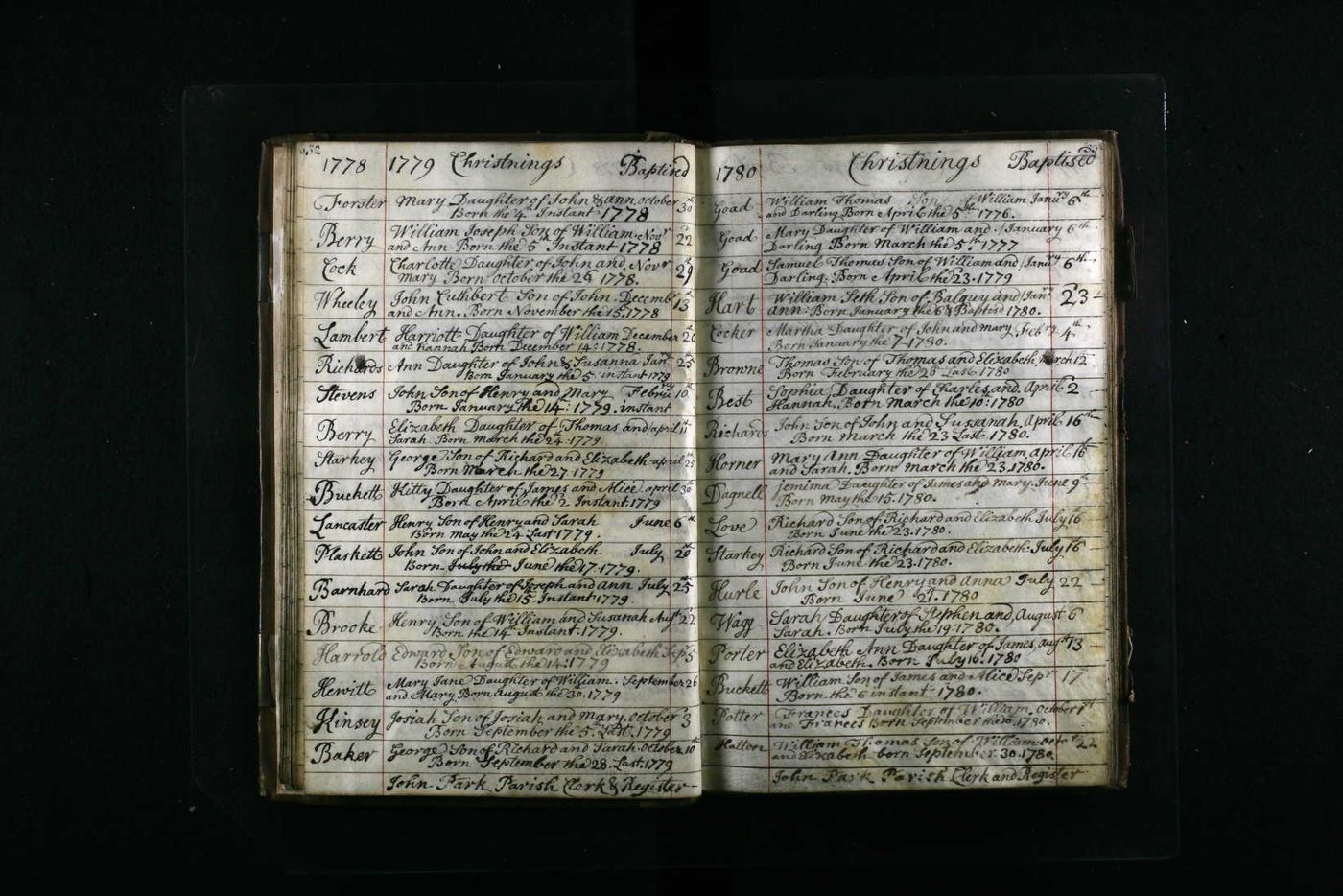
Baptism record of Frances Potter – father William Potter – mother Frances
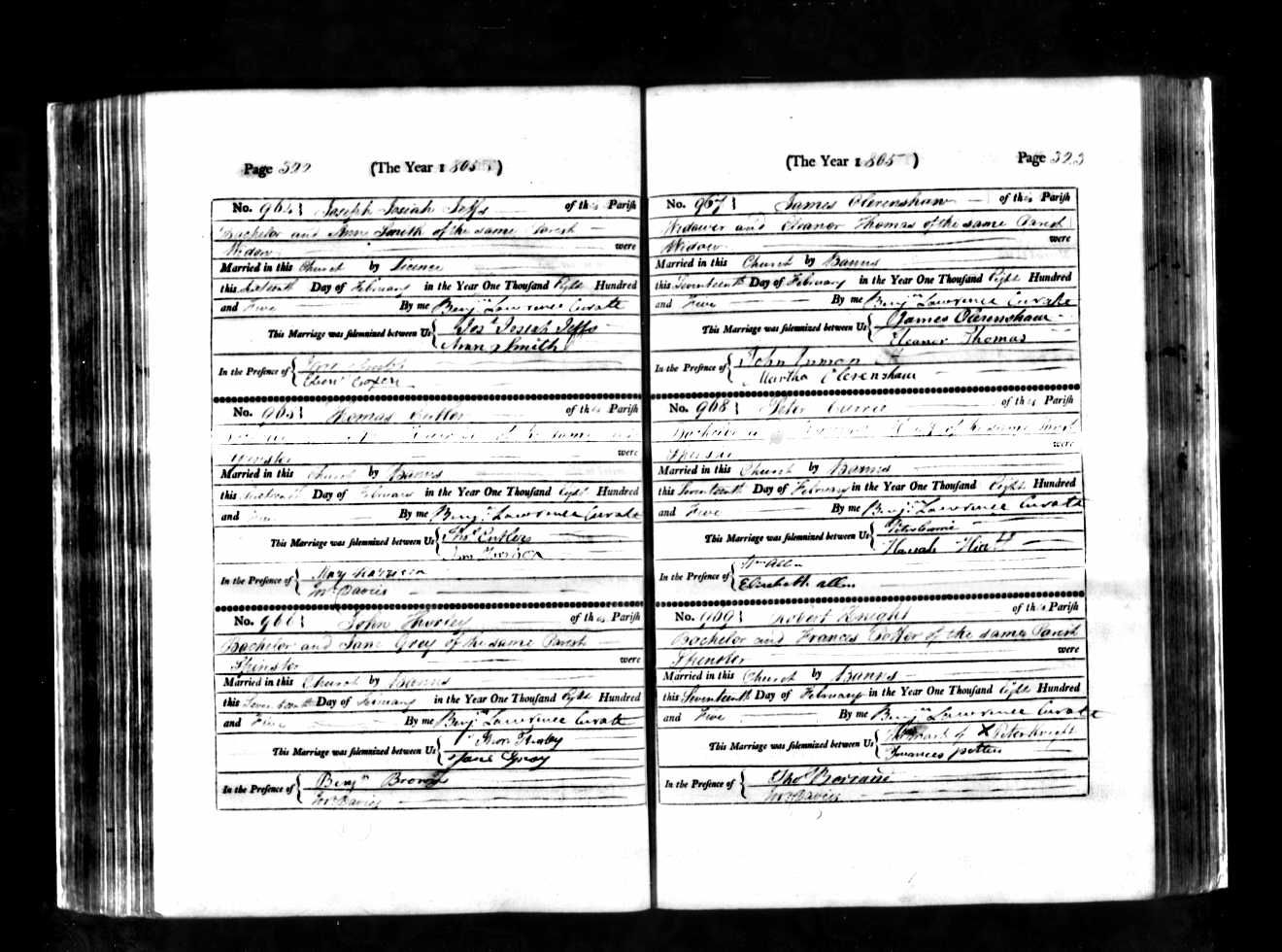
Marriage of Frances Potter to Robert Knight 17th February 1805 but signed as Peter Knight.
Witness – Thomas Barrand
Baptism record Frances Potter – 1st child of (William Potter & Frances Barraud)
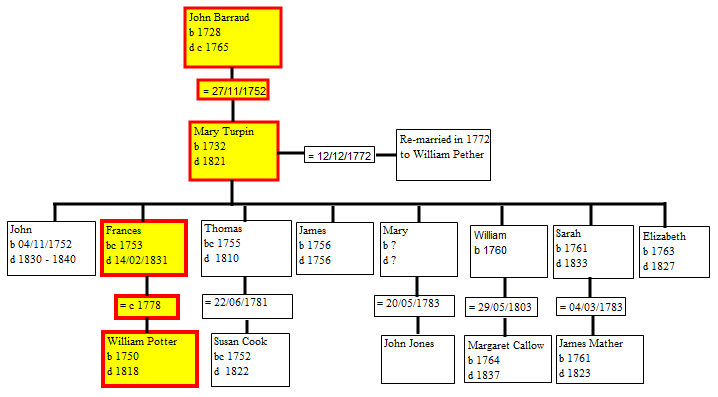
The other eight children of William Potter and Frances Barraud were:
William, b 4th February, 1782, and he married Ann Carr on the 30th March, 1807 in St. Anns Church, Soho. Jane Potter was the witness.
Robert, b 15/06/1783 – married Maria Cornish 1808
James, b 13/12/1784
Samuel Frederick, b 02/04/1786 (d 1787)
Joseph, b 08/12/1787
Jane, b 30/10/1789 – married George Hewitt 1816
Mary, b 13/05/1791 (d 1793)
Elizabeth, b 24/10/1792 (d 1798)
William Potter was a master carpenter and tea chest maker and produced some notable items by inlaying thin sheets of various types of wood in a process known as 'marquetry'. He also made chronometer cases for the admiralty and therefore also most likely for the Barraud family. They were possibly quite wealthy at one time but what happened to the family is unknown, as the death records of both William and Frances Potter (nee Barraud) confirms that this part of the family must have fallen on hard times, as the burial records show that he died in the St. Marylebone Workhouse in 1818 in Fetter Lane, and was buried on the 13th December, 1818, aged 68. Frances died also in the workhouse in 1831 aged 78, making her estimated DOB around 1753.
London, England, Deaths and Burials, 1813-1980
Name: Frances Potter
Record Type: Burial
Event Date: 14 Feb 1831
Age: 78
Estimated Birth Year: abt 1753
Died in the Workhouse
Parish: Saint Marylebone
Borough: Westminster
County: Middlesex
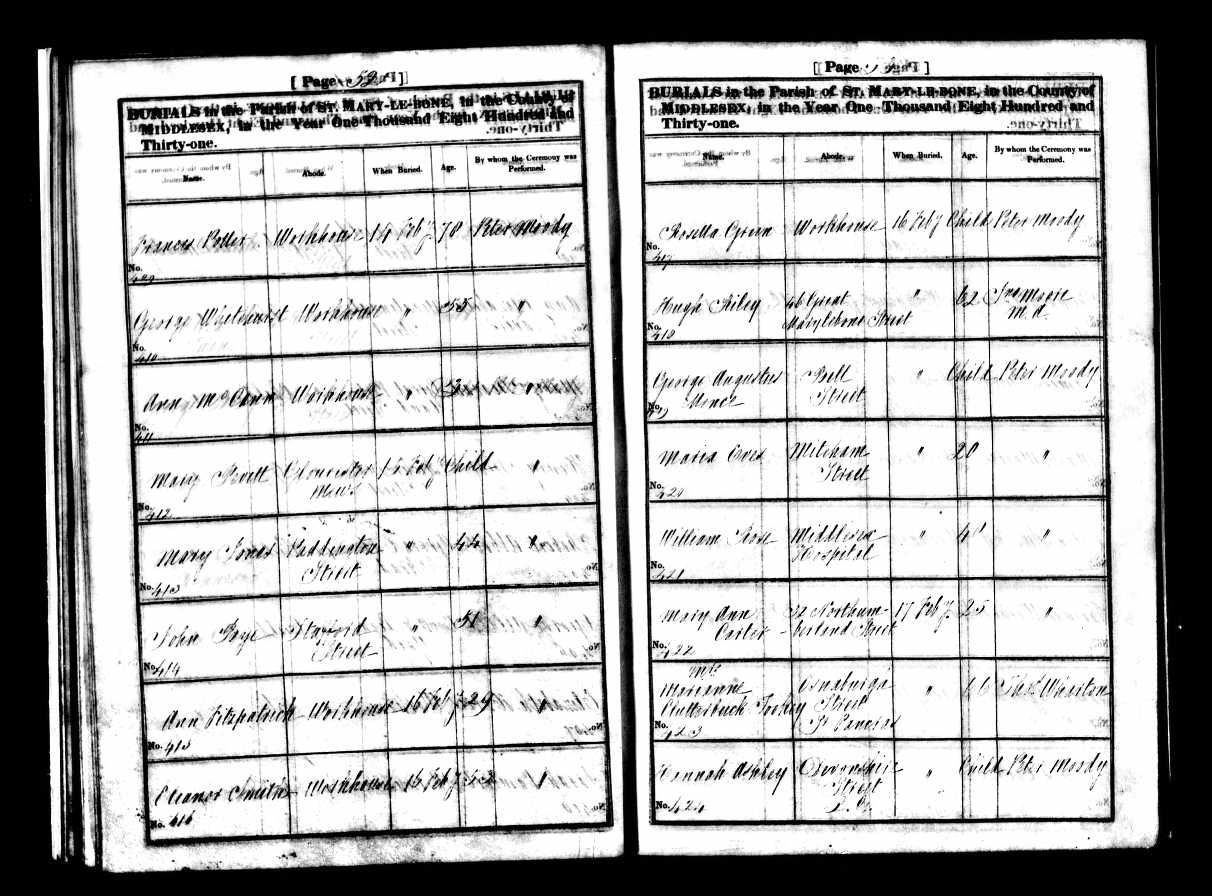
Burial record of Frances Potter
What life was like in the Marylebone Workhouse:
People ended-up in the workhouse for a variety of reasons. Usually, it was because they were too poor, old or ill to support themselves. This may have resulted from such things as a lack of work during periods of high unemployment, or someone having no family willing or able to provide care for them when they became elderly or sick. Unmarried pregnant women were often disowned by their families and the workhouse was the only place they could go during and after the birth of their child. Prior to the establishment of public mental asylums in the mid-nineteenth century (and in some cases even after that), the mentally ill and mentally handicapped poor were often consigned to the workhouse. Workhouses, though, were never prisons, and entry into them was generally a voluntary although often painful decision. For vagrants and casuals, the 'bed' could be a wooden box rather like a coffin, or even just be a raised wooden platform, or the bare floor. In some places, metal rails provided a support for low-slung hammocks. If an inmate died in the workhouse, the death was notified to their family who could, if they wished, organize a funeral themselves. If this did not happen, which was often the case because of the expense, the Guardians arranged a burial in a local cemetery or burial ground — this was originally required to be in the parish where the workhouse stood, but later rules allowed it to be the deceased's own parish if they or their relatives had expressed such a wish. A few workhouses had their own burial ground on or adjacent to the workhouse site.
The burial would be in the cheapest possible coffin and in an unmarked grave, into which several coffins might be placed on the same occasion. Under the terms of the 1832 Anatomy Act, bodies unclaimed for forty-eight hours could also be disposed of by donating them for use in medical research and training — this was not specific to workhouses, but applied to any institution whose inmates died while in its care. Deaths were, however, always registered in the normal way.
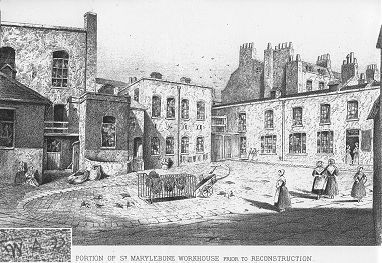
A glance at the recipe in a Workhouse is a sobering experience. “Take a pint of water and a large spoonful of oatmeal. Stir it together and let it boil up three or four times, do not let it boil over; then strain it through a sieve, salt it to your palate.” This recipe for ‘water gruel’ appears in The Art of Cookery Made Plain and Easy, published in 1796, and inmates of Marylebone’s workhouse could look forward to this breakfast five days a week. Other culinary delights on the workhouse menu included boiled mutton or meatless pease soup for the main meal, and bread and butter for supper. With meal times often being the highlight of a day, it is little wonder that many saw the workhouse as little better than prison. This was not the way it was supposed to be. In less than 20 years, circumstances had rendered the original building wholly inadequate for the task. Rats from the nearby burial ground and sewers had moved in. A building designed for 40, now housed over 200. Working days lasted from 6am to 6pm in the summer, with a half hour break for breakfast and one hour for dinner. In the winter, work carried on for as long as the workers could see. Hard work undertaken in poor conditions for no pay inevitably led to resentment, but any ill-discipline was treated harshly. When Anne Rollinson and Sarah Saunders were recaptured after running away, their punishment summed up Marylebone’s workhouse regime. They were stripped naked from the waist up and whipped, “until their backs were bloody”. They were then placed on hard labour, and fed bread and water for a week. In less than 50 years Marylebone’s workhouse had become a place where cold economics ruled, and inmates were seen as fodder to be farmed out for profit. It was a situation, repeated across the nation, which would last for generations.
St Marylebone workhouse engraved by an inmate "W.A.D.", 1866.
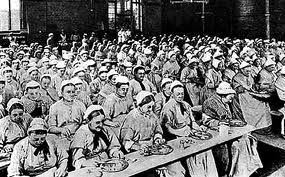
Typical dining room
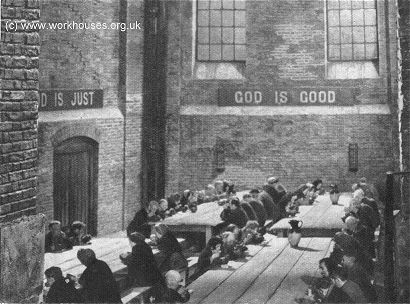
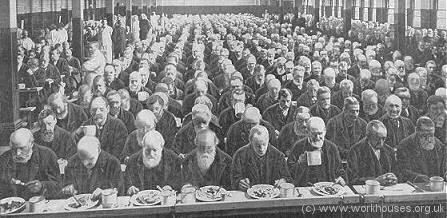
Mens dining room 1900 Marylebone Workhouse
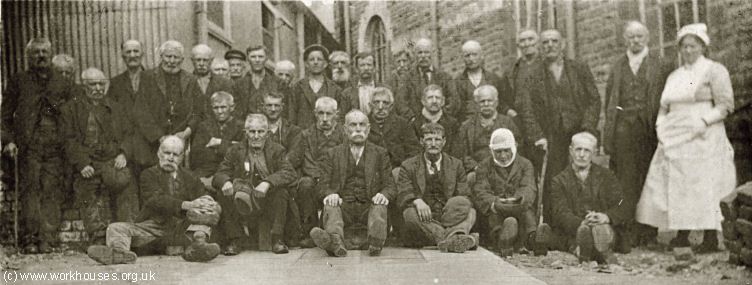
Typical workhouse inmates Marylebone
Thomas
The next child of John Barraud and Mary Turpin was Thomas, born about 1755. Again, I cannot find any record of his birth, nor his baptism which would possibly have been in the St. Anne’s, district of Soho but, it is known the family moved to Holborn between 1756 or 1757, it is quite possible the baptism took place there. There are no records hovever for St. Sepulchre Church in Holborn either but, as with Frances, there is a clear record of his death in 1810 which shows his age at the time of death as 55, making a birth date of around 1755.
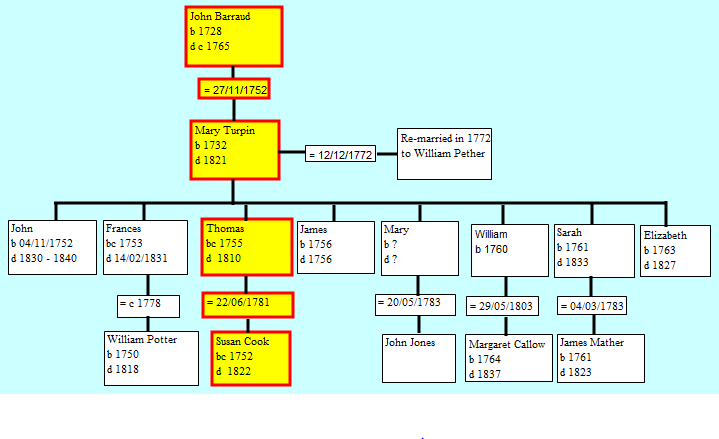
I will come back to Thomas (on Page 170) as he is the main source of the Barrand name.
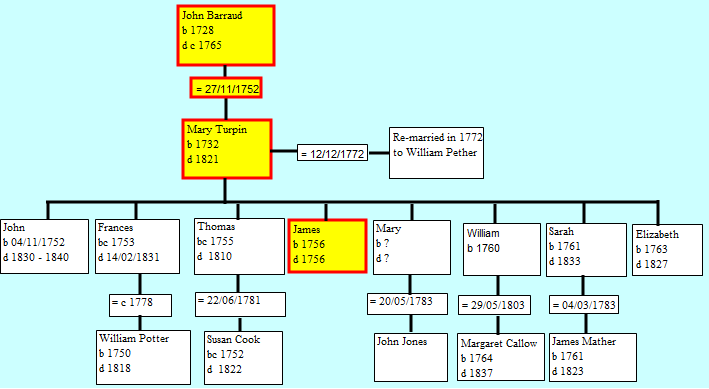
James
Most probably the next child of John Barraud and Mary Turpin was James, but again there is no record of his birth or baptism, but there is however a record of a James Barraud’s death and burial. The burial citation reads “James Barraud (of St. Clements) was buried in St. Anne’s (Soho) on 1st December, 1756.” It gives no age, and therefore it can be assumed that he was an infant, as ages were usually given only for adults. This is mentioned in Ms. E. M. Barrand’s book – “Barraud, The story of a family” There is a possible baptism record however - James, son of John and Mary Barrow (sic), bapt 18th November, 1755 in Old Church, St. Pancras.
This then gives a clue that John Barraud and Mary Turpin may have lived in the St. Clement Danes area, which was next to St. Anne’s in Soho. If this is indeed the son of John Barraud and Mary Turpin, it would suggest the family were still in Soho in December 1756, and did not move to Holborn until after this date.
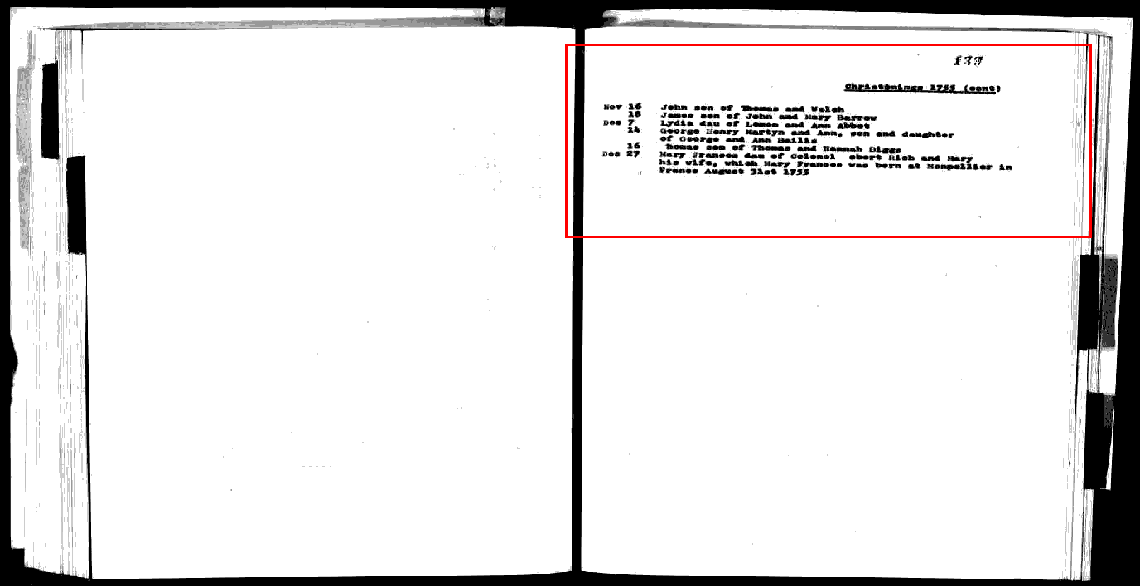
Christening Record of James Barrow (sic) St. Ann's Church, Soho, 16th November, 1755
Mary
The next child of John Barraud and Mary Turpin was Mary who was probably born around 1757. Once again, there is no record of the birth or baptism, but it is most possible she was actually born in Holborn as the family moved to Turnagain Lane around 1756-57. There is a record of a Mary Bar.. (sic) (Illegible) being baptised at St. Sepulchre Church, Holborn on the 12th June, 1758 with parents, John and Mary, but I cannot be sure this is the same Mary Barraud. I can only speculate, but her birth date must have been between 1756 and 1760. She certainly married John Jones on the 20th May, 1783 in St. George Hanover Square, London, and it seems that John Jones and Mary Barraud had a child called Hannah born on the 12th May, 1783, a few weeks before their marriage and baptised on the 27th July, 1783.
Hannah, it appears married Henry Newton on the 14th January, 1810 in St. Anne’s Church, Soho. They had 5 children.
John Jones and Mary Barrand then had another daughter Mary, born on the 24th December, 1784 and baptised on the 23rd January, 1785 in St. Marylebone Church.
They then had another daughter, Martha, born on the 13th January, 1786 and baptised on the 21st February, 1786.
Charles was their next child, born on the 20th November, 1786 and baptised on the 4th December, 1786.
Susannah was their last child, born on the 13th March, 1789 and baptised 18th June 1789. It appears she remained unmarried.
It should also be noted that John Jones was a witness to the marriage of William Barrand (Thomas Barrand’s son) in 1803 along with William’s mother, so this gives positive identification to the family. The record of the marriage of Mary Barraud shows the surname as Barrand instead of Barraud, and this is around the time this branch of Barraud’s seems to have changed the name permanantly from Barraud to Barrand. I can find no further records for Mary Jones since her marriage however. The occupation of John Jones was as Tailor and he had his own business with premises at No 6, Princes Street near Drury Lane. He is shown on the professional registers of 1784 as a "Taylor"
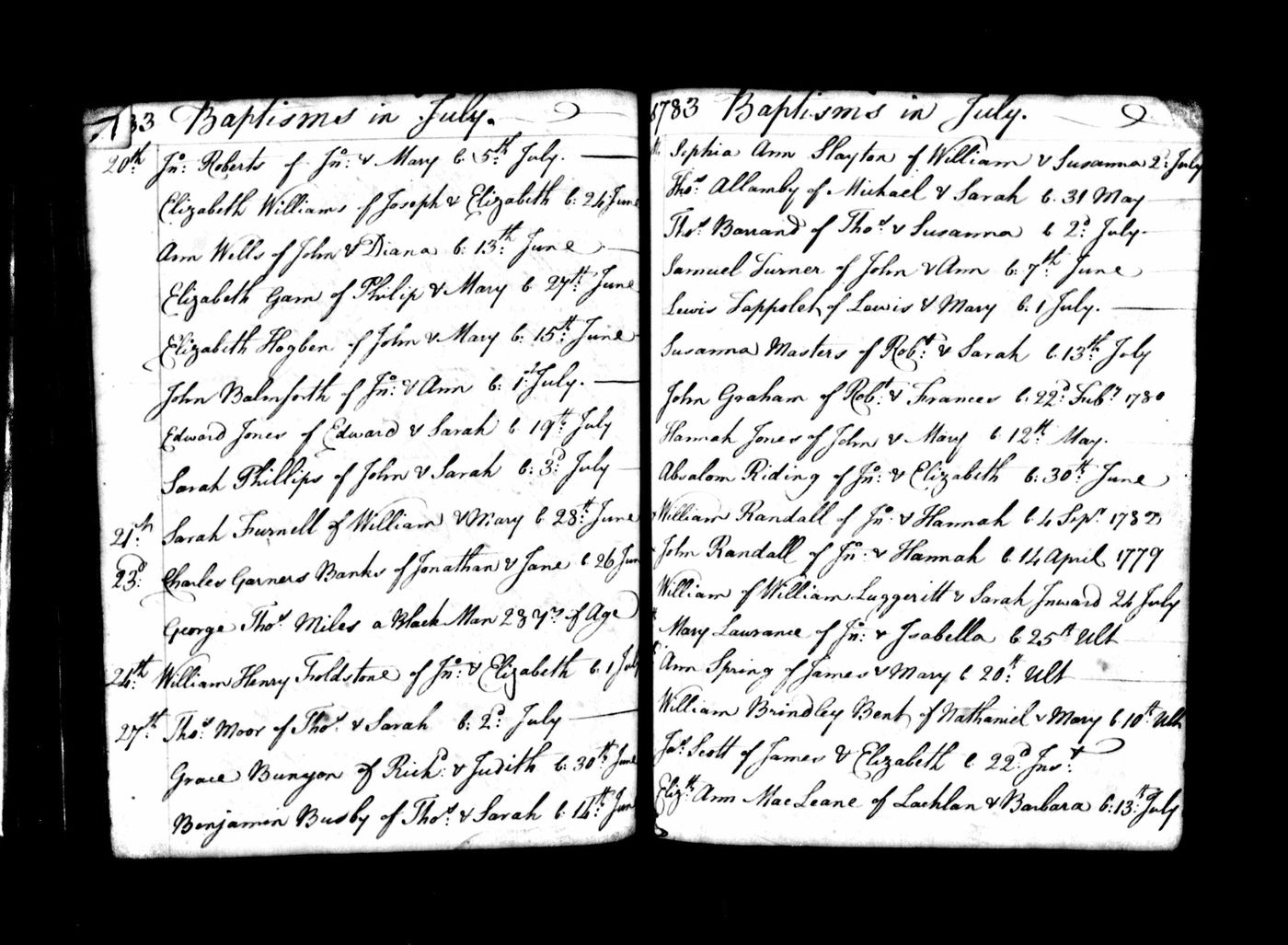
Baptism of Hannah Jones (also shows baptism of Thomas Barrand at St. Marylebone Church)
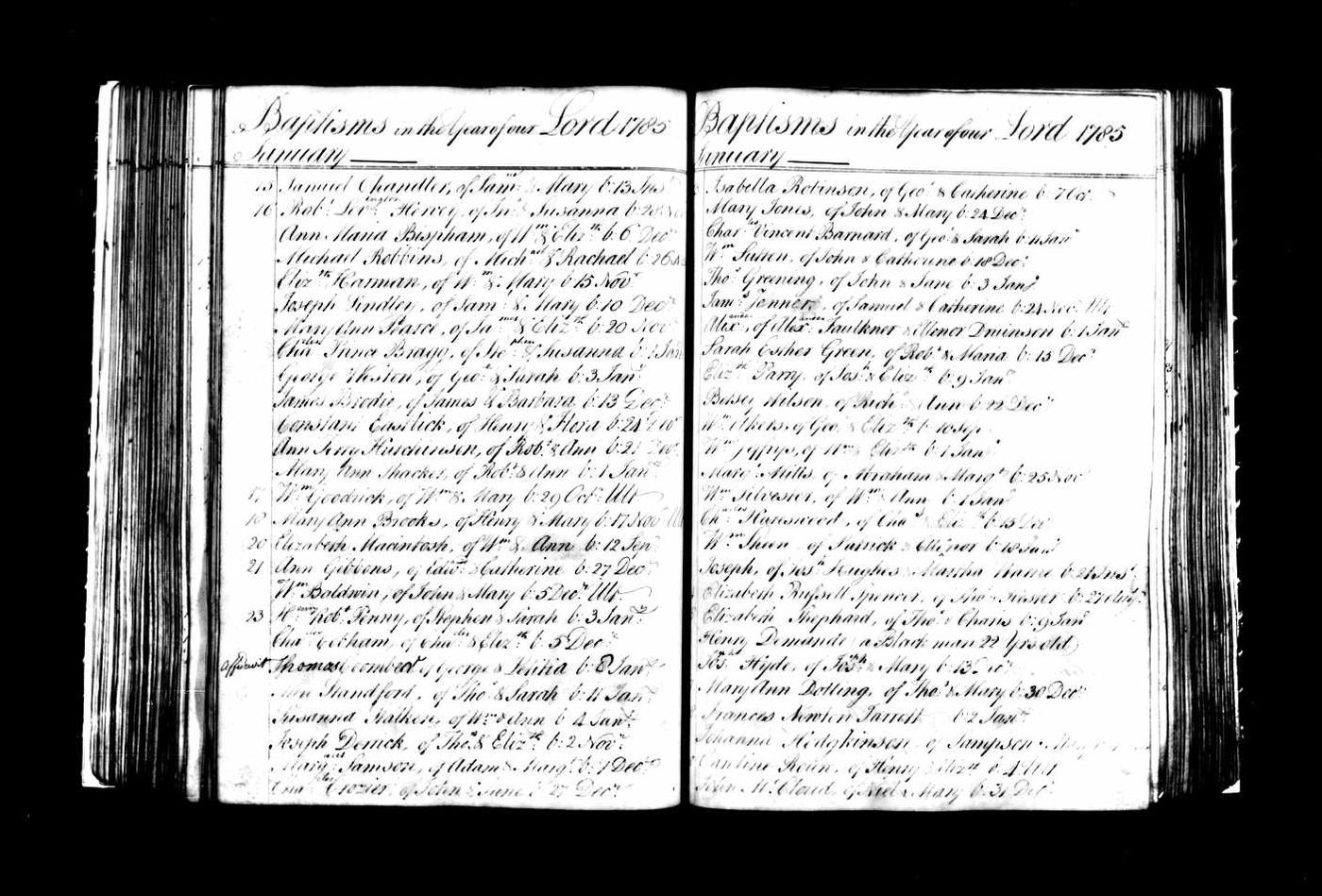
Baptism of Mary Jones 1785
Sarah's dad, can only afford to rent one single room; a standard arrangement for poor people. There J jmmon jsituation which is illustrated as a typical arrangement by a Victorian artist below:
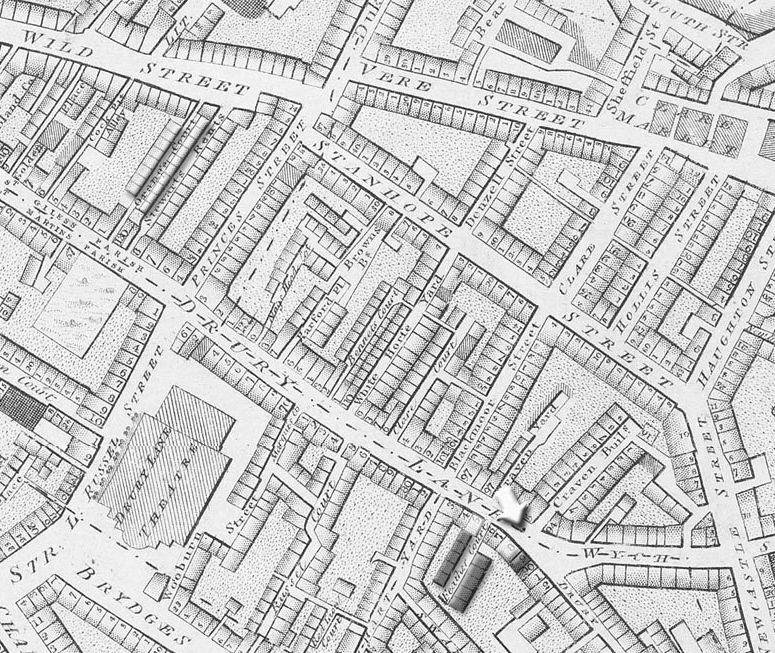
John Jones had his tailors shop and works at No: 6, Princes Street.
It has been suggested on numerous records of London, that many of the French immigrants changed their surnames to make them appear more “English” due to the continuing Anglo/French wars around the turn of the century, and the dislike of anything French. This would certainly account for several members of the the Barraud family changing to Barrand, although there are also records of the surname being transcribed as Barrend, Barren, Barron, Barand, Barrard and Barrow.
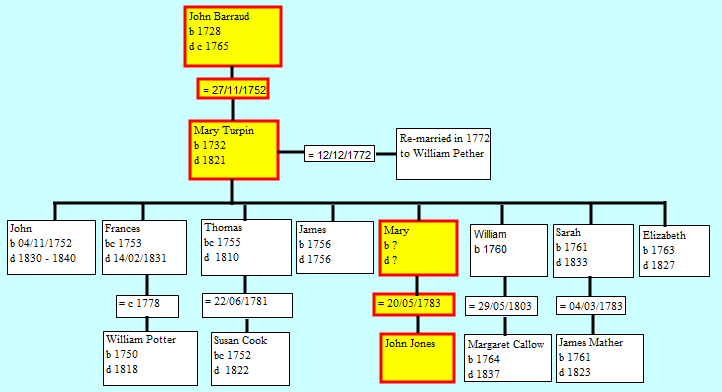
Mary Barrand: Female
Marriages:
Marriage: 20 May 1783 Of, London, London, England
Source Information:
Film Number: 177892
Page Number: 57
Reference number: 2218
Boyds Marriage Index 1538-1840 shows the spouse name as John Jones (JN JONES
Parish records of the marriage of Mary Barrand to John Jones
Parish Records Collection - marriage
Year: 1783
Supplied Surname: JONES
Full First name: John
Supplied First Name: Jn
Spouse Surname: BARRAND
Spouse Full First name: Mary
Place: Westminster (St George Hanover Square)
County: London
Record source: Boyd's Marriage Index 1538-1840
Data provider: Society of Genealogist
Society of Geneologists’ record of the Marriage of John Jones to Mary Barrand
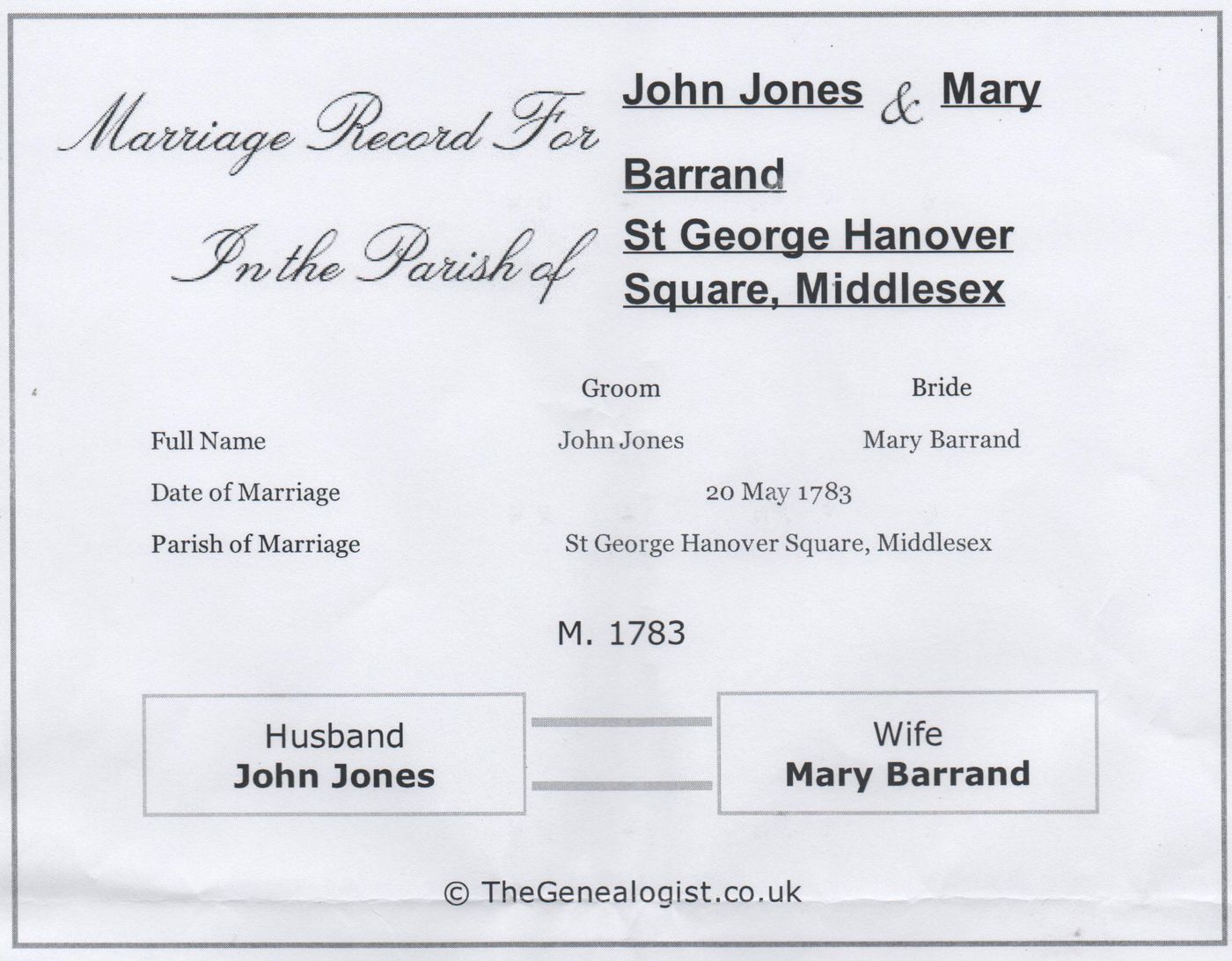
Copy of transcript from the Genealogist – Marriage Mary Barrand + John Jones 1783

Marriage of John Jones to Mary Barrand
William
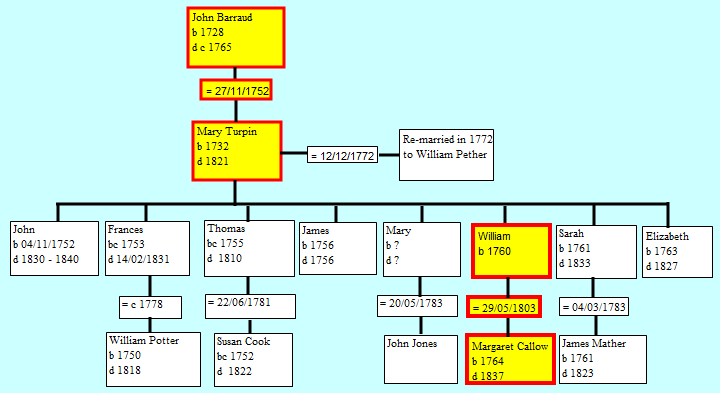
The next child of John Barraud and Mary Turpin was William, born around 1759/1760, but again there are no records of the birth or the baptism. There are however records of a William Barrow baptised on the 21st December, 1760 in Old Church, St Pancras with parents John and Mary Barrow (sic), the same Church as James and Frances.
What is known for certain however is that William married Margaret Catlow (or Callow) on the 29th May, 1803 at St. Martins-in-the-Fields. The IGI record shows a “comment of 54”, and this is confirmed in the Pallots register of marriages, but I do not know whether it represents a reference number, or the age of William, but there are other instances where it certainly represents an age. There are no records of the Catlow name in London between 1750 and 1770, but the surname Catlow is prominent in both Yorkshire and Lancashire around this time. I do not know where Margaret came from, but it may be a mis-spelling of the name. William Barrand was a fully qualified carpenter and served his apprenticeship possibly with his brother, Thomas. He moved south of the River Thames to Camberwell where he must have found work, but returned to central London after several years.
There are records of a William Barrand as a Jury-Qualified Freeholder from 1814-1824, and his address is Southampton Street in Camberwell. Also living at a different address in Southampton Street is a J. Barrand (possibly John Barrand). I cannot find any positive death records for William, but Margaret certainly died in the Workhouse in Westminster in 1837, aged 73, making her date of birth around 1764. (IGI Ref: B02082-6 Film - 560360) There is a record of a William Barrow’s (sic) death in 1832 aged 77 at the same church. No children are known from their marriage. Again, the Barrand family must have been on the poor side. (See description of the Workhouse on Page 94/95)
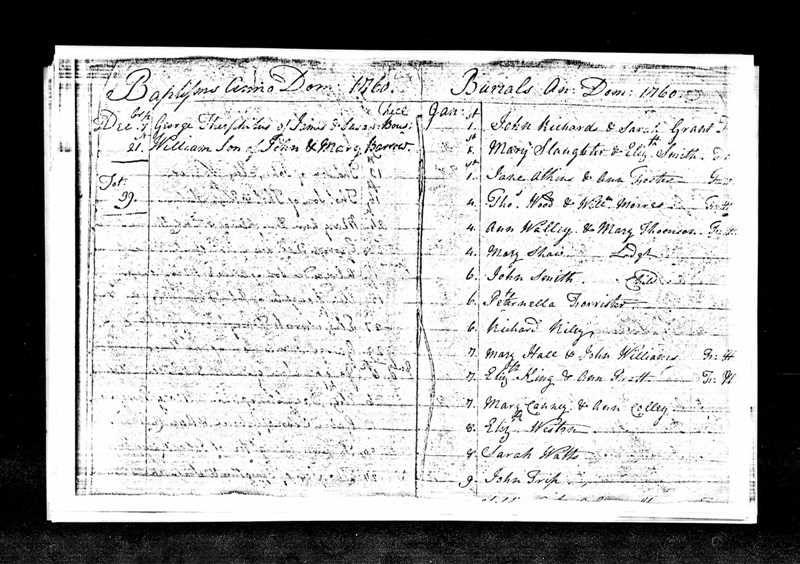
Baptism record of William Barrow
Name: Wm Barrand
Spouse: Margt Catlow
Comments: 54
Marriage Date: 1803
Parish: St. Martin In The Fields
MARGARET CALLOW Female
Spouse: WILLIAM BARRAND
Marriage: 29 MAY 1803 Saint Martin In The Fields, Westminster, London,
Source Information:
Batch No.: Dates: Source Call No.: Type: Printout Call No.: Type:
M001453 1798 - 1806 0561160 Film NONE
IGI Record of Marriage William Barrand and Margaret Catlow (Callow)
Name: Margaret Barrand
Record Type: Burial in the workhouse
Estimated Death Date: abt 1837
Burial Date: 16 Jun 1837
Age: 73
Estimated Birth Year: abt 1764
Parish or Poor Law Union: Westminster St John the Evangelist
Borough: Westminster
County: Middlesex
The Death Record for Margaret Catlow (Callow)
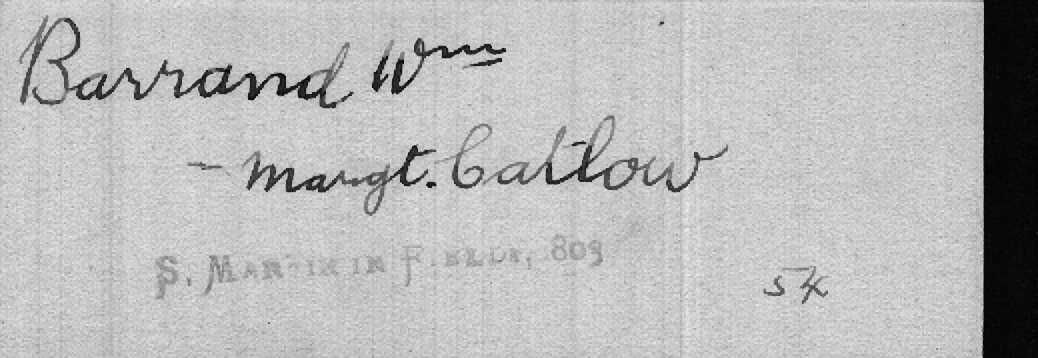
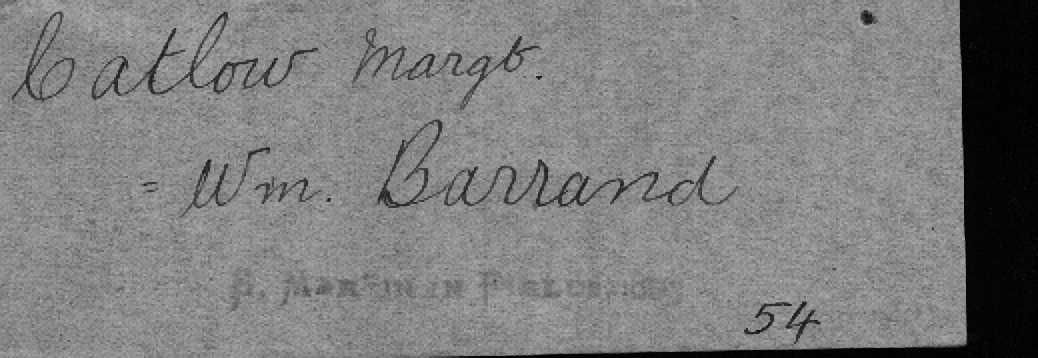
Pallots record of marriage William Barrand and Margaret Catlow (Callow)
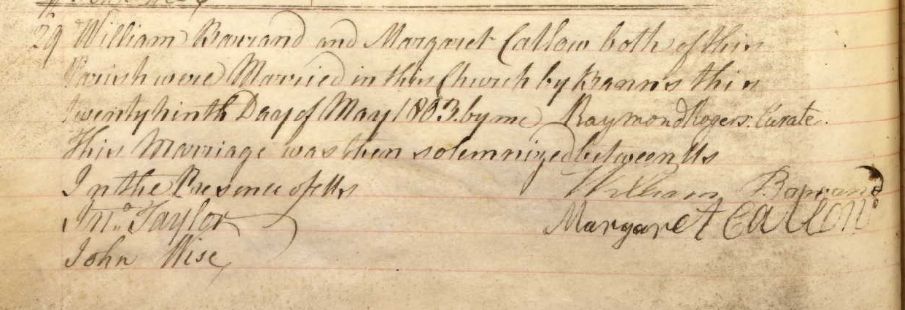
Marriage William Barrand and Margaret Catlow (Callow)
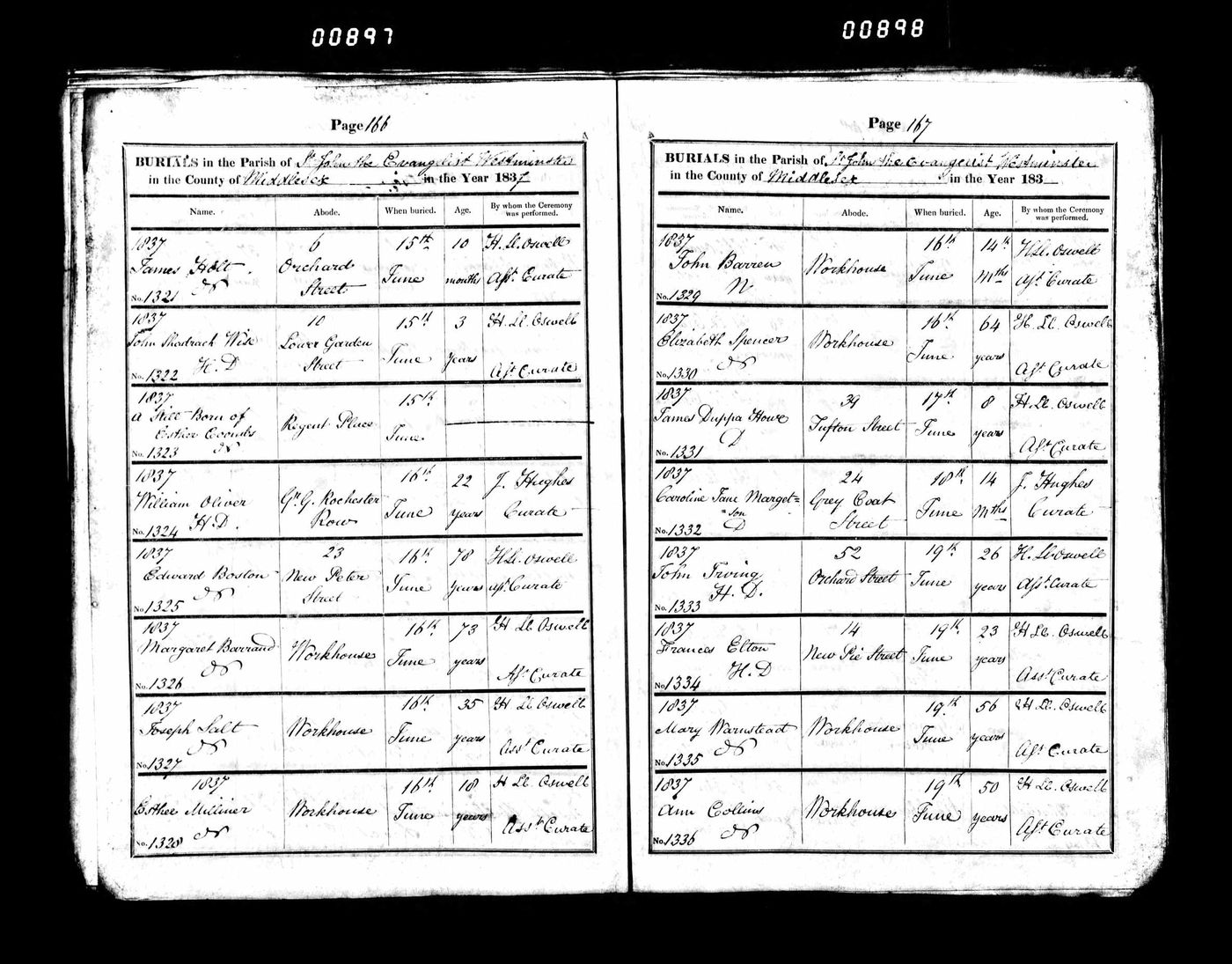
Burial record of Margaret Barrand
Sarah
Next child of John Barraud and Mary Turpin was Sarah Barrand, born in 1761. Once again there are no definite known records of the birth or baptism, but there are records of a “Sarah Barrow” born on the 24th January, 1761 and baptised on the 6th February, 1761 at St. Sepulchre Church with parents John and Mary Barrow, so it seems very likely that this the correct child.
It is known she married Rev. James Mather on the 4th March, 1783, and one of the witnesses again was Thomas Barrand, her elder brother. There are several records of the marriage. Sarah and James Mather had 4 children, George, born 22nd December, 1783, John, born 7th February, 1786, Ann, born 24th August, 1788 and finally Sarah, born 24th July, 1791. Rev. James Mather was a Lay Minister in the Methodist Church and was appointed as a traveling preacher. Although James Mather was illiterate and found difficulty in writing, he could memorize passages in the Bible and read them aloud during his travels. He eventually became a renowned preacher in his own right. He preached in strange places - public houses, coffee houses, houses, fields, public squares, and even to family homes or wherever a crowd assembled to hear him. His aim was to educate the masses through his preaching. Although he often preached three or four times a day, he had real-life experiences to call on which provided him with plenty of material. He donated to the missionary society in December, 1819 as reported in the Evangelical Magazine and Missionary Chronical. He was also the treasurer of the North Britain Bible and Missionary Society. Wherever he travelled, Sarah was always with him. They both survived from expenses and support of accommodation offered by James Mather’s audience which was quite substantial in many occasions.
From newspaper records, (London Star January 2nd 1818 and also The Champion) it is mentioned that both Paul Philip Barraud and James Mather described as (A friend from Shadwell) were amongst the chief donators to a fund for a Mr. William Hone, a fellow church minister and his family who was tried for blasphemy and which raised £2,500.00.
It seems clear therefore that Paul Philip Barraud and James Mather were close friends. Despite help from friends, many of William Hone’s businesses ended in failure.
In 1815, William Hone started the Traveller newspaper, and he tried in vain to save Elizabeth Fenning, a cook convicted on thin evidence of poisoning her employers with arsenic. Although Fenning was executed, Hone's 240 page book on the subject, The Important Results of an Elaborate Investigation into the Mysterious Case of Eliza Fenning — a landmark in investigative journalism – demolished the prosecution's case.
William Hone published the Reformists' Register, using it to criticise state abuses and in April 1817 he successfully won a court battle against Government censorship and this marked a turning point in the fight for British Press freedom. Three separate trials took place before special juries on 18, 19 and 20 December 1817. The prosecution took the ground that the prints were harmful to public morals and brought the prayer-book and even religion itself into contempt. In spite of illness and exhaustion, William Hone spoke on each of the three days for seven hours, and although the judges were biased against him, he was acquitted on each count by a jury.
Hone however, was soon sent to the King's Bench Prison for debt, and his friends, including Paul Philip Barraud and James Mather however, again came to his assistance and, after his release, he started a coffeehouse in Gracechurch Street but this, like most of his business enterprises, ended in failure.
James Mather remained as a lay-minister and died in 1823. He was buried in Abney Park Cemetery. Sarah Mather died at the age of 72 in High Street, Shadwell in 1833, and was buried on the 21st January, 1833.
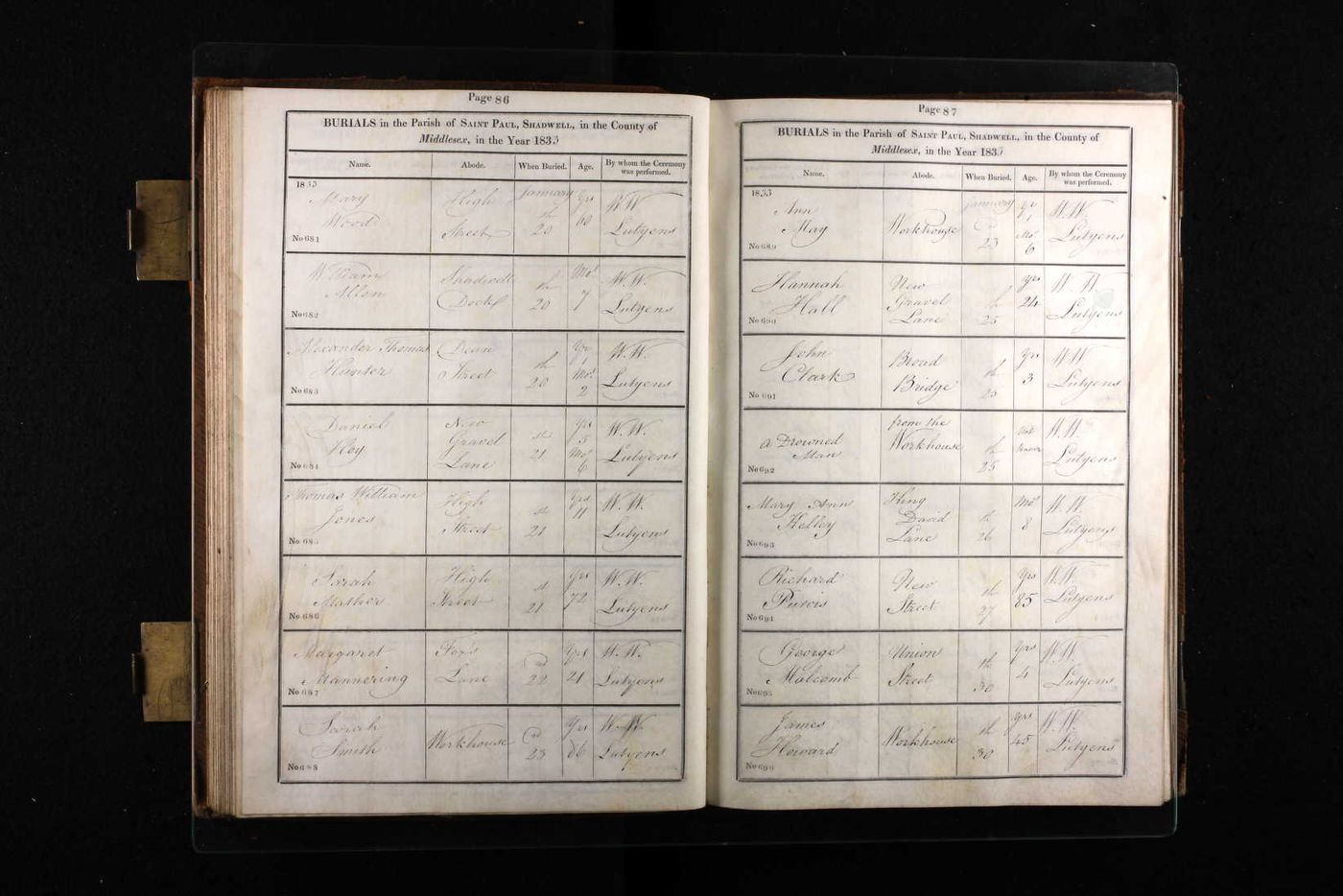
Burial record of Sarah Mather, High Street, Shadwell
| Name: | Sarah Mather |
| Record Type: | Burial |
| Burial Date: | 21 Jan 1833 |
| Age: | 72 |
| Estimated Birth Year: | abt 1761 |
| Parish or Poor Law Union: | Shadwell, St Paul |
| Borough: | Tower Hamlets |
| Register Type: | Parish Register |
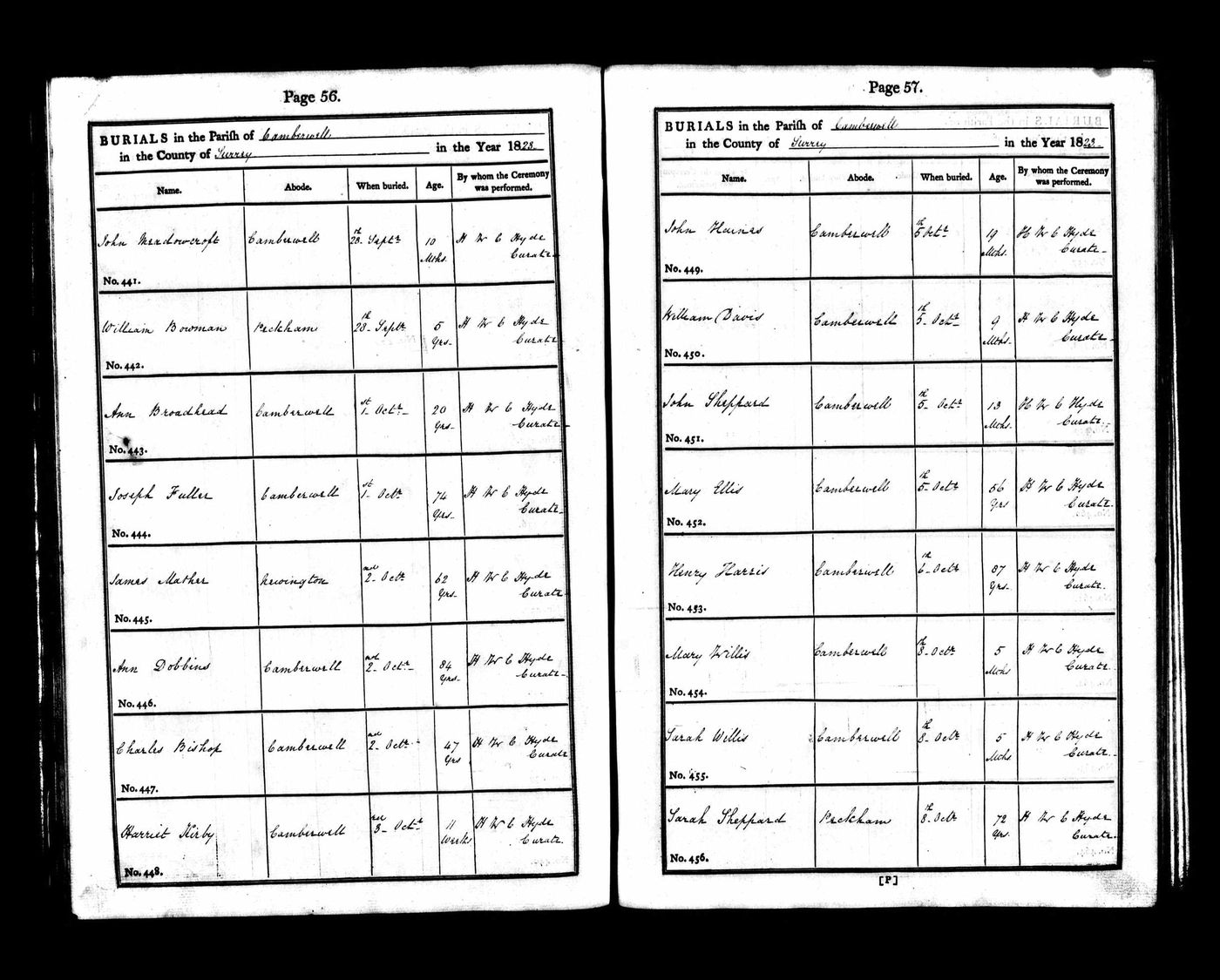
Burial record of James Mather
Shadwell High Street is actually part of the old Ratcliff Highway, and at one time shared with what is now St. George Street its unsavoury reputation. The western portion of the highway was associated with occasional disorderly behaviour of seafarers of all nationalities, who after all brought money into the pockets of shopkeepers and others, while the Shadwell side of it was affected by the poverty of a rough class of population inhabiting the area situated between it and the river. The comparatively small number of houses brought about sub-letting to families, each occupying one room, which was often bared of wooden fittings as the result of having fuel to hand. Shadwell and the East End were not seen as pleasant places. The growth of Shadwell's port led to an increase in the number of prostitutes in the area, and the area was known as the centre of the capital's opium smoking
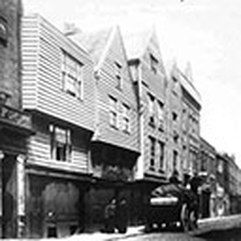
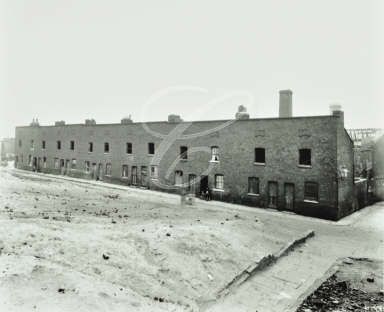
Shadwell High Street
SARAH BARRAND Female
Event(s):
Marriages:
Spouse: JAMES MATHER
Marriage: 04 MAR 1783 Saint Olave Hart Street, London, London, England
Source Information:
Batch No.: Dates: Source Call No.: Type: Printout Call No.: Type:
M001591 1776 - 1876 0557013 Film 0883926 Film
IGI Record of the marriage of Sarah Barrand & James Mather
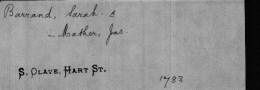
Marriage Record from Pallots Marriage Index
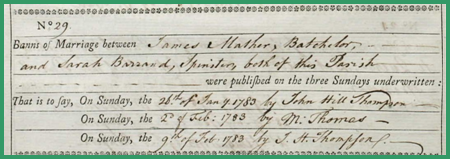
Banns record of Marriage between James Mather and Sarah Barrand
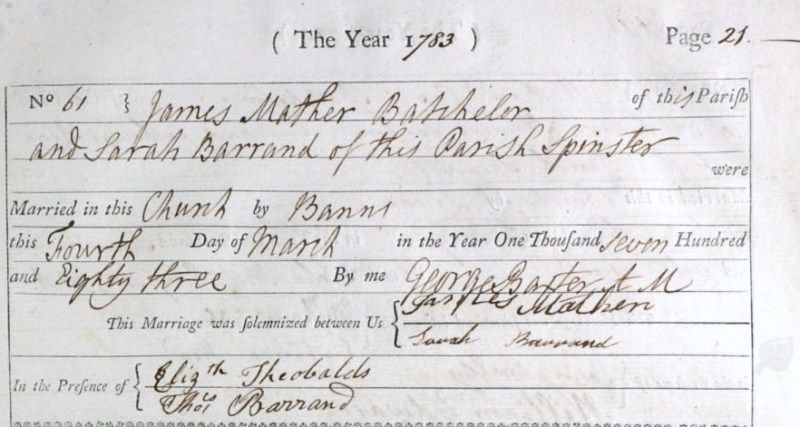
Marriage Record from the Parish Register showing the witness signature of Thomas Barrand.
The baptism records of the four children:
Name: George Mather
Born Date: 22 Dec 1783
Baptism Date: 18 Jan 1784
Parish: St Bride´s, Fleet Street
County: London
Borough: City of London
Parent(s): James Mather,
Sarah Mather
Record Type: Baptism
Register Type: Parish Register
Name: John Mather
Born Date: 07 Feb 1786
Baptism Date: 26 Feb 1786
Parish: St Bride´s, Fleet Street
County: London
Borough: City of London
Parent(s): James Mather,
Sarah Mather
Record Type: Baptism
Register Type: Parish Register
Name: Ann Mather
Baptism Date: 23 Sep 1788
Parish: St Bride´s, Fleet Street
Borough: City of London
Parent(s): James Mather,
Sarah Mather
Record Type: Baptism
Register Type: Parish Register
Name: Sarah Mather
Birth Date: 24 July 1792
Baptism Date: 19 Aug 1792
Parish: St Bride´s, Fleet Street
Borough: City of London
Parent(s): James Mather,
Sarah Mather
Record Type: Baptism
Register Type: Parish Register
Name: Sarah Mather
Record Type: Burial
Estimated Death Date: abt 1833
Burial Date: 21 Jan 1833
Age: 72
Estimated birth year: abt 1761
Parish or Poor Law Union: Shadwell, St Paul
Borough: Tower Hamlets
County: Middlesex
The Death Record of Sarah Mather (nee Barrand)
Name: James Mather
Record Type: Burial
Estimated Death Date: abt 1823
Burial Date: 2 Oct 1823
Age: 62
Estimated Birth Year: abt 1761
Parish or Poor Law Union: Camberwell St Giles
Borough: Southwark
Register Type: Parish Register
The Death Record of James Mather
Elizabeth
The 8th and final child of John Barraud and Mary Turpin was Elizabeth but, as with the other children, there is no record of the birth or baptism. It would appear that Elizabeth was born around 1763, most probably in Holborn, as John, her father had moved to Turnagain Lane in Holborn around 1756 and where he died in 1763. Elizabeth never married, and it is believed she lived in Soho, and was known to be a prostitute in the Soho area of London and died a spinster in 1827 at the age of 64, in Castle Mond Yard, (sic) and was buried on the 16th December, 1827. She appears to have stayed in the Soho and Westminster area of London all her life working both as a servant and prostitute. There are records of possibly Elizabeth Barrand (Miss B-nd) in the well noted "Harris's list of Covent Garden Ladies" of 1783. Sex tourists interested in visiting one of London's brothels could buy the guide book, Harris's List of Covent Garden Ladies (1773) to help them find a prostitute that would suit their taste and income and which was published from 1757 to 1795. It was an annual directory of possibly the best 80 prostitutes working in London. The guide offered a list of the sex workers of an area infamous for its brothels and bath houses, including the women’s addresses, the prices they charged, and any special services they offered. One in five women made a living as a prostitute, a remarkable number. The young women and girls who chose prostitution as a living were poorly educated and fit only to work in backbreaking, menial jobs. Most prostitutes were independent street-walkers and kept a majority of their wages. A London prostitute stood an excellent chance of earning more than £400 a year. but a good housemaid earned around £50 a year, and one can readily see why so many women were drawn to the trade. As the book details the charge made by each prostitute, the sum of two guineas charged by Elizabeth B-nd (sic) was clearly at the top end of the scale, as the average worker's wage was around one pound per week and certainly two guineas was a large sum of money being on average two weeks wages. A "common prostitute" could be "purchased" in London for around a shilling or perhaps two shillings and six pence to enjoy her company in a lodging house or tavern. The book had a circulation of around 8000 copies a year and cost two shillings and sixpence. The book gives details of their appearance and sexual specialities. The entry for Elizabeth B-nd appears as follows:
Miss B—nd, No. 28, Frith-Street.
A rose-bud blows in either cheek,
Round which the lily makes its bed;
Two dimples sweet good nature speak,
And auburn ringlets deck her head.
Her heaving breasts pant keen desire,
Their blushing summits own the flame;
Her eyes seem wishing something nigher,
Her hand conducts it to the same.
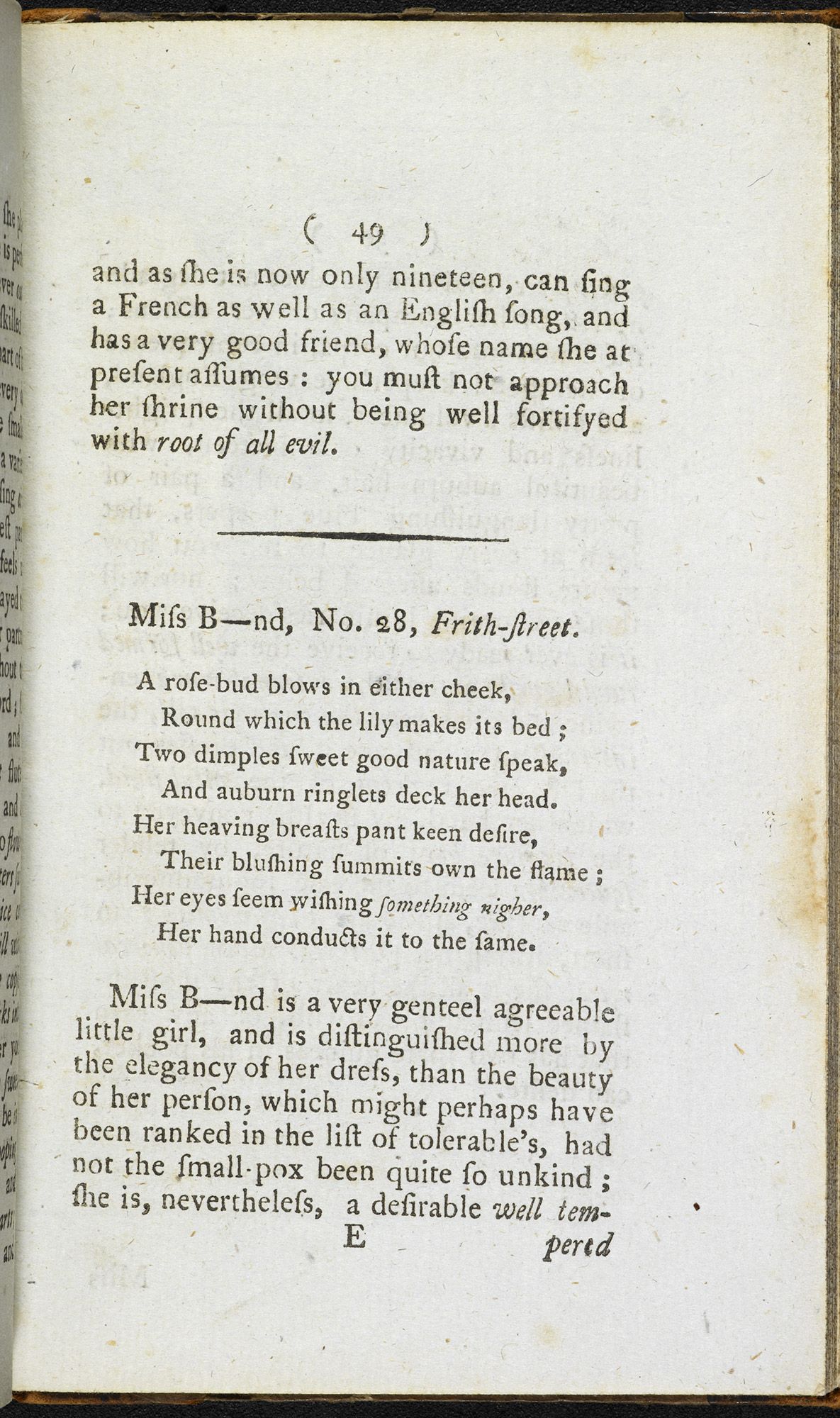
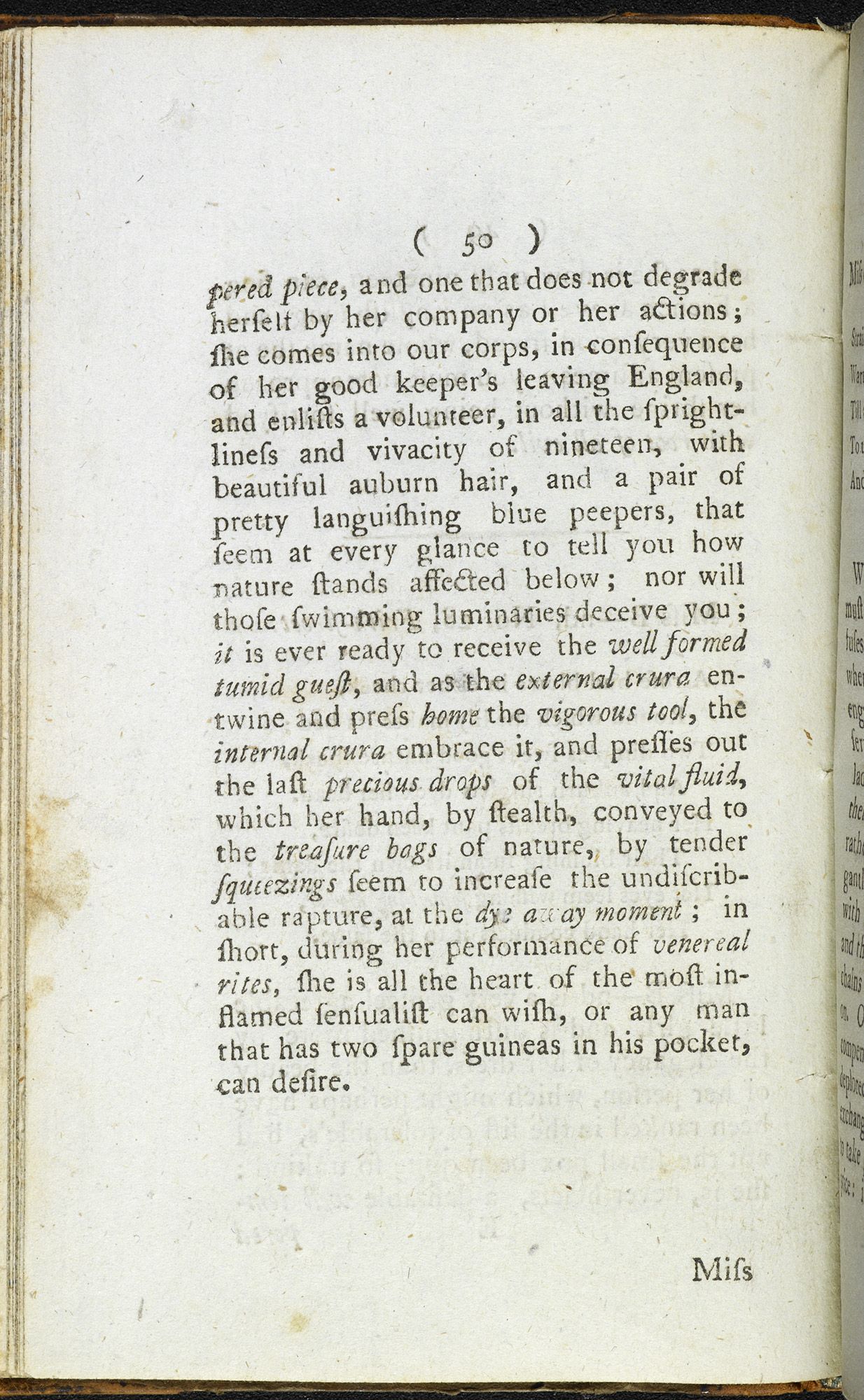
Extract from Harris's List of Covent Garden Ladies
Miss B—nd is a very genteel agreeable little girl, and is distinguished more by the elegancy of her dress, than the beauty of her person, which might perhaps have been ranked in the list of tolerable's, had not the small-pox been quite so unkind; she is, nevertheless, a desirable well tempered piece, and one that does not degrade herself by her company or her actions; she comes into our corps, in confequence of her good keeper's leaving England, and enlists a volunteer, in all the spright- liness and vivacity of nineteen, with beautiful auburn hair, and a pair of pretty languishing blue peepers, that seem at every glance to tell you how nature stands affected below; nor will those swimming luminaries deceive you; it is ever ready to receive the well formed tumid guest, and as the external crura en-twine and press home the vigorous tool, the internal crura embrace it, and presses out the last precious drops of the vital fluid, which her hand, by stealth, conveyed to the treasure bags of nature, by tender squeezings seem to increase the undiscribable rapture, at the dye away moment; in short, during her performance of venereal rites, she is all the heart of the most in- flamed sensualist can wish, or any man that has two spare guineas in his pocket, can desire.
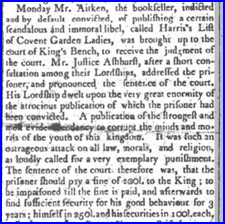
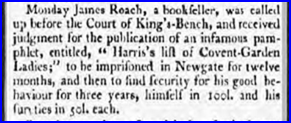
The Ipswich Journal 14 November 1795 Bath Chronicle and Weekly Gazette 19 February 1795
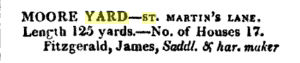
On Elizabeth's death, I can find no record of a Castle, Mond Yard in the Street Records of London or in the 1841 census, but from information published, the whole area was due to be demolished around 1829 and therefore I would guess that she was in fact living with her nephew Peter Cook Barrand (son of Thomas Barrand) as he lived at “The Castle, in Moore’s Yard.” in 1828, and that the transcription in the burial record is mis-spelt. Elizabeth was buried in St. Martin-In-The-Fields Church on the 16th December, 1827. (See Peter Cook Barrand Page: XXXXXX) Moore’s Yard is described as: A builders’ yard with workshops and stable, and six newly built dwellings and an enclosed yard with stabling and a stack of warehouses, the property of W.B. Moore, a bankrupt.
Description of Moor’s Yard:
A little beyond the Church is Moor's Yard, a large Place for Stablings, with several ordinary Houses, and hath a Passage into Church Lane, and another into Thackham's Court, and so into Shandois Street (Chandos Street) and beyond this Street are several Allies and Places, most of which have a Passage into Bedfordbury, but are very narrow, ill built, and as ill inhabited.
It began as a narrow alley from St Martin’s Lane’ but soon ‘spread out into an open space almost the size of St Martin’s Church. In the middle of the open space was an isolated block’ which ‘probably occupies the site of the horsepond which was there in the eighteenth century. It was always associated with horses. There was a farrier here in 1683 and the last occupant of Moor’s Yard, as late as 1839, was John Armstrong, Farrier.’ The other end of Moor’s Yard ‘narrowed again into a long alleyway which ended at Church Lane’
Illustrations of Moor’s Yard have been reproduced in the book 'George Scharf’s London: Sketches and Watercolours of a Changing City, 1820-50' (pages 30-31).
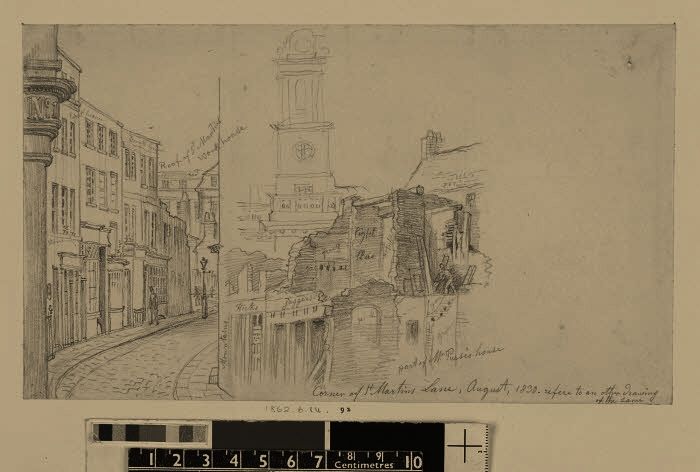
Corner of St. Martin’s Lane
There are 3 Moore's Yards in London..... From John Strype's description of London Streets:-
(1) Chandos-street, near St. Martin's Lane. This Place hath a Passage into Moors Yard, which leadeth into St Martin's Lane; also another Passage into New Round Court, and another turning Passage to St. Martin's Church, all but indifferently built or inhabited. It is descriped as "a few doors north of the Church - it leads to Church Lane."
(2) In King Street - St. James's
(3) It is in Fashion Street - Spitalfields.
As Elizabeth was buried in St. Martin's Church, by far the most likely location for Moore's Yard is at St. Martin's Church. In 1828, it was reported in The Morning Post and also in the London Standard, that all the houses in both Moore's Yard and St. Martin's Churchyard were to be demolished by spring 1829 for new building work in Trafalgar Square.
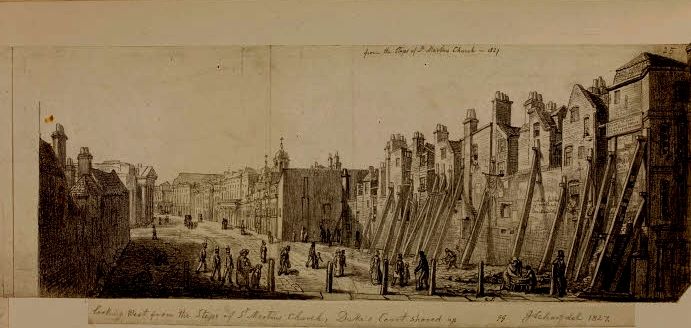
Looking west from the steps of St. Martin’s Church. Duke’s Court shored up 1827
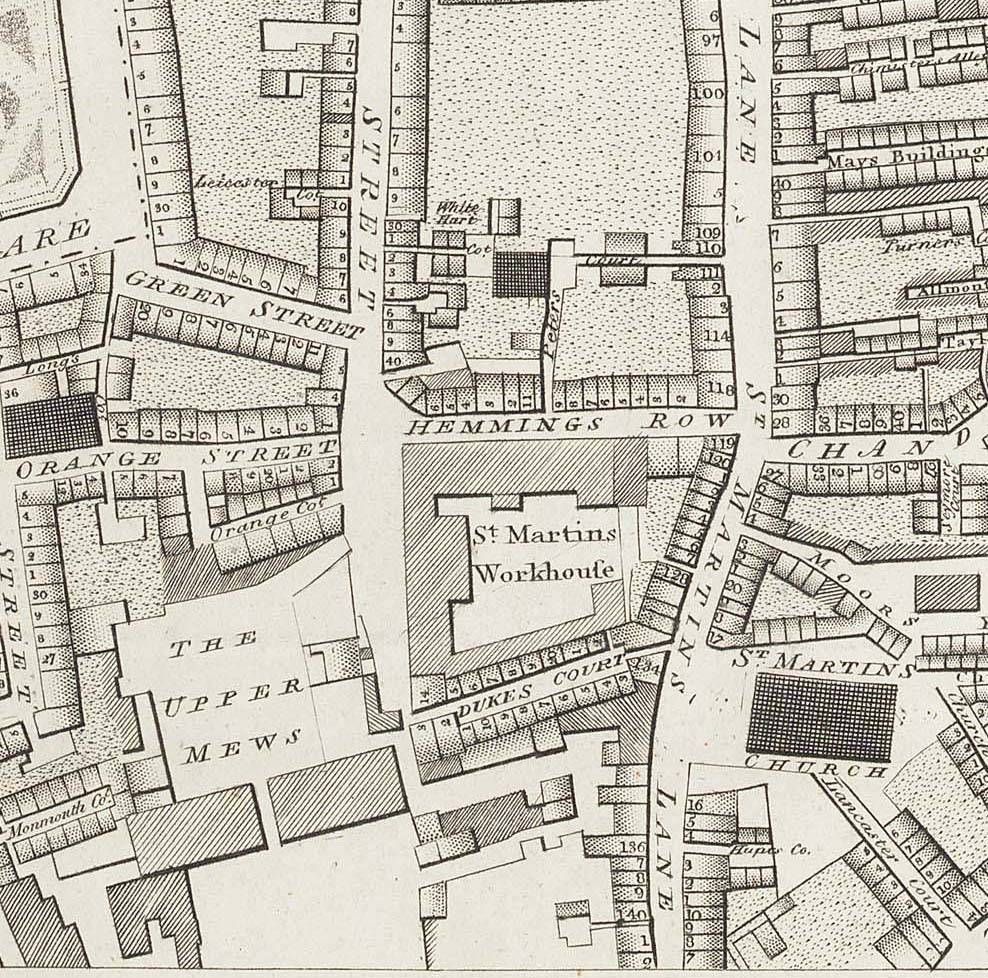
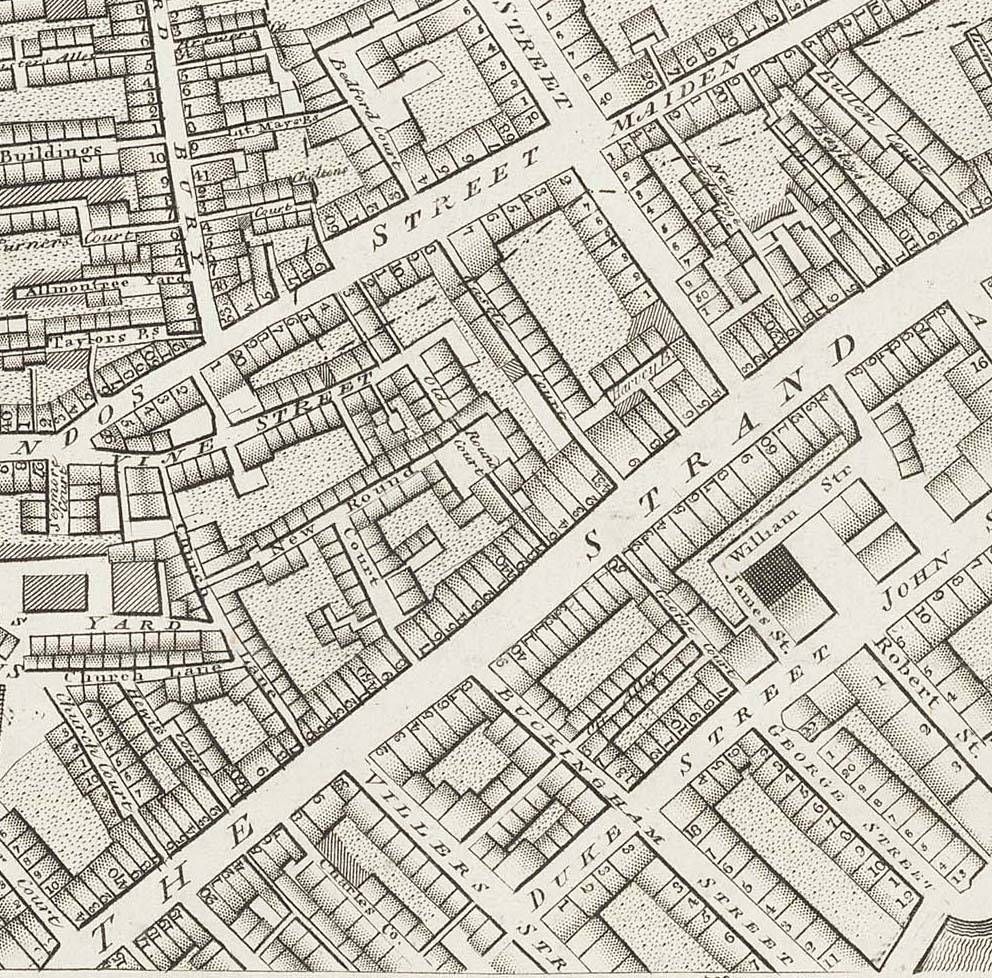
Moore's Yard near St. Martin's Church (Horwood’s Map 1792)
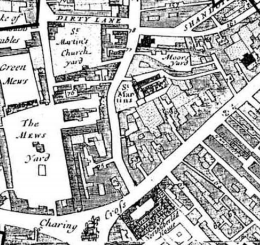
Map of c1700 showing St. Martins’ Church and Moors yard
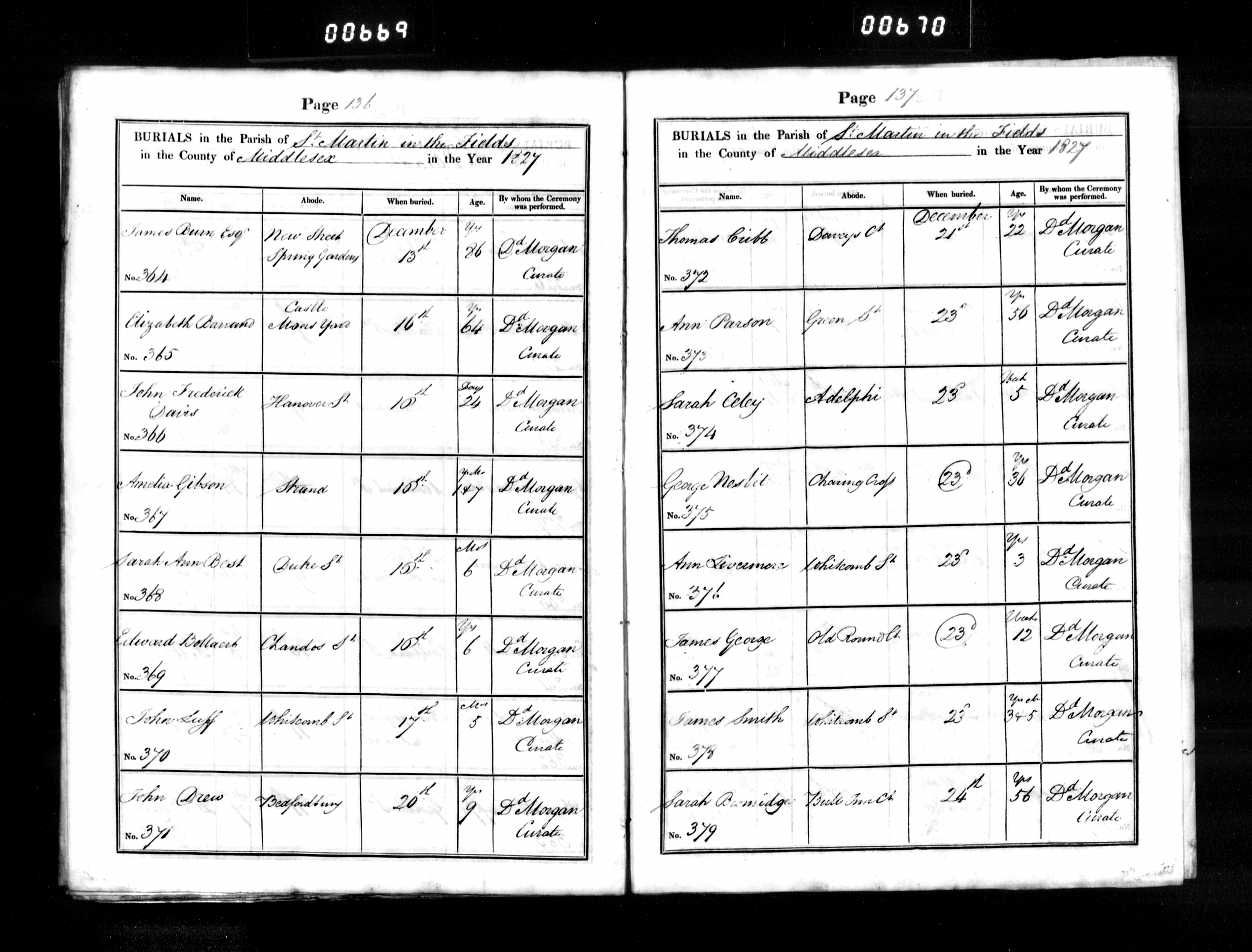
Burial Record of Elizabeth Barrand 1827 – Address as Castle Mond Yard?
Death record of Elizabeth Barrand
Name: Elizabeth Barrand
Record Type: Burial
Estimated Death Date: abt 1827
Burial Date: 16 Dec 1827
Age: 64
Estimated Birth Year: abt 1763
Parish or Poor Law Union: St Martin In The Fields
Borough: Westminster
Register Type: Bishop's Transcript
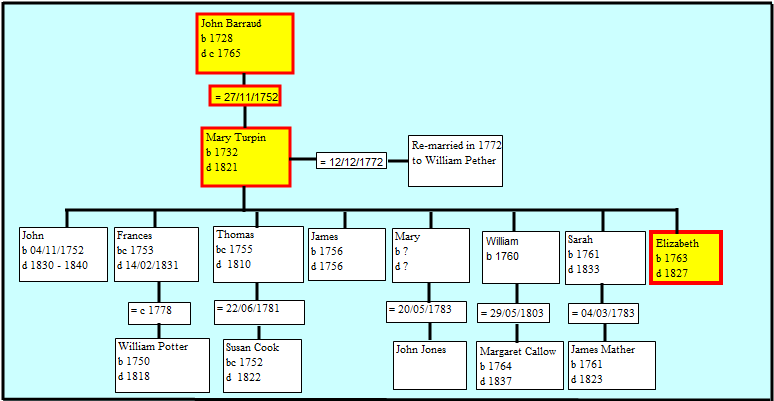
Moore’s Yard was mentioned in numerous Newspaper articles:
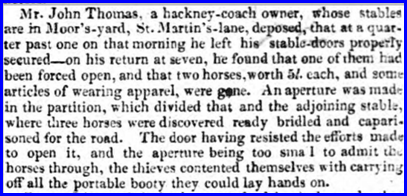
Public Ledger and Daily Advertiser 19 April 1828
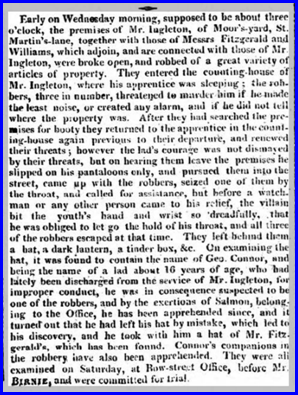
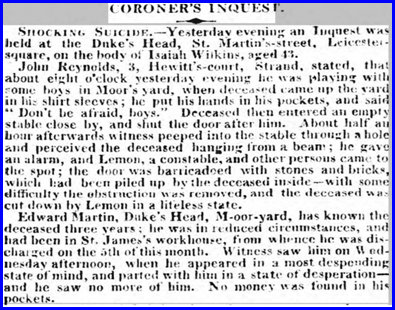
Globe 30 October 1815 Morning Advertiser 18 July 1828