There are three main families of Barrand in the United Kingdom:- Lincolnshire, Yorkshire and London but none of these are connected to each other in any way.
The Lincolnshire Barrands originated around 1500 with the arrival of Willheim and Johanna Barraund from the Netherlands. Most probably they arrived along with so many of the Dutch immigrants who brought with them the skills and know-how of windmill building to drain the fens of Lincolnshire as they had done in the lowlands of Holland. At one time there were as many as 300 windmills in the fens of Lincolnshire. There are numerous branches of the Barrand family that originated in Lincolnshire, and several settled in Tilbury and Essex and also in the centre of London.
The Barrands of Yorkshire are first noted in the Hull area around 1550 and eventually settled in the Bramhope and Otley areas of Leeds in West Yorkshire where the family is mentioned in 1560. The name was originally Barron or Barond and soon evolved to Barrand. They were mainly farmers and agricultural workers. The Barrands of Yorkshire are well documented by Charles Barrand of Chichester.
In London however, the name Barrand originated as Barraud or Barreau, and the family came from Angoulême in France as Huguenot refugees. The Barraud or Barreau name can be traced back to around 1450 in France. In 1700, a Philip Barraud fled France and settled in London, being naturalised in 1704 and it is from Philip Barraud that the Barrand name has evolved. The Barraud name has been extensively researched over the years but part of the Barraud family in London changed their name to Barrand around the early 1800’s as a result of the dislike of all French people by Londoners due to the on-going wars between England and France. The name Barrand appeared to be more “British” sounding than Barraud.
The story of the Barraud family from France is already well documented in the excellent book “Barraud – The story of a family” written by Miss Enid M. Barraud in 1968, and who also collaberated with Mr. Cedric Jagger to produce his superb book “Paul Philip Barraud.”
I would certainly recommend that any researchers of the Barraud and Barrand families should first obtain a copy of these books. I make no attempt to correct any of her research which is extremely well documented, but simply to expand on her observations, and continue with the life of John Barraud, the youngest son of Philip Barraud and his 2nd wife, Frances Prevost with information that was possibly unavailable at the time.
As Miss Barraud did not pursue John Barraud’s life, I have continued with his story and his family. I have also documented some basic facts about the Barraud Family from Ms. Barraud’s book to explain how the family fits together.
To expand on her book: We know that in Angoulême in France and surrounding areas there have been Barraud, Baroud or Barreau families in the area since the early 1400s, and also that the existence of numerous “Baroud” family members were potters of tin (Pewterers) or “Pintais” and existed from well before 1600, and they were also founders of bells.
The art of casting iron bells goes back in time to the 6th or 7th century when metal plates were held together by rivets. The bell makers (founders) were mainly travellers until the mid 15th century. They roamed the countryside in search of orders, and the skills were passed from father to son for generations. Not only did many of the bellfounders confine themselves with the art of making bells, they also combined their skills with metal-ware goods such as utensils and gunmaking. For bellmaking, they used to build furnaces in the graveyards of churches or inside the shrine to protect them from inclement weather to produce a single bell. In some occasions, the church was actually built around the bell itself and then hoisted into the tower. When a town produced a bell, it was a momentous event in which the whole community would participate.
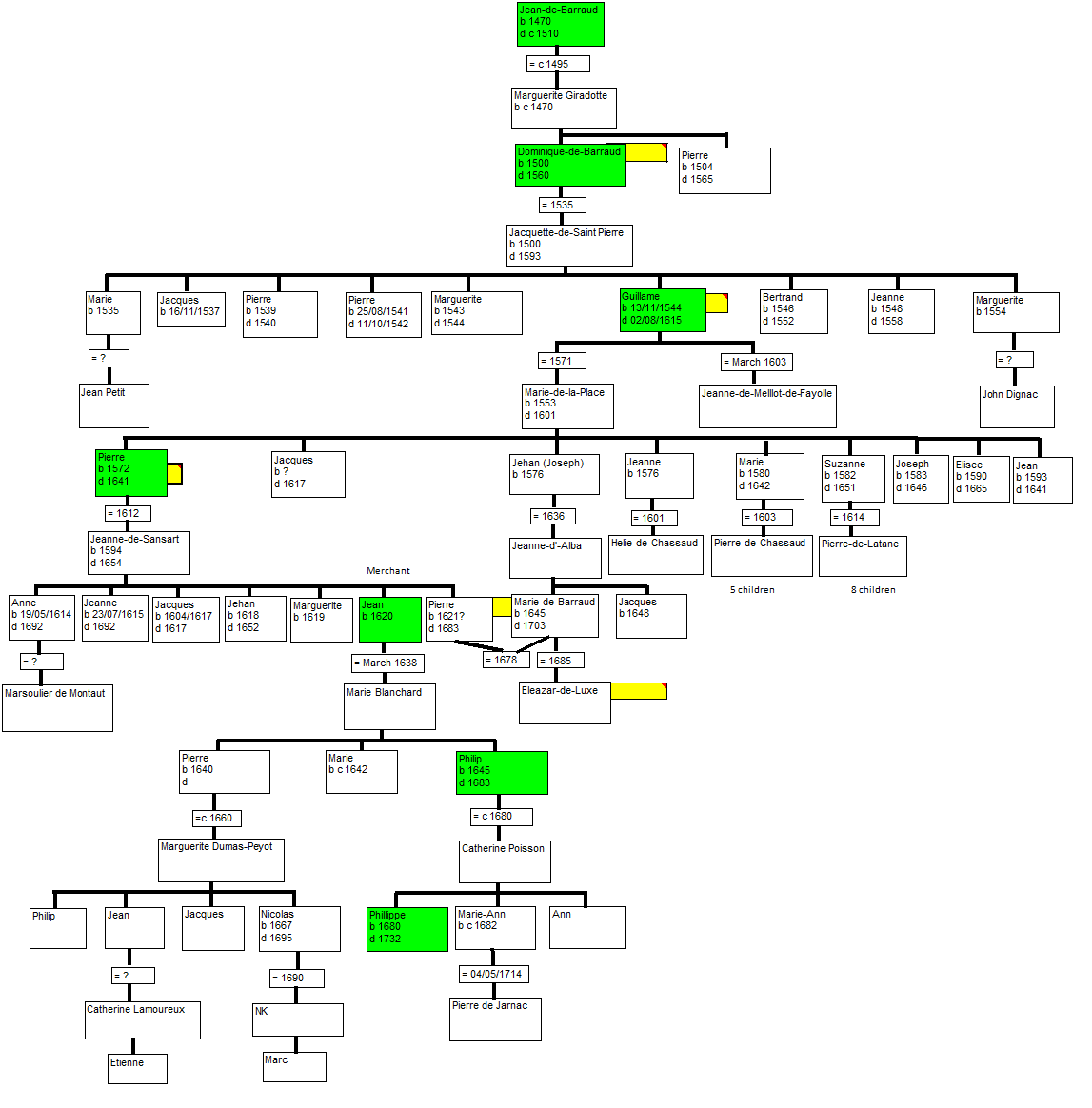
The Earliest Barrauds:- From information available from the Barry-de-Gorre tree, Martine Belliard tree, Jean-Michel Ducosson Tree, Wailly Tree & Bruto Benazzi Tree (Unverified) and other Ancestry Trees, (See Barraud Family Tree, page 7) they mention that the origins of the Barraud name can be traced to around 1450.
The first mention of a Barraud is a “de-Barraud” from about 1450 and his two sons, Pierre-de-Barraud and Jean-de-Barraud.
Pierre-de-Barraud, the elder son of “de-Barraud”, was probably born around 1468, and there is mention of a "Pierre Barraud" a priest being given the ownership of a house and alleyway next to the church in Angoulême in 1497 by a Richard Leonard, and clear records of this agreement being renewed on 30th November, 1530 by the owners, Richard Leonard and William Richard. There are also records of a Pierre Barraud being a priest and canon in Angoulême in 1504. This is most probably the same Pierre Barraud.
Pierre Barraud had two sons Pierre (2) who became both a pastor and notary (One level under a Mayor) in 1550, and there are records of a Pierre Barraud also being a priest and canon in Angoulême in 1557 and this seems to suggest this was the son of Pierre Barraud. Pierre is again mentioned in 1574 as a "Sergeant Royal" and again in 1584. Pierre (2) had a son, Daniel who also became a notary between 1627 and 1648.
Jean-de-Barraud, the second son of Pierre-de-Barraud was born around 1470, a farmer and plowman and he married Marguerite Girardotte in 1495 and they had 2 children, Pierre and Dominique.
Dominique-de-Barraud was born c1500 in Le Fieu, Gironde and he died 6th July, 1561 in Mussidan, in Dordogne. He became wealthy by buying land and became one of the biggest land owners in Mussidan. Dominique married Jacquette-de-Saint-Pierre in 1535 and they had 9 children. Dominique’s occupation was as a Notary, tenant farmer and a principal seigniory of Mussidan along with his Brother-in-Law Saint-Pierre.
Dominique and Jacquette’s 6th child was Guilluame-de-Barraud (William) born 23rd November, 1544 and died on 2nd August, 1615 aged 70, a protestant and who became the magistrate of Mussidan. Like his father, he was profilic in purchasing land and was called “Mon bon ami” “My good friend” and was knighted in 1604. Guilluame married Marie-de-la-Place (1553-1601) in 1571, and they also had 9 children. Their eldest child, Pierre-de-Barraud was born 30/05/1572 and died 16/10/1641 and he was known as Councillor of the King. Pierre-de-Barraud married Jean-de-Sansart in 1612 and had 7 children. Jeanne-de-Sansart already had the title “Young Lady of Saint Sauveur” and on their marriage, Pierre then took the title Lord of Fornil and Saint Sauveur and was enobled by Henry IV. It is also known that a Pierre-de-Barraud was made a councillor of Angoulême after the death of a Pierre Balau on the 23rd December, 1628. He was responsible for advising the House of Angoulême as an Alderman and almost certainly this is the same Pierre Barraud.
Pierre and Jeanne-de-Sansart’s’ youngest son Pierre Barraud (2) b1621 married his direct cousin Marie-de-Barraud and became the owner of the Castle of Monbazillac in 1656. (see below)
This came as a result of Guilluame’s 3rd child Jehan who married Jean-d’Alba and their daughter was Marie-de-Barraud who married Pierre, the son of of Guiluame’s eldest son, Pierre.
We can also trace a Jean Barraud of the parish of Saint-Jean d’Angoulême, who on 10th May 1643 was instructed by Msr. Micheau, a notary in Angoulême, to make a bell for the parish of Saint-Martial Of Coulonge (today, Rouffiac-Saint-Martial) in the marquisate of Barbezieux and it seems most probable he was a grand-son of Pierre (above). There is also mention of a Jacques Barraud in 1666 who, on February 27, 1666, with the instruction of the parish priest of Saint-Estèphe, supplied a bell which weighed 687 pounds and delivery was made on December 29, 1666 for the sum of 20 sols per pound.
I believe we can start with the Barraud dynasty for certain with a Pierre ‘Baraud’ (sic), b1640 and Phillippe Barraud b1645 who were brothers. It is extremely likely that these were the sons of Jean Barraud, a merchant and his wife, Marie Blanchard who were married in March, 1638. Jean Barraud was known to be a draper and he had among other things a mill located on the river Anguienne below the walls of the city of Angouleme. He was also a son of Pierre Barraud and Jean-de-Sansart, and therefore a brother of the Pierre Barraud who owned the Castle of Monbazillac, but as this information comes from several family trees in France, I can only assume they have researched the facts. It also seems that Jean Barraud and Marie Blanchard (his wife) also had a daughter Marie, born in 1642 and also possibly another daughter, Jacquette.
Philippe Barraud, the brother of Pierre Barraud, was certainly the “Philip” that married Catherine Poisson and therefore the father of Phillip Barraud who travelled to England in 1704. We know that Philippe Barraud senior was also a merchant, most probably in cloth and general goods, and also an Angoulême town official, and this is shown in “History of old Carmel Angoulême” and that the records also show that a "bargain" between Jean (or Jehan) Barraud and the Angoulême Carmolites to complete work (bells) was struck and the signatory was Philippe Barraud. It would seem most likely then that Jean (or Jehan) Barraud the son of Pierre Barraud the bell maker, was the nephew of Philippe Barraud. Both Philippe Barraud and his wife Catherine Poisson were protestants, but they swore recantation in 1683 and abjuration under pressure on the 5th October, 1685 to become catholics again and signed a certificate. The original French notification is as follows:
Registres de la Paroisse Saint Paul d'Angoulême: Abjuration de Philippe BARREAU et Catherine POISSON sa femme, 5 oct 1685. … certifie avec permission de M l’Archidiacre avoir reçu l’abjuration …. De Philippe BARREAU, Catherine POISSON sa femme. Signé Barreau, Poisson
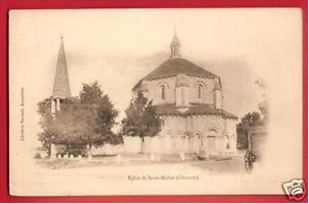
St. Michael’s Church, Angoulême
It is not known when Philippe Barraud (snr) died but there are records to show that “a dying man called Barraud was taken from his bed and wheel-barrowed “naked” through the streets of Angoulême.”
“Naked” in the seventeenth to nineteenth century usually meant wearing only undergarments, but it also had a less formal secondary use: to describe people in the street as “naked” seems to suggest they were not wearing outdoor clothes – eg: no hats, and the men may not have been wearing jackets. In mixed company, “naked” usually suggested that men were in shirtsleeves and women were probably not wearing their neckchieves, leaving their shoulders uncovered over low-cut dresses.
Philippe Barraud's name appears on many documents in the church of Saint Jean d'Angoulême as an official and at weddings etc until late in 1698, so certainly he was still living at this time.
Philippe's death therefore was between 1698 and 1703 as there are records to show that Catherine Poisson was a widow on the 8th August, 1703,
"8th August, 1703 the date of the award of the manor of Corking (the crown), against Jaques Lambert, Lord of Fontelles: tutored the children in favour of Catherine Fish, the widow of Philippe Barraud the Bourgeois of Angoulême, to end to be paid a sum of 300 pounds to promise such a sum given by Msr. and lady Jousserand, on the 26th February, 1680, the Sieur de la Beaulieu Pulbautier (prevost), which was called Poisson transferee." (translated from Oliver Jousserand family tree.)
Philippe Barraud and Catherine Poisson also had two daughters, Marie-Anne and Ann. Marie-Anne married Pierre-de-Jarnac; seigneur of Gardpee, Bourgeois de la ville d'Angoulême and of Létang, on the 4th May, 1714 in Anguelême and this was his 3rd marriage. His first wedding was June 23, 1692, with Jeanne Lambert. The second marriage, in 1697 was with Marie-de-Chilloux, who died in 1711. Pierre-de-Jarnac and Maria Anne Barraud had 2 sons, Pierre-Joseph-de-Jarnac b 24th June 1715, and Henri-de-Jarnac, born in 1717 in Angoulême.
The “Avril” family tree states that François Avril, Lord of Guyonnierre and Gregueuil married Ann Barraud “the daughter of Philippe Barraud and Catherine Poisson on the 14th October, 1705.” They had 5 children: 3 boys and 2 girls. Ann’s sister Marie-Anne Barraud was the god-mother to their first child, Catherine Ann b1703. Avril-Les Blasons de la Charente (Translated from French) Note: Their first child was born two years before their marriage.
Pierre ‘Baraud’ (sic) the son of Jean Barraud and Marie Blanchard lived in the village of Cherbontiere with his wife Marguerite Dumas-Peyrot. They had at least four children, Philip, Jean (or Jehan) Jacques, and Nicolas. Pierre was a bell-maker and produced the bells for the parish of Saint Gervais and St. Protais in 1663 and he died on the 18th February, 1668.
Philip, their first son appears to have died in infancy.
Jean (or Jehan) Barraud, the second son of Pierre Barraud and Marie Blanchard married Catherine Lamoureux from Cherbontiere and assisted by his brother Nicolas cast a bell weighing 1300 pounds for the Cathedral of Angoulême to replace the one which was broken by the Huguenots when they looted the city. The chapter for the cathedral shows that they paid Jehan and Nicolas Barraud 200 pounds for their work. The activity of Barrauds is great during the years of religious wars and the decades that followed the looting and burning of shrines.
Jacques the 3rd son may well have died in infancy.
Nicolas Barraud, the 4th son, was the youngest child of Pierre Barraud, born in 1667 shortly before his father’s death in 1668, and was nicknamed “Founder of the King” and worked with his own son Marc long after the death of his brother Jean (or Jehan). In 1690, Nicolas alone recast the bell in Rougnac which was damaged by the Huguenots but father and son worked together on the bell in Perignac Marc continued with the family trade and produced the bells in Longre and was still making bells in 1725. Marc also worked with his cousin, Etienne Barraud on many other bells.
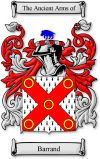
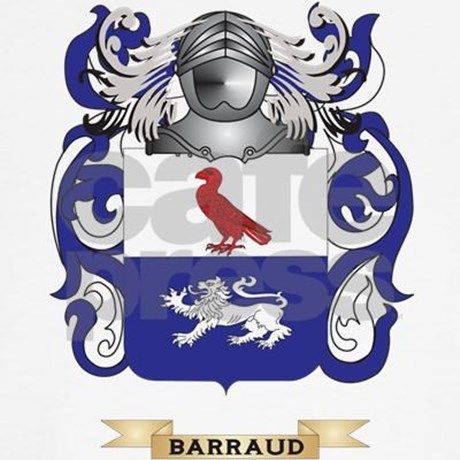
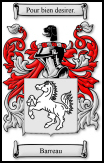
Barrand Coat of Arms Barraud Coat of Arms Barreau Coat of Arms
The surname of BARRAUD was derived from the Old French word 'baril' an occupational name 'a maker of casks and barrels' a cooper. The name was brought into England in the wake of the Norman Invasion of 1066, and has been Anglicized to Barrel, Barrod and Barrow.
The surname of BARRAND is of Dutch origin, a baptismal name meaning 'the son of Barend' a form of Bernhard or Bernard which means 'bear-hard.' The Dutch language is most closely related to Low German, and its surnames have been influenced both by German and French naming practices.
The surname of BARREAU is of medieval French and originates in both the Normandy and Bordeaux areas of France. The name is also recorded as Barau, Barrau, Barraud and Barroux etc. This name was also derived from the old Fench word ‘Baril’ an occupational name ‘a maker of casks and barrels’ – a cooper. It is possibly an occupational name meaning little barrel but also possibly a nickname for a rounded person (one who is barrel-shaped) The English name of Barreau is Barrow as England and France were at almost permanent war and refugees and Huguenots with French sounding names changed their names to the more English sounding names to avoid persecution.
During the Middle Ages, when people were unable to read or write, signs were needed for all visual identification. For several centuries city streets were filled with signs of all kinds, public houses, tradesmen and even private householders found them necessary. This was an age when there were no numbered houses, and an address was a descriptive phrase that made use of a convenient landmark. At this time, coats of arms came into being, for the practical reason that men went into battle heavily armed and were difficult to recognise. It became the custom for them to adorn their helmets with distinctive crests, and to paint their shields with animals and the like. Coats of arms accompanied the development of surnames, becoming hereditary in the same way. Most of the European surnames were formed in the thirteenth and fourteenth centuries. The process had started somewhat earlier and had continued in some places into the 19th century, but the norm is that in the tenth and eleventh centuries people did not have surnames, whereas by the fifteenth century most of the population had acquired a second name.