John Barrand (Son of Thomas Barrand and Susannah Cook) was child number six, and his name is also transcribed as Barren on the IGI record. On the Parish register transcription however, his name is shown as Barron, and it certainly shows that the name was written as Barron. He was born on the 12th June, 1791 and baptised on the 17th July, 1791 in St. Mary’s Church, St. Marylebone.
On the 29th November, 1813, John Barrand married Nancy Ann Routledge at St. Marylebone in London. The witness to the marriage was John’s father, Thomas Barrand. The record from the IGI suggests the marriage was on the 14th November, 1813, but the actual parish Register shows the date to be the 29th November, 1813. From the records, it shows that only the banns were read in the church on the 14th November, 1813.
John and Nancy had 10 children that are known about, but there is possibly another child (Joseph) born in 1819/1820 that has not been proved.
Nancy Ann Routeledge was born on the 10th July, 1795 and baptised on the 29th July, 1795, a daughter of Robert Routeledge & Phoebe Sherol who were themselves married in 1789. Robert Routeledge and Phoebe Sherol also had 3 other daughters, Eleanor (b 26th February, 1792) who married Solomon West in 1815 and their daughter married the son of John Barrand and Nancy Ann Routeledge. Isabella (b 21st July, 1790) who married John Rattray (b1798-?) in Cumberland on 29th November, 1823 and they had 6 children. They moved to Warrington in 1860. Mary, (b 3rd February, 1808) and baptised on 29th May, 1808. Lewis, born in 1801 and baptised on the 12th July, 1801, and he emigrated to Australia and married Matilda Watson (1808-1852) and thay had 7 children. John, born in 1803 and baptised on the 16th October, 1803. There is also another son, Aaron, born in 1806 in Chatham and he moved to Holme Cultrum in Cumberland, married a Sarah Hodgson in 1845 and became a grocer and by 1871 was a coal agent, Hotel owner and Freemason. I cannot find any baptism or birth record however. It is probably no coincidence that James Barrand (1830-1885) travelled to Holme Cultrum in 1882, met Mary Biglands and married in London. I guess that he must have visited Aaron Routelege (the brother of his Grandmother) in Holme Cultrum and met his 2nd wife.
Robert Routeledge (according to other researchers) was born in 1772 in Chatham (Kent) the son of John Routeledge (1747-1823), a tailor, and Margarett Martin (b1745-?). Robert Routeledge's wife, Phoebe Sherol was born in 1766. The surname has been spelt as "Routeledge," "Rutledge," Routledge,” “Ruttledge", Rutlidge and “Ruttlidge” in the records over the years.
Robert Routeledge was a carpenter working in the Marylebone area of London and probably worked with Thomas Barrand. If this is the case, it would possibly explain how Thomas's son John, met Robert Routeledge’s daughter, Nancy and both families would have most likely approved of the marriage. Robert Routeledge moved to Chatham area of East London around 1801 where his sons, Lewis, John and (possibly Aaron) and his daughter Mary were born. The move to Chatham was followed by Thomas Barrand some 6 years later to Woolwich, and it is most likely they still worked together until Thomas Barrand's death in 1811.
It would seem that after Thomas's death in 1811, Robert Routeledge then moved his family back to London and he died in 1814 in the York Hospital, at the age of 44 and his burial is recorded at St. George Hanover Square Church on the 24th October, 1814. Phoebe (nee Sherol) then moved to 25, Little Earl Street in 7-dials, with her daughter, Nancy Ann and John Barrand where she died in 1828 and was buried on the 4th September, 1828 at the age of 62.
Nancy Ann Routeledge’s elder sister, Eleanor Routeledge married Solomon West who was a shipwright Freemason, and past master of the Caledonian Lodge 234. He was also member of the worshipful shipwrights company and employer at the London Docks. Solomon West and Eleanor Routeledge were married on the 21st December, 1815 in Erith (Kent), and one of their daughters, Eleanor West eventually married John Barrand, a son of John Barrand and Nancy Routeledge. John Barrand and Eleanor West were therefore cousins. Solomon West was born in 1792 and he died on 14th October, 1832 in Woolwich. Solomon West and Eleanor Routeledge had seven children that are known of but possibly eight:
William, born on 7th November, 1816 (worked with John Barrand in the cheesemongers shop and eventually became a shoemaker) Richard, born in 1818; Robert, born in 1820, (married Emmeline Abram Longstaff) Eleanor, born in 1821, Thomas, born in 1826, Mary Ann, born in 1827, (not married - died 1882) and Martha, born in 1831. There was another son Solomon, but there are no records of his birth or baptism.
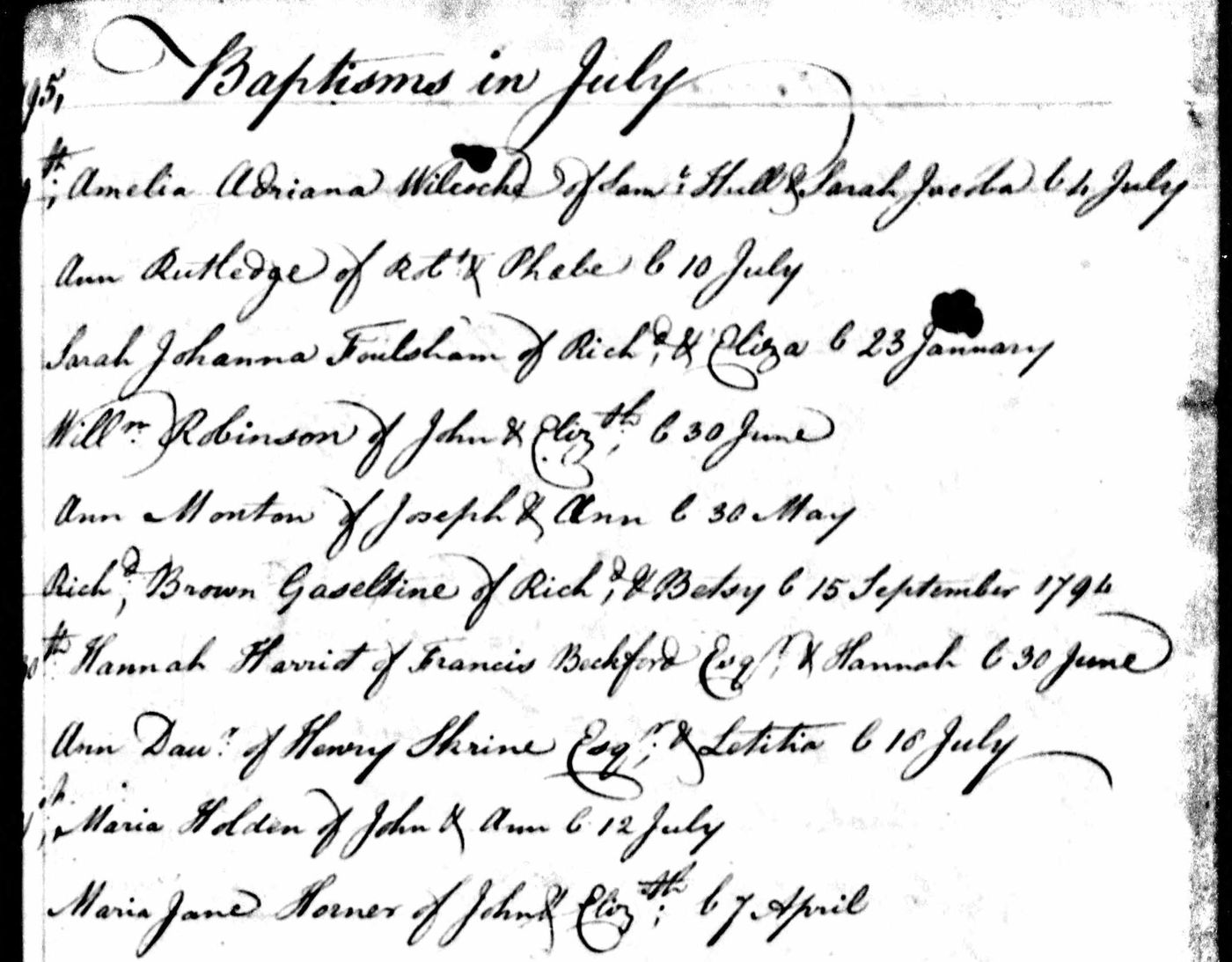
Baptism Record of Nancy Ann Routeledge
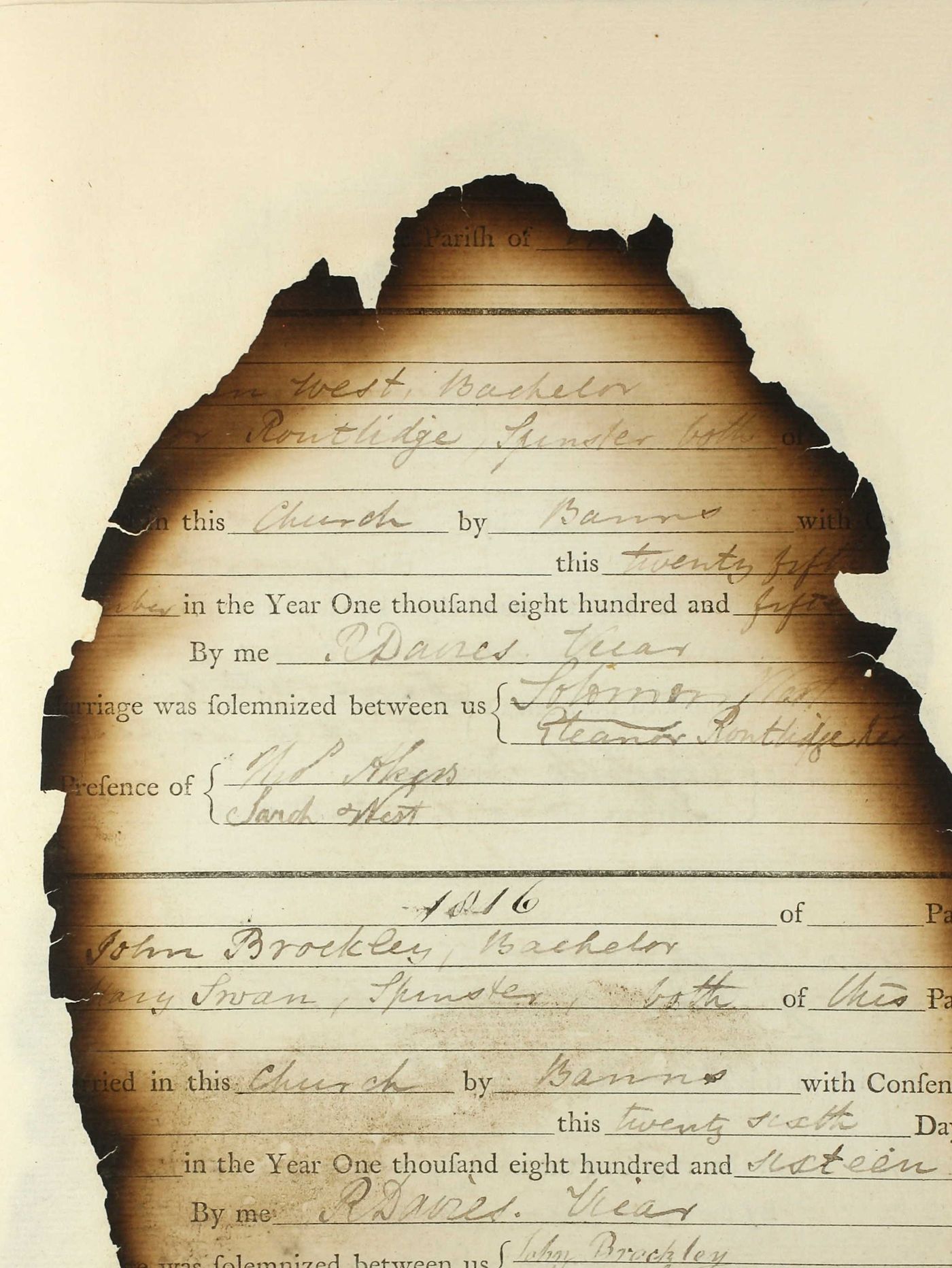
Marriage record of Solomon West and Eleanor Routeledge
|
| Robert Routeledge b 1769 d 1814 John Barrand b 1791 d 1871 Ann Routeledge b 1795 d 1857 = 29/11/1813 John Barrrand b 1818 d 1867 = 16/03/1841 Eleanor West b 1821 d 1859 Eleanor Routeledge b 1792 = 21/12/1815 Solomon West b 1792 d 1832 Phoebe Sherol b 1766 d 1828 = 1789 Isabella b 1790 Mary b 1808 Lewis b 1801 John b 1803 Aaron b 1806 d 1878 | ||||||||||
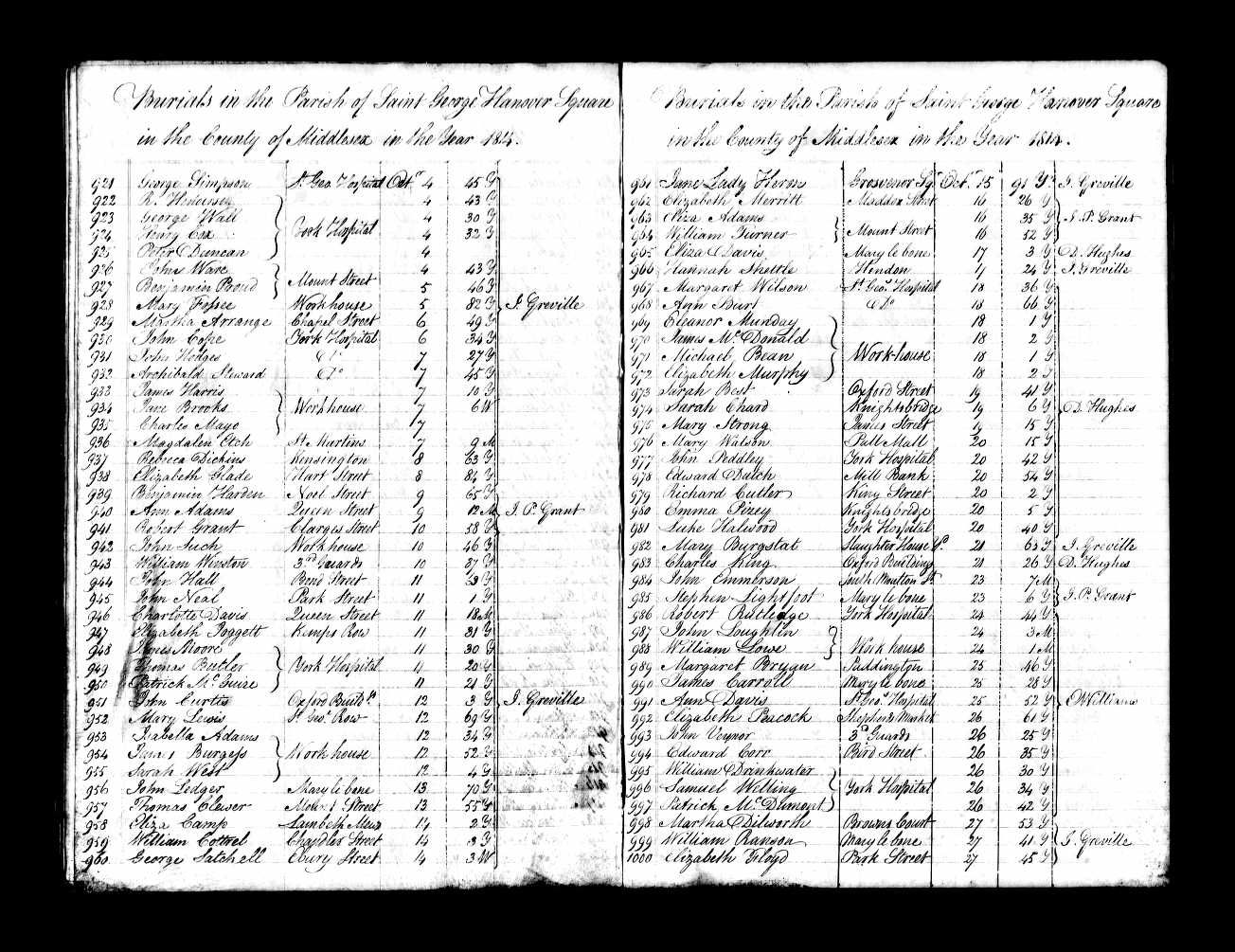
Death records of Robert Routeledge, 1814 aged 44

Probate of Aaron Routeledge
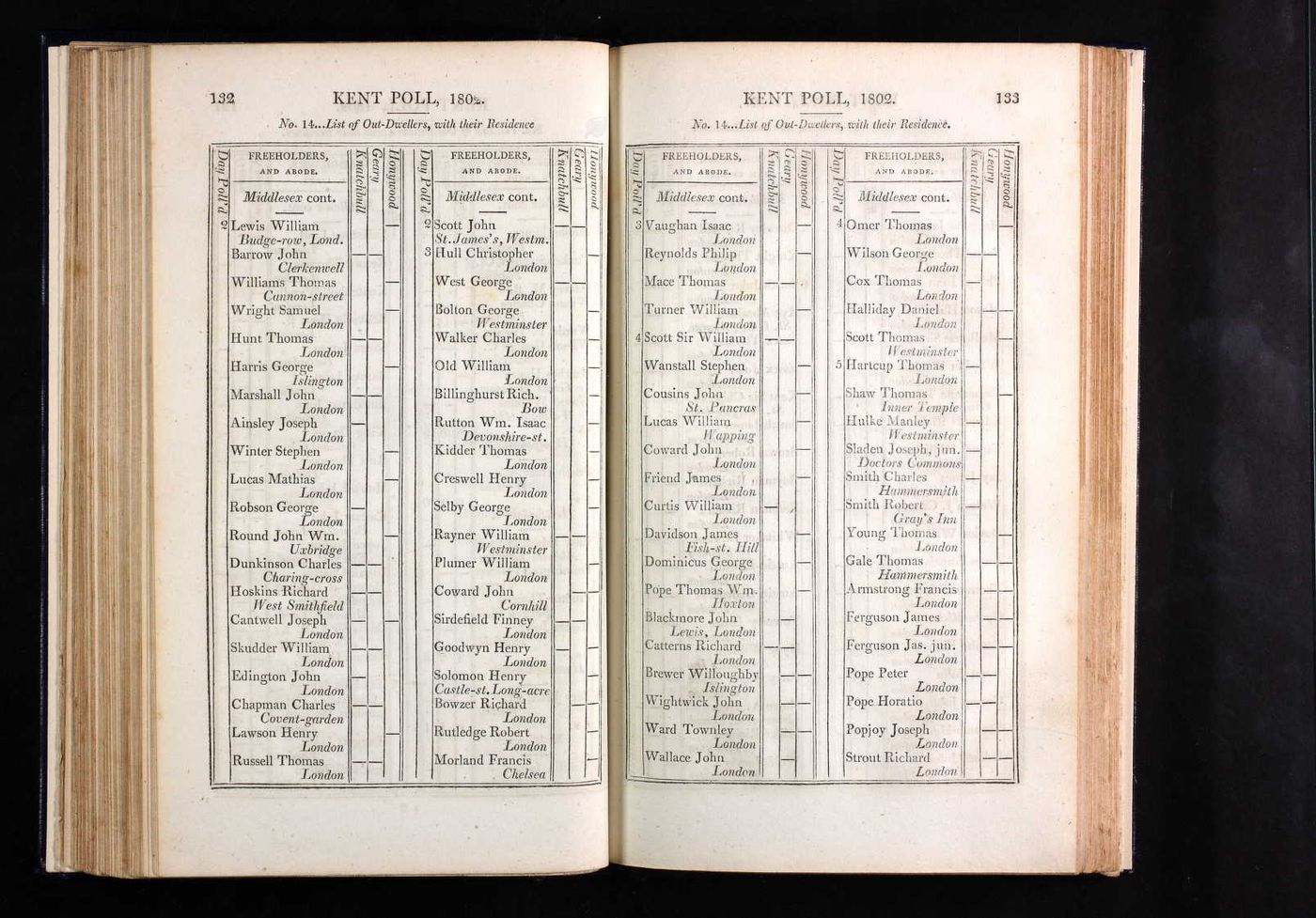
Robert Routeledge living at Chatham 1802
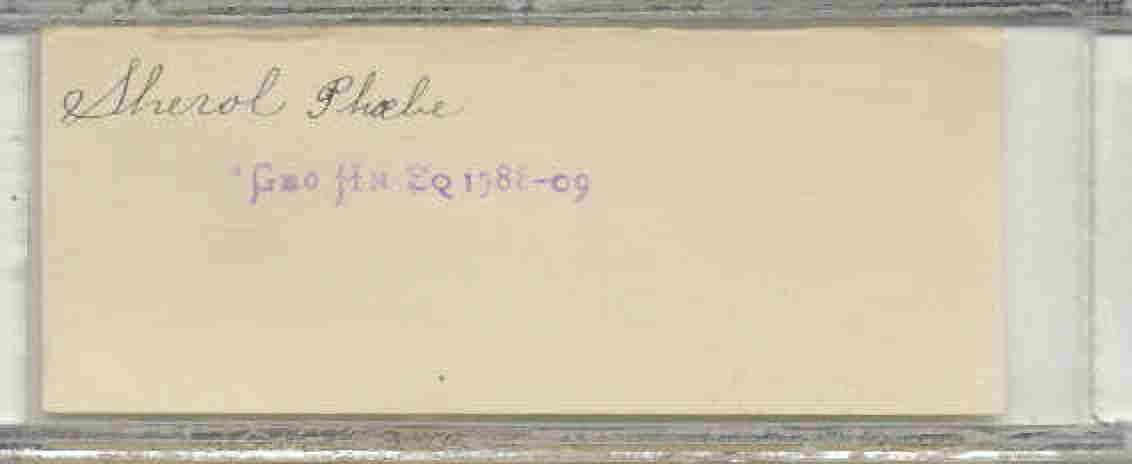
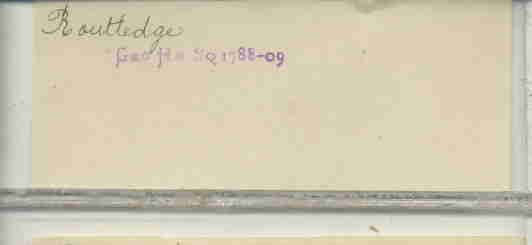
Pallots record of marriage of Robert Routledge and Phoebe Sherol
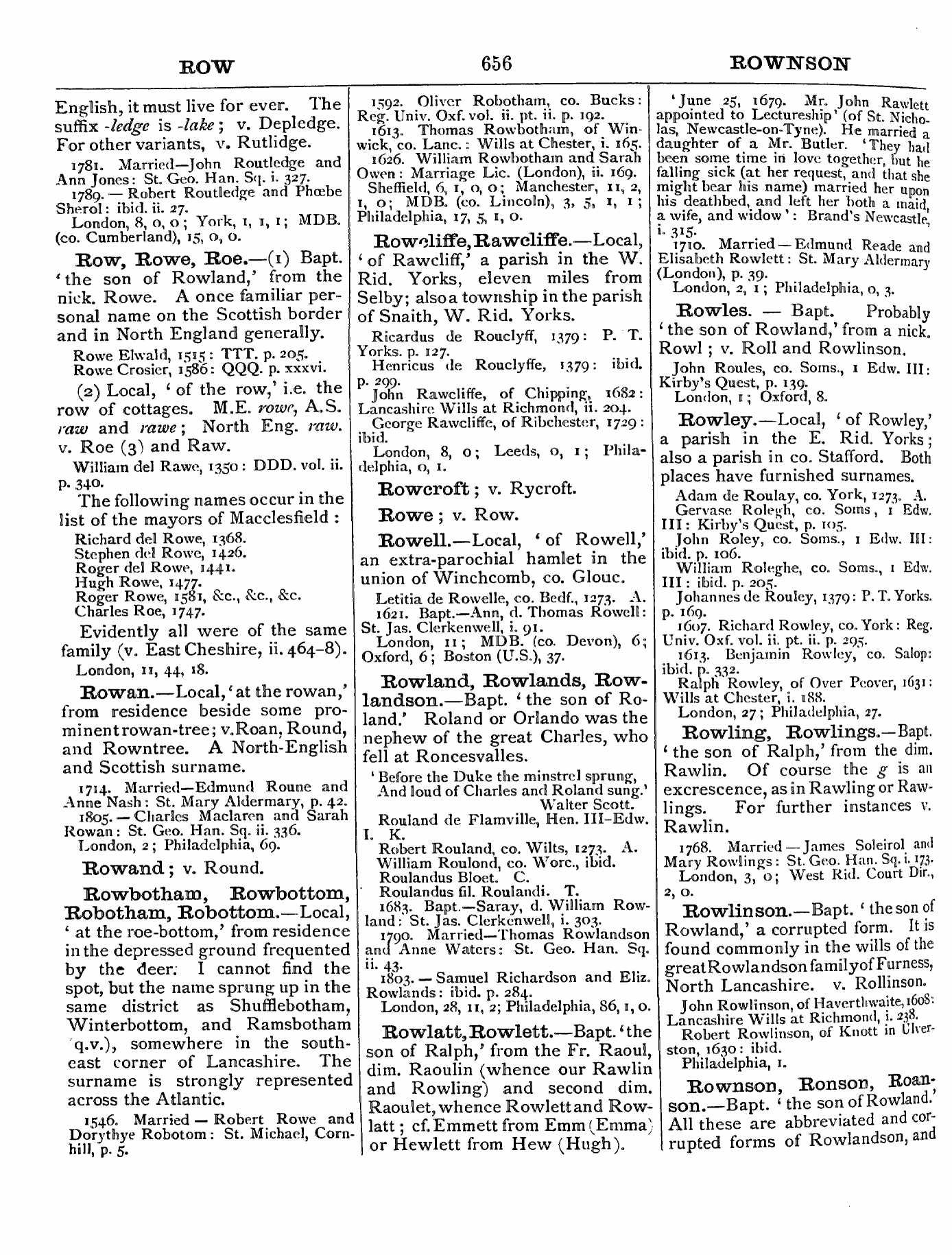
Record of marriage of Robert Routledge and Phoebe Sherol (ibid – Latin, meaning from the same place)
The suggestion here is that they both lived in London, but one may have originated in York and the other probably from Cumberland. There are records of Aaron Routeledge born in Chatham in 1806 and settling in Cumberland as a grocer, coal merchant, Hotel owner and Innkeeper. This raises the question whether the Routeledge family originated in Cumberland. There are no birth or baptism records of an Aaron Routelege that I can find from Chatham, but he was certainly a son of Robert Routeledge and Phoebe Sherol, as they were living in Chatham from 1802 as recorded in the Kent Poll of 1802. His marriage certificate to Sarah Hodgson in 1845 confirms his father’s name as Robert. There are numerous records of Aaron Routledge (sic) in Holme Cultrum, Silloth and Wigton where he was a well-known member of the Provincial Grand Lodge of Freemasons and hotel owner. He had 3 children, Phoebe (1847-1898) married Robert Marshall and had 2 children , John (1849-1876) and Robert (1853-?) married Emmeline Abram Longstaff and had 6 children, (2 died in infancy).
Phoebe and Robert were named after Aaron’s parents.
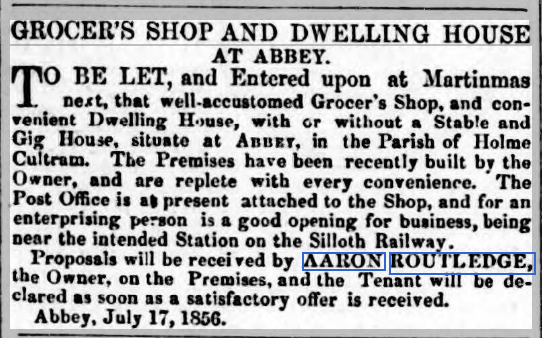
Cumberland Summer Assises, 1856
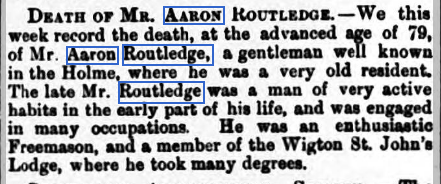
Wigton Advertiser 16 May 1885
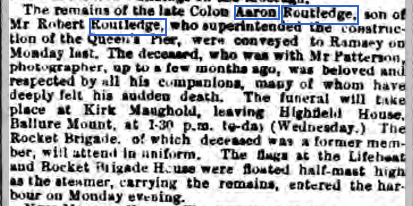
Isle of Man Times 3rd October, 1888
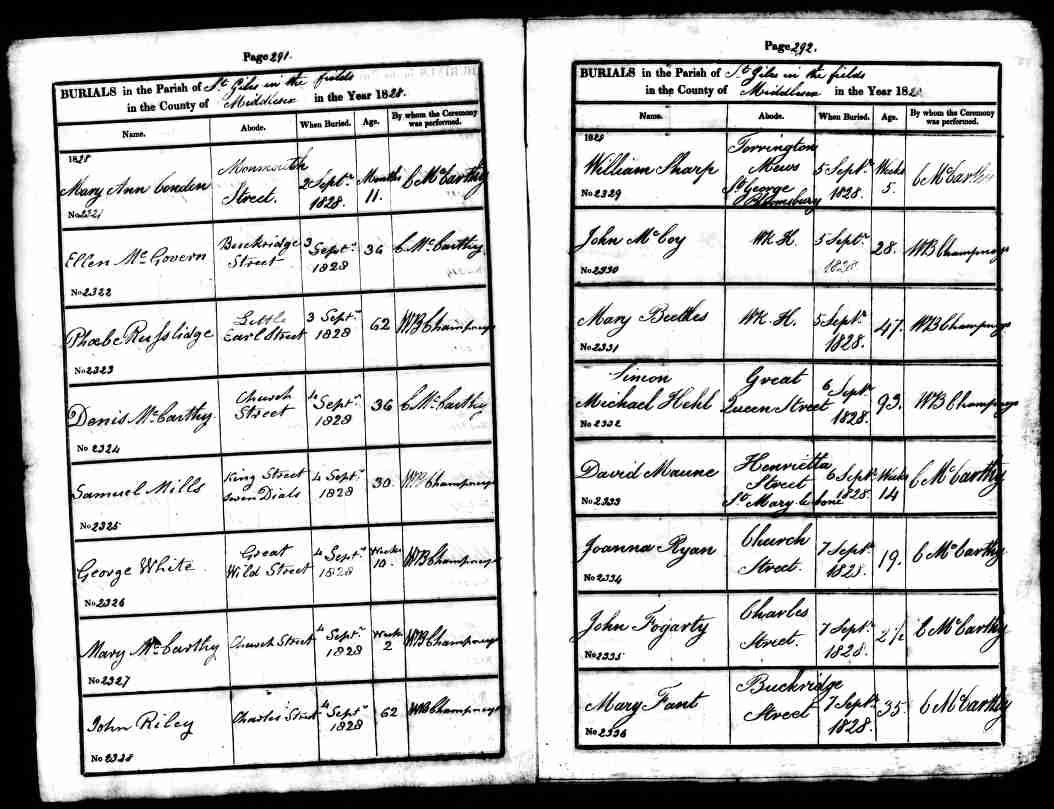
Death Record of Phoebe Sherol at Little Earl Street, 7-Dials
John Barrand did not immediately follow the occupation of his brothers William or Peter as a carpenter, but in the 1861 census however, he is shown working as a packing case maker. Like his elder brother Thomas, he was probable apprenticed as a Shoemaker as the parish records show him as a shoemaker in 1815, but it seems certain that he most likely gave up this profession, as he is then shown as a cheesemonger by 1818 and this is confirmed on the Parish Registers of the birth of his children, and also on the Parish Registers for 1819. John’s elder brother Thomas was also shown to be a shoemaker, for which we know he took an apprenticeship, and after completing his apprenticeship he also became a cheesemonger by 1820, and it is a certainty that they were in business together and, for some reason Thomas and John parted company around 1825, as Thomas once again became a shoemaker on the 1826 registers, leaving John alone with the business. Why John is noted as an egg salesman rather than a cheesemonger on the 1828 registers at the time of his daughter Phoebe’s birth is not known, but it is significant in that he was primeraly an egg dealer and merchant later in life as were two of his own children. There are clear records to show that John Barrand was living in Little Earl Street, Seven Dials in Westminster (see below) from the early 1820s until at least 1832, as a tenant. On the 21st December 1830, John was declared bankrupt at the Court-House, Lincoln Inns, Portugal Street and the bankruptsy petition in the London Gazette of 1830, confirms he was living at Little Earl Street, Seven Dials, Middlesex, and was employed as “An egg dealer and occasionally dealer in bacon and cheese.” At his bankruptcy hearing, John Barrand had to declare all his personal and business possessions including stock-in-trade and accounts to the Court House in Lincoln Inns, Portugal Street. The bankruptcy was noted in the London Gazette of 1830, and confirms he was living at Little Earl Street, Seven Dials, Middlesex, and was employed as “An egg dealer and occasionally dealer in bacon and cheese.” The event was also reported in Perry’s Bankrupt and Insolvent Gazette. Furthermore, on the petition he had to declare all his living dependants, and his family members were noted as Wife: Nancy Ann (nee Routledge), and children as Robert, Susan, John, George, Thomas, Arthur and James. No mention is shown of either Eliza or Phebe.
Eliza, was born on the 4th July, 1826 and died on the 18th July, 1828 and was buried in St. Anne’s Churchyard on the 23rd July, 1828. Phebe (also known as Phoebe) was born on the 7th July, 1828 and was buried on the 6th August, 1829 and the address here is quite clear – Little Earl Street. Quite clearly then, both Eliza and Phebe had died prior to the bankruptcy in 1830.
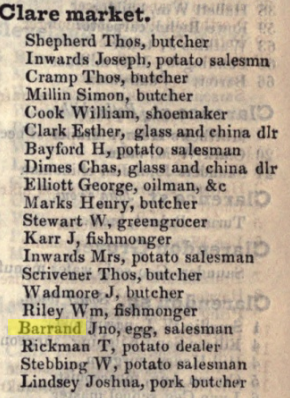
In 1839, John Barrand was on the paddle steamer, Starlight traveling on the river Thames and it was involved in an accident with a small boat in which two young boys were thrown from their craft and drowned. John Barrand was a witness in the inquest that followed. It is most probable that he was collecting the debts from the numerous hotel premises that bought eggs and cheese from his business along the river at the time. It is known that John had his business in Clare Market and the reputation of Clare Market is quite shocking. There are also records of John’s bankruptsy for a second time on the 1st April, 1842, also at the Court-House, Lincoln Inns, Portugal Street, but this time he is recorded as a “fishmonger,” but now living at Clare Market. Reported in Perry’s Bankrupt and Insolvent Gazette 1842. (p174) This is probably incorrect as he was still trading in eggs and cheese at the time.
Although John was declared bankrupt for a second time in 1842, he is still recorded in the 1843 Post Office Directories for London as as an egg merchant/salesman and his address is still Clare Market.
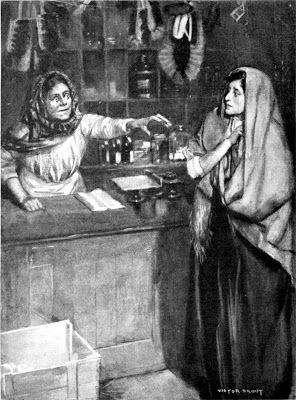
Typical of a shop in Clare Market
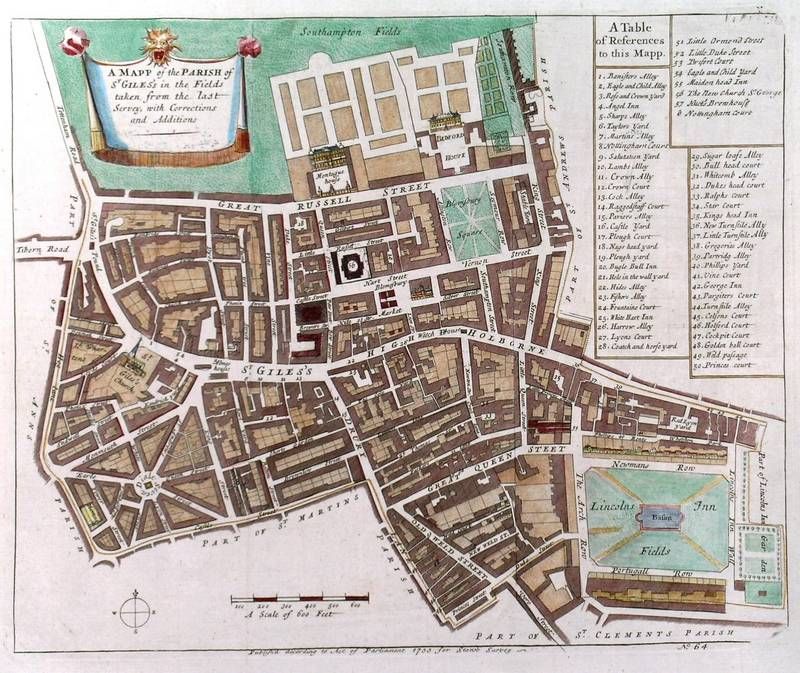
SEVEN DIALS Was an open area in the parish of St. Giles-in-the-Fields, on what was once known as "Cock and Pye Fields", from which seven streets, Great Earl-Street, Little Earl-Street, Great White-Lion-Street, Little White-Lion-Street, Great St. Andrew's Street, Little St. Andrew's-Street and Queen Street, radiate, and so called because there was formerly a column in the centre, on the summit of which were seven sun-dials, with a dial facing each of the streets.
From a Newspaper report of 1850: Seven Dials is a small but well-known road junction in the West End of London in Covent Garden where seven streets converge. At the centre of the roughly-circular space is a pillar bearing six (not seven) sundials, a result of the pillar being commissioned before a late stage alteration of the plans from an original six roads. However, in the early of 19th century, Seven Dials became a slum district of London. This locality is celebrated as the heart of one of the poorest districts in London. Nowhere within reach of the West-end of London can such a glimpse of the life of the poorer classes be obtained as on a Saturday evening at the Dials. If it is desired to see poor London, it is better not to go straight on, but to turn up any of the side streets. Here poverty is to be seen in its most painful features. The shops sell nothing but second or third hand articles—old dresses, old clothes, old hats, and at the top of the stairs of little underground cellars, old shoes, so patched and mended that it is questionable whether one particle of the original material remains in them. The walk through the Dials after dark was an act none but a lunatic would have attempted, and the betting that he ever emerged with his shirt was 1,000 to 60.
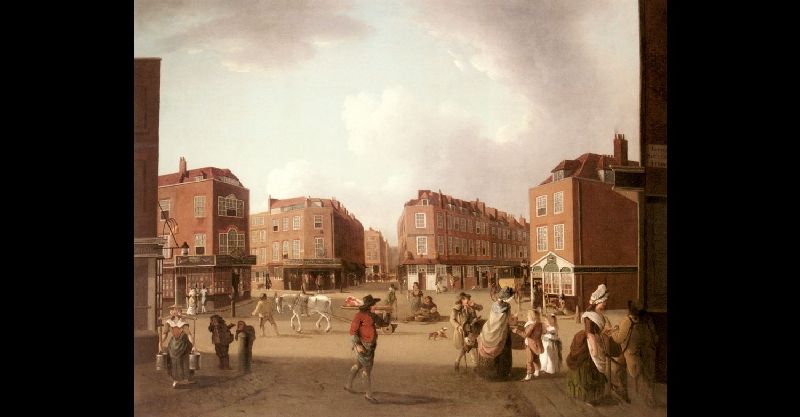
Seven Dials 1780


Robson’s Directory 1832
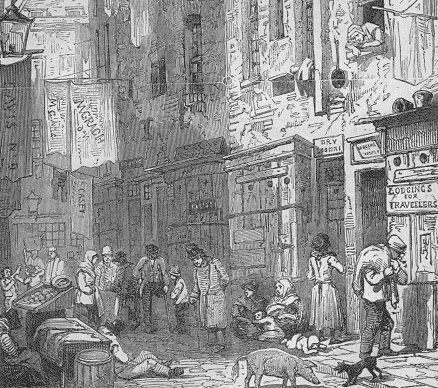
The image above is from Thomas Miller’s Picturesque Sketches of London 7-dials (1852)
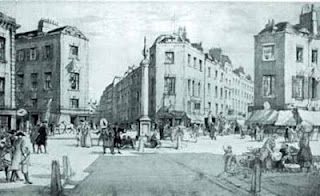
7 Dials 1860
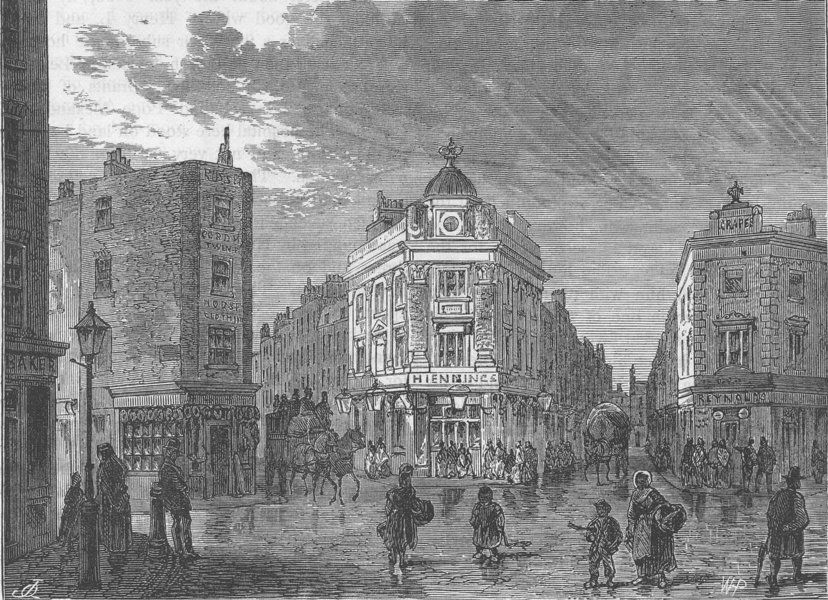
Seven Dials 1870 (Same location as above, but the centre pillar has been removed)
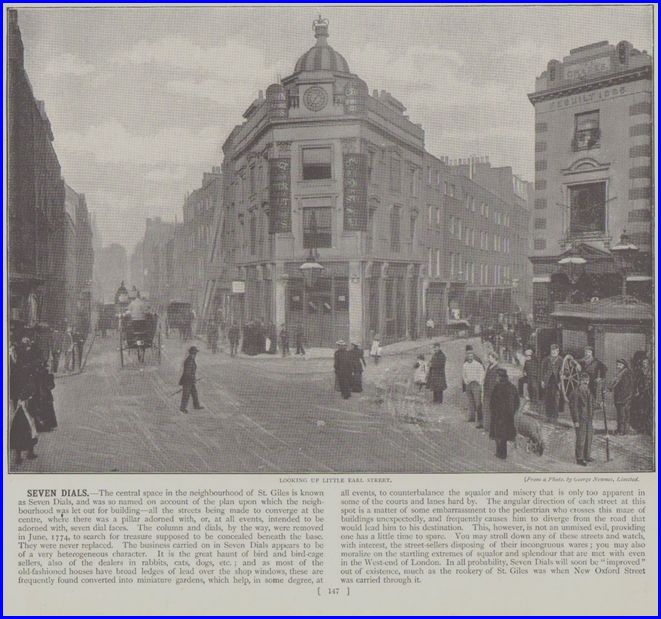
Little Earl Street
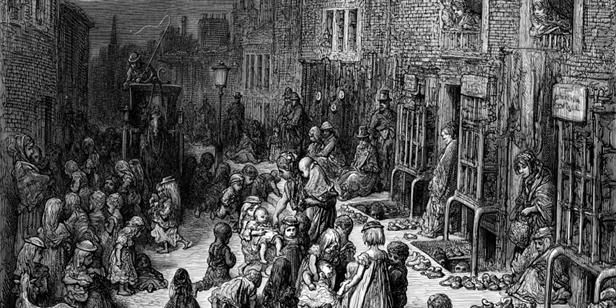
Dudley Street, 7 Dials 1872
It may be of interest to remember as previously mentioned, that John Barrand’s grandfather (John Barraud born 1729) had a brother, Francis-Gabriel Barraud (1727-1795) and when Frances Prevost (their mother) moved from Greenwich to King Street in Soho in 1743, Francis-Gabriel eventually married and originally set up home in the Seven Dials area of St. Giles. Frances Prevost stayed at the King Street, Soho address until her death in 1772, although she actually died at Shoe Lane, the next address of her son, Francis-Gabriel Barraud. Francis-Gabriel Barraud and Magdalen Crespin (his wife) had their first child in 1752 and the first known recorded address for them was Great St. Andrew’s Street, Seven Dials, in 1760. This street is now renamed Monmouth Street and runs from Long Acre to St. Giles High Street. It is clear that they lived there for several years until at least 1762 or 1763 when they then moved to 7, Shoe Lane, just off Oxford Street where he ran his business. In 1781 they then moved his business again to 8, Wine Office Court in Fleet Street.
By the middle of the 19th century, Soho had become an insanitary place of cow-sheds, animal droppings, slaughterhouses, grease-boiling dens and primitive, decaying sewers, and underneath the floorboards of the overcrowded cellars lurked a fetid sea of cesspits as old as the houses, and many of which had never been drained. In the summer of 1854 cholera spread throughout the area and in St Anne's Place, and St Anne's Court, in 1860 the open cesspools were still to be seen in the courts. No change has been made; so that here, in spite of the late numerous deaths, there were all the materials for a fresh epidemic. In some houses the water-butts were in deep cellars, close to the undrained cesspool. It was reccommended "the immediate abandonment and clearing away of all cesspools, not the disguise of them, but their complete removal." Nothing much was done about it and Soho was to remain a dangerous place for some time to come.
Extract of a letter from a resident in Soho to the Times Newspaper 1849:
“We live in muck and filthe. We aint got no priviz, no dust bins, no drains, no water-splies, and no drain or suer in the hole place. The Suer Company, Soho Square, all great, rich and powerfool men, take no notice watsomedever of our cumplaints. The Stenche of a Gully-hole is disgustin. We all of us suffur, and numbers are ill, and if the Colera comes Lord help us.”
St. Ann's Churchyard, Soho.
The Church was opened around 1687 when the parish of St Anne was formed from part of St Martin in the Fields parish. It was a pleasant open space (enclosed by an extraordinarily hideous fence, presumably to keep out undesirables) in a busy London Street. With just ½ acre, it is estimated that in this small ground and the vaults under the church 110,240 bodies were interred during 160 years. The ground level is at shoulder height compared with the pavement outside, which gives some indication of the number of burials here. Bodysnatchers with grapplers and pickaxes were apprehended here in 1806. Five of the gang of six got away. The body of a woman and child were found in the ground 'in a state to be carried away'. (The Times February 20th 1806)
There is only one burying ground belonging to this parish; it is walled in on the side next to Princes Street; close to this wall is the bone house; rotten coffin wood and fragments of bones are scattered about. Some graves are only partly filled up, and left in that state, intended, probably, for paupers. The ground is very full, and is considerably raised above its original level; it is overlooked by houses thickly inhabited. The inhabitants of the neighbourhood have frequently complained of the past and present condition of this place. The numbers of dead here are immense.
(Walker 1839)
From Pages 395-417, it may be remembered that John’s sisters, Elizabeth Barrand (Who married John Stead) and Ann Barrand both lived in Princes Street, Soho around this time, and must have been witness to the squalor and the burials at this church.
Certainly, on the marriage certificates of John’s children, in 1841, 1844, 1846 and 1852, John Barrand is described as an Egg Merchant rather than an egg salesman, so kept that profession and seems to have up-graded from an egg salesman to an egg merchant. It is also known that John eventually became a packing case maker, and that was first shown in the 1860s, after the bankruptsies in 1830 and 1842. On the first census for 1841, John is shown as an Egg Dealer (not a merchant), living at No 6, Clare Market with his wife, Nancy Ann Routeledge and three of their children, Thomas, James and Alfred. On the 1851 census, John is then described as a labourer, renting the house at 7, Duke Street, but then he is shown on the 1852 marriage certificate for his son James, described now as an Egg Merchant. His son, Alfred was a chronometer box maker at the time of his death in 1854 and probably making cases for the Barraud family, as the Barrauds were makers of chronometers, it is highly possible that John was also in a similar trade as a case maker at the same time. It is most probable therefore that John may well have also trained as a carpenter like his elder brothers. In 1861, he is now shown as a widower, as his wife, Nancy Ann had died of a heart attack in 1857, and he seems to have completely abandoned the trade of Egg Merchant and became a packing case maker but still living in Duke Street.
It is perhaps also a coincidence that in the 1861 census, there was a Marion (or Maria or Mary Ann) Barrand (born around 1820) living at 18, Duke Street although she originated from Lincolnshire. Mary (or Maria/Marion) was a daughter of a Joseph Barrand and Mary Joslin. She was still living in Lincolnshire in 1839 as she witnessed her sister's marriage on the 19th November, 1839. She had an illegitimate daughter, called Becky or Betsy or Elizabeth (born in 1839-1842) in London, but the father is unknown and unfortunately, I cannot make any direct connection between the London Barrands with the Lincolnshire Barrands. There is no record of Betsy's birth in London and the various census records have Betsy's birth between 1839 and 1842, and she never married. She lived with her mother until Mary Ann's death in 1907. Mary Ann, Betsy's mother was a shareholder in the Great Western Railway and a Mr. Reuben Green inherited the shares after her death. Betsy's estate was administered by Fanny Wells, her cousin who also came to live in London from Lincolnshire.
The address of 7, Duke Street, Lincoln Inns for John Barrand is correct, because this is also the address where Nancy Ann (Routeledge) was living when she died of a heart attack on the 25th October, 1857. The death certificate of Nancy shows she died of a diseased heart and kidneys and the certificate was subject to the coroner’s report. She was aged 64, so that suggests her DOB was 1793 and not 1795. Although John’s occupation is shown as a packing case maker, on his own death certificate he is described as a carpenter on that of Nancy Ann. Death Ref: St. Giles 1857 - 4th Qtr (1b - 261)
John Barrand stayed at 7, Duke Street until 1870 when he moved to Chelsea, and is found on the 1871 census living with his daughter, Susan and her husband, William Baskett in Earls Court Road. John was still working as a labourer even at the age of 80. John died on the 13th December, 1871 of celulitis (skin infection) and chronic bronchitis in Chelsea at the age of 80, and his daughter, Susan Baskett was present at the death. The Death Ref: Kensington 1871 - 4th Qtr (1a - 94)
The 10 known children of John Barrand and Nancy Ann Routeledge are:-
Robert (b 1815), Susan (b 1817), John, (b 1818), George R (b 1820), Thomas (b 1822), Arthur (b 1824), Eliza (b 1826), Phoebe (b 1828), James (b 1830), Alfred (b 1834) There is also a possibility of another child, Joseph, born in 1819 but unlikely as there is no mention of Joseph on the bankruptsy records.
JOHN BARREN – BARRON Male
Event(s):
Birth: 12 JUN 1791
Christening: 17 JUL 1791 Saint Mary-St Marylebone Road, Saint Marylebone, London, England
Parents:
Father: THOMAS BARREN
Mother: SUSANNA
Source Information:
Batch No.: Dates: Source Call No.: Type: Printout Call No.: Type:
C035243 1791 - 1793 0580906 Film 6903614 Film
IGI Record of the birth of John Barren (Barrand)
Here we are in the Seven Dials:
When the streets were built around 1700, they were designed to be the “best in the city”, and several conditions were placed on the builders to encourage the “better-off” to either rent or buy the properties.
The builders were not permitted to lease their houses “to any person ... who shall exercise therein ... the trades or misteries of a Common Brewer, Butcher, Melter of tallow, Soapboyler or a tobacco pipe maker...', the activities of whom might create noise, smell and risk of fire and thus deter genteel occupants. The original residents were all men of substance, though not the highest ranks of society. The original occupants were a cross-section of merchants, gentlemen and better-off tradesmen. The first batch included, a merchant, a Ship’s Captain, many gentlemen, a grocer, a distiller, a victualler, a lawyer of the Middle Temple, a gunsmith, a haberdasher, a carpenter and a timber merchant. Some of the houses were taken in groups as investments. For instance, Robert Winter, a wax chandler, took five houses in St. Andrew Street and five in King Street which he sub-let. The social respectability of Seven Dials was short-lived however, as the layout came to be seen as confused and cramped rather than novel. The houses were progressively divided into lodgings and the area became increasingly commercialized from the 1730s and the 1740s. At least three buildings had become public houses by that date.
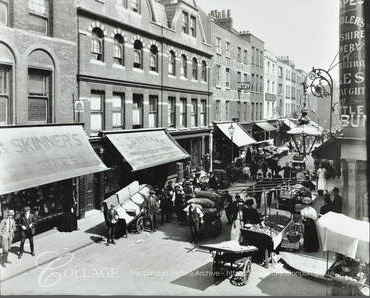
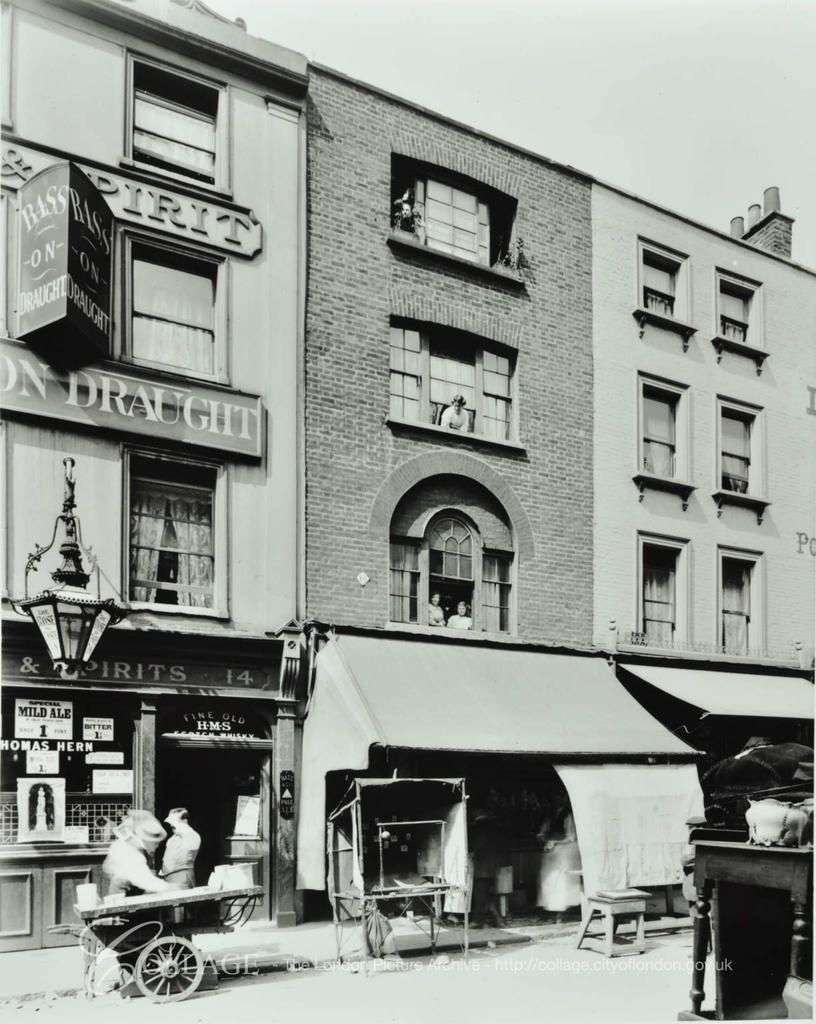
Little Earl Street looking East (Approx 1908)
From an account of 7-Dials:
We will enter these streets and peep into those dark, close, tin- healthy, and forbidding-looking rooms. In this narrow alley a dusky twilight reigns throughout the sunny noon of day. We have to feel for the staircases which open on either hand; and now we have found one, we will grope our way through this land of gloom and shadows. What a dead smell floats around us! a close noisome air, such as arises from an overcrowded vault, even more death- smelling than many a vault we have in our day visited. The staircase is encrusted with dirt, a kind of black greasy mud, which has been trampled into toughness, not unlike what covers the city streets after rain or snow in winter; but "that" is "clean" dirt in comparison to this, for here we tread upon old filth, and the accumulation of it and it may have been there for years; for by the side of the staircase, where it is least trodden, it is mildewy and mouldy. The smoke of our cigar is the only wholesome aroma that rises amid these stifling roams. Even the strong sweet-smelling May-blossoms would struggle in vain to disperse the poison of this motionless air.
Now we have reached the room, we cannot see what forms are before us, so little light streams in through that "dirt-ditched and cobweb-covered casement, which appears as if it were never opened, as if they knew that the noisome air was better kept out than in. There is no ventilation, no "thorough-draft" through any of these miserable rooms; the walls are damp through so many breaths, for where the moist air falls there doth it rest, hanging like cold beaded drops on the brow of one who wrestles sternly with death. It must have been many years since these apartments were either painted or whitewashed; a black grey hue pervades every thing, as if the very atmosphere had itself grown dark through hovering here so long and motionless, as if it were compelled to stand and sicken between the stench from below and the black vapours above - the one arising from the foetid cellars, the other hurled down by the rain from the soot-covered roofs-exhalations of the earth earthy - of the sewer sewery - of the filth filthy - poison ever propagating poison - gutters ever generating deadly gases, and creeping into the blood of the inhabitants; and yet strange, in spite of its filth, this neighbourhood was passed over lightly by the "fell destroyer," compared to others which he ravaged during the last dreadful epidemic. There they had tended the sick couch, and through those dilapidated doorways carried out their dead.
Those cabbages which the man is piling up in the corner are the unsold remainder of to-day's stock; he will strip off the outer leaves in the morning to give them a fresh look: they will also be eaten on the morrow, in spite of the poisonous exhalations they are steeped in. He will sleep beside them all night; the man with the three dogs will share his bed, and perhaps the dogs themselves may find a couch amongst the cabbages. The woman who has just brought in that bundle of filthy rags (too late to be sold to-day in the market) is also a lodger, and will no doubt make a pillow of her dirty burden. That pile of shavings, sacking, straw, and rags will be dragged out of the corner, and one will lie down here and another there, and for a few hours bury their miseries in forgetfulness. How so many manage to sleep in one apartment, especially in hot weather, is only known to themselves. In the bleak bitterness of the chilling winter we can picture them crowding together for warmth. But we must retreat; for we find a difficulty in breathing,
and here we are again in the filthy street; for they have no backyards into which to throw their refuse, so must either keep it to putrify and decay in the overheated rooms, or throw it out, and let their neighbours go "share and share alike" in the sights and smells which pervade the uncleansed neighbourhood. True, there is a man employed to clear away the garbage; but, when this is done, they have no water, saving what they beg, and not a drop can they spare to wash down the gutters. Wherever a sunbeam alights, you see it steaming with the filth, and behold the golden ray dimmed with the vapoury and deadly exhalations. Yet these poor people are not naturally dirty. From many of the windows you see their tattered garments hanging out to dry, though, from the colour, you have a difficulty in persuading yourself that they have ever been washed, and come to the conclusion that they are only hung there to be aired.
Many of the door-posts are worn smooth and bright, through the idle loungers, who have rubbed and rested against them while smoking and looking out into the streets, hour after hour, and day after day,- men who seem to have no business upon earth, having to smoke and sleep, and when they awake, to smoke and lean against the self-same doorways until it is time to sleep again. On the steps, and on the edges of the pavement, or at the entrance of those unexplored courts, withered old women sit with folded arms scowling at you as you pass. All are not idle, be it remembered, who frequent such haunts as these; many have seen "better days," and only fell because they possessed not fortitude enough to struggle against unfortunate circumstances. Others had never been taught any trade, and when they lost such situations as ten thousands were capable of taking, they never raised their heads again, although they went many a weary day, week, and month afterwards in quest of employment, returning at night to sleep in such dens as we have here described, sick and sad at heart. At length their attire became too shabby for their admission into respectable houses only to ask for employment, and then they sank with a kind of sullen recklessness amid the filth and squalor of St. Giles's, and from that wretched state never emerged again.
Thomas Miller, Picturesque Sketches of London Past and Present, 1852
Name: John Barron
Baptism Date: 17 Jul 1791
Parish: St Marylebone
County: Middlesex
Borough: Westminster
Parent(s): Thomas,
Susanna
Record Type: Baptism
Register Type: Parish Register
Transcript of Parish Register of the birth of John Barron (Barrand)
.
| John b 04/11/1752 d 1830 - 1840 Frances bc 1753 d 14/02/1831 = c 1778 William Potter b 1750 d 1818 Thomas bc 1755 d 1810 = 22/06/1781 Susan Cook bc 1752 d 1822 James b 1756 d 1756 Mary b ? d ? = 20/05/1783 John Jones Sarah b 1761 d 1833 James Mather b 1761 d 1823 Mary Turpin b 1732 d 1821 John Barraud b 1728 d c 1765 Re-married in 1772 to William Pether = 12/12/1772 William b 1760 = 29/05/1803 Margaret Callow b 1764 d 1837 = 04/03/1783 = 27/11/1752 Elizabeth b 1763 d 1827 Thomas b 1783 d 1836 Peter Cook b 1785 d 1839 Elizabeth b 1787 Ann b 1789 d ? John b 1791 d 1871 Joseph b 1793 d 1839 Eliza Cook b 1795 = 11/11/1804 Sarah Eliz. Took b 1780 d 1852 = 05/09/1810 Eliz. Corry b 1784 d 1837 = 15/11/1812 John Stead b 1778 d ? Ann Routeledge b 1795 d 1857 = 27/03/1827 Eleanor Page b 1795 d 1845 = 24/08/1815 James Able b 1779 d 1849 William b 1782 d 1835 = 06/04/ 1804 Alice Young b 1774 d 1833 = 29/11/1813 Robert W, b 1815 d 1839 Thomas b 1822 d ? Emigrated = 16/02/1846 Caroline Anderson b 1826 Arthur b 1824 d 1854 (Eliza) b 1826 d 1828 Phoebe b 1828 d 1829 James b 1830 d 1914 Alfred b 1834/36 d 1854 John b 1818 d 1867 Emma Lash b 1829 d 1894 = 09/08/1852 George Richard b 1820 d 1872 Emma Chivers b 1825 d 1890 = 19/05/1844 = 16/03/1841 Eleanor West b 1821 d 1859 Susan b 1817 d 1876 William Baskett b 1818 d 1899 = 09/12/1844 | ||||||||||||
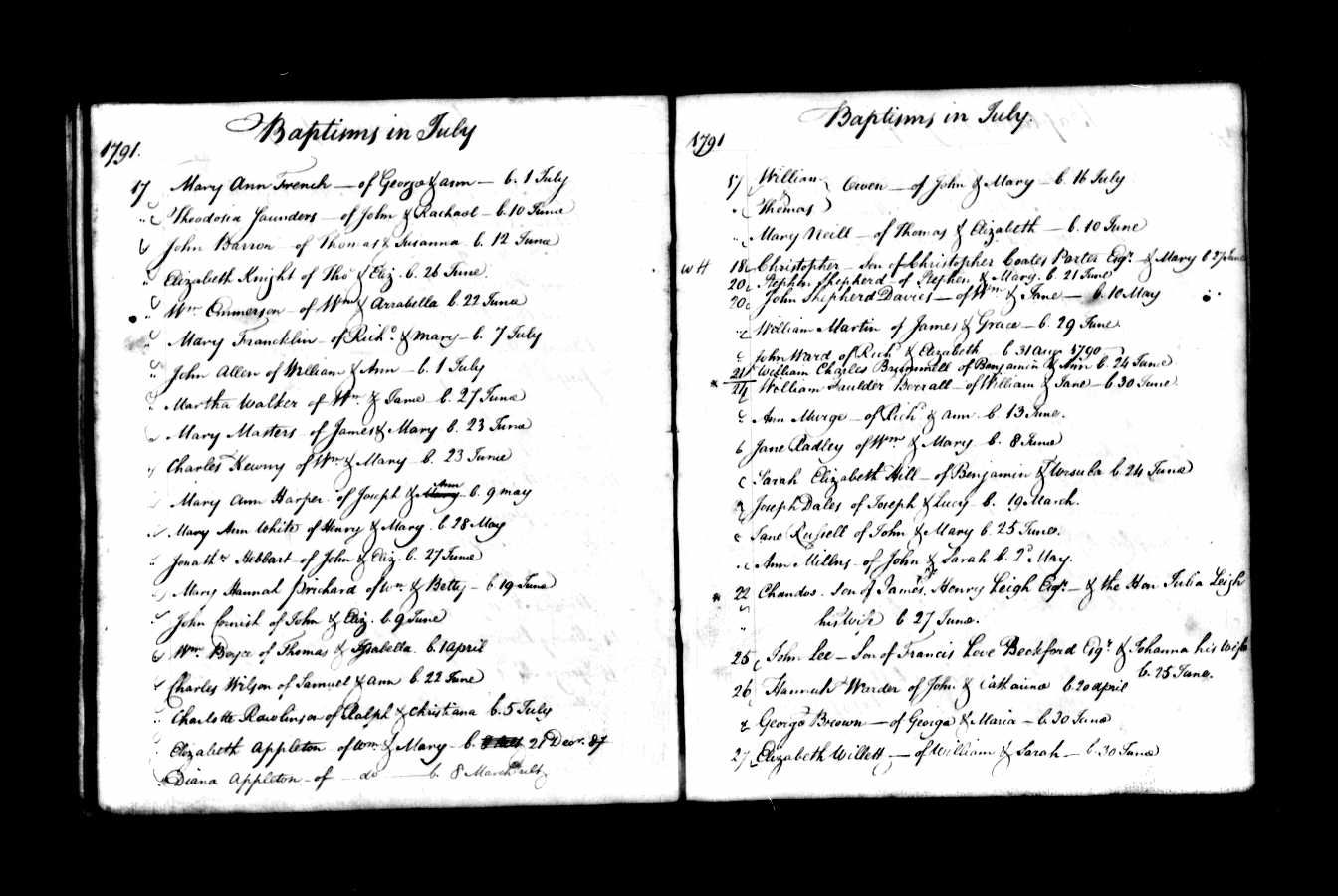
Baptism record for John Barrand
John Barrand Male
Event(s):
Marriages:
Spouse: Nancy Routledge
Marriage: 14 NOV 1813 St. Marylebone, London, England
Source Information:
Batch No.: Dates: Source Call No.: Type: Printout Call No.: Type:
I031452 Film
IGI Record of the marrage of John Barrand and Nancy Routledge
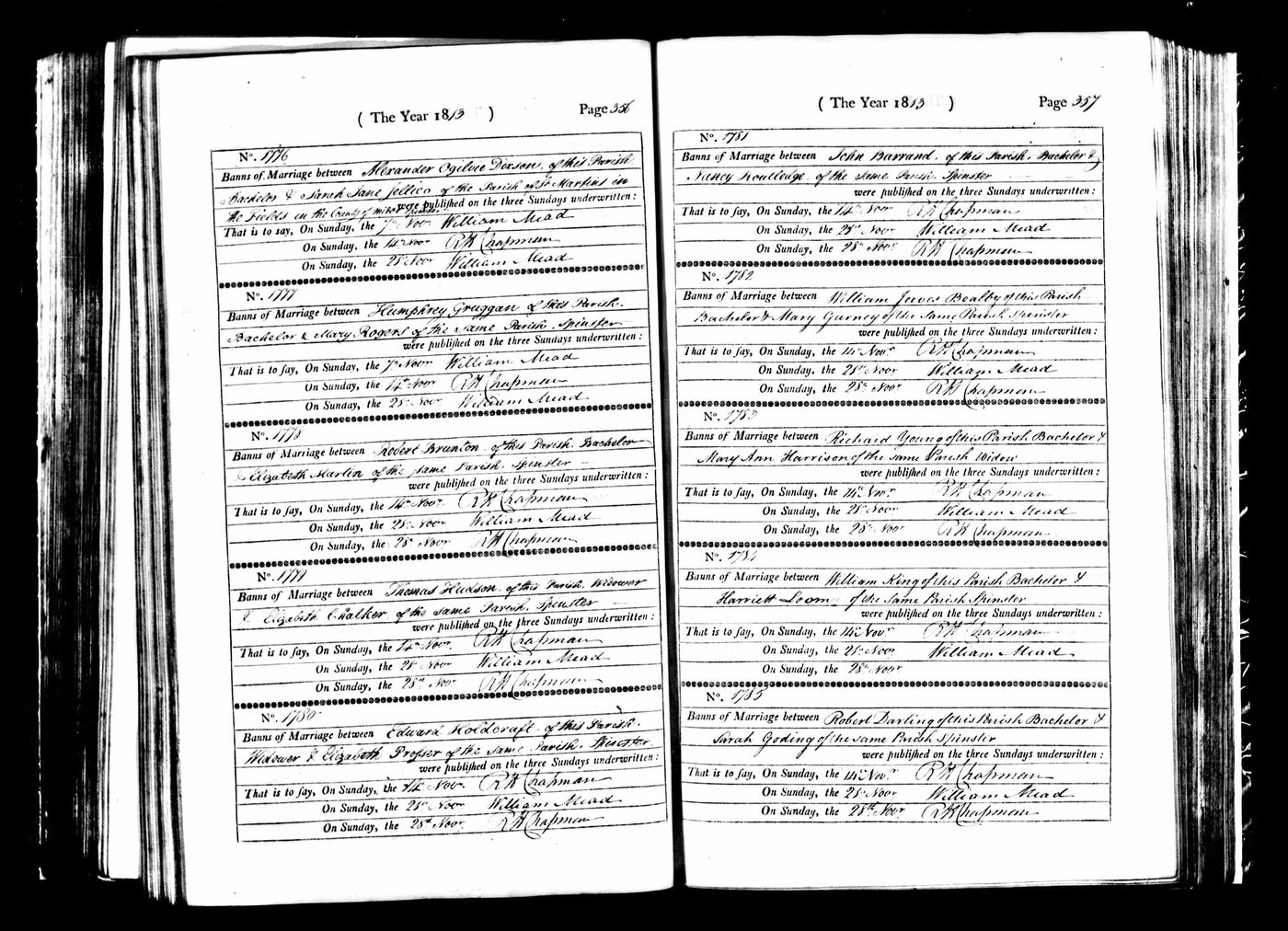
Banns record of John’s marriage to Nancy Routeledge
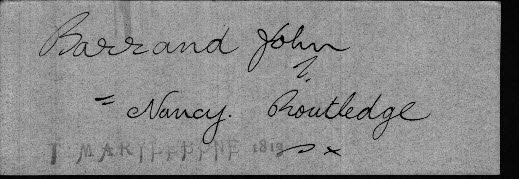
Pallots record of John’s marriage to Nancy Routeledge
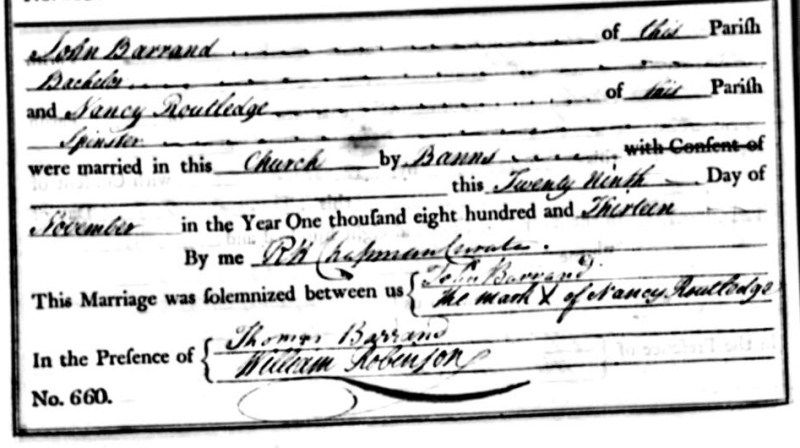
Marriage certificate of John Barrand and Nancy Routeledge
| 1815, living at Little Chapel Street | |||
| 1817, living at 25 New Brompton Street - Cheesemonger | |||
| 1830, living at 25, Little Earl Street - Cheesemonger | |||
| 1841, Living at 6, Clare Market - 38 people in the same house | |||
| 1850, Living at 18 Air Street | |||
| 1851, Living at 7, Duke Street | |||
John Barrand England, Westminster Rate Books
| Name: | John Barrand |
| Event Type: | Tax Assessment |
| Event Place: | Westminster, Middlesex, England |
| Event Date: | 1840 |
| Address: | 6 Clare Markett |
| Note: | Poor Rates 1840-1841 |
Joh. Barrand England, Westminster Rate Books
| Name: | Joh. Barrand |
| Event Type: | Tax Assessment |
| Event Place: | Westminster, Middlesex, England |
| Event Date: | 1840 |
| Address: | 6 Clare Market |
| Note: | Poor Rates 1840-1841 |
John Barrand
England, Westminster Rate Books
| Name: | John Barrand |
| Event Type: | Tax Assessment |
| Event Place: | Westminster, Middlesex, England |
| Event Date: | 1850 |
| Address: | 18 Air Street |
| Note: | Rate Books 1850-1851 |
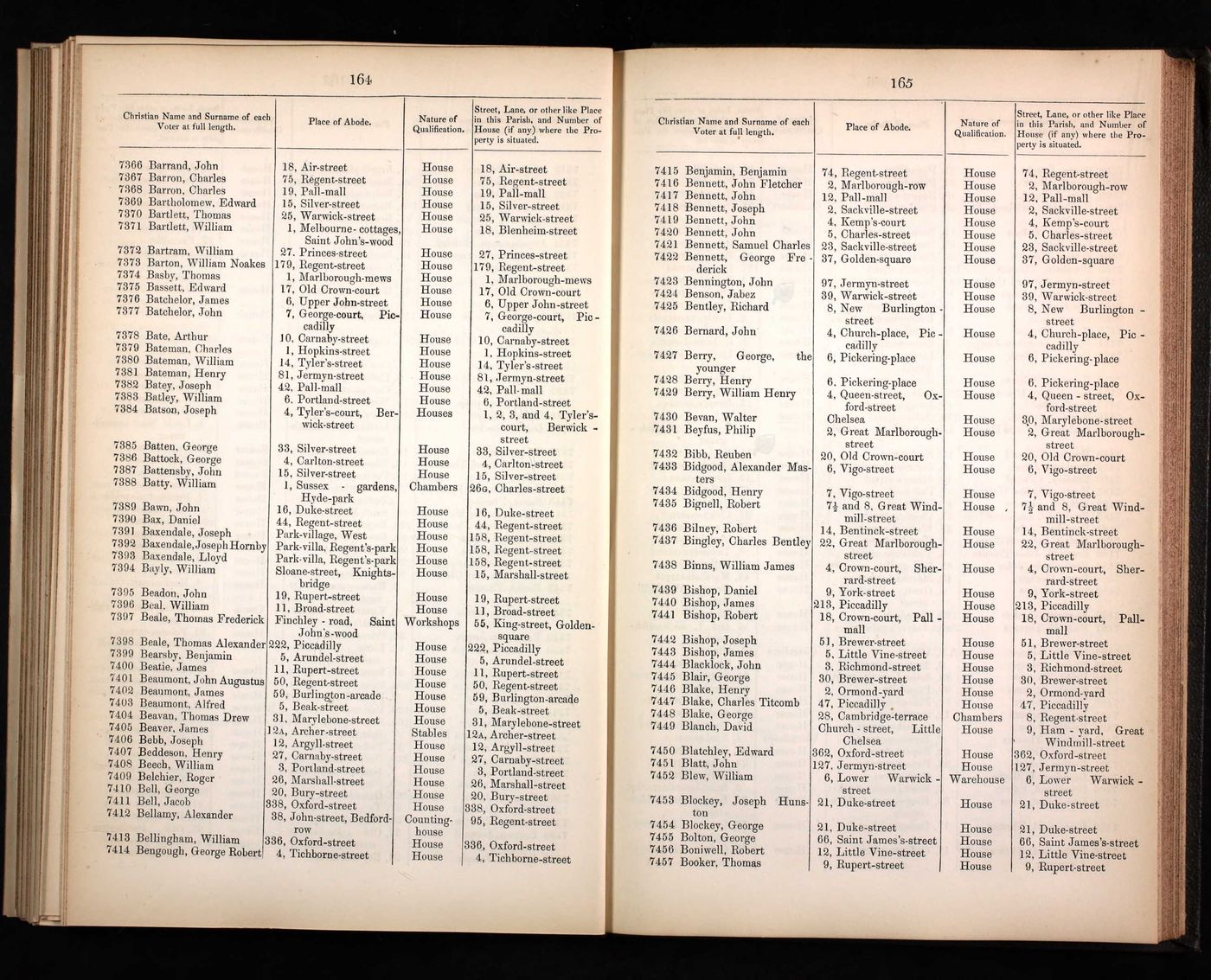
Record of John Barrand at 18, Air Street 1850
969. MARY HAGAN was indicted for stealing, on the 6th of March 1828, 1 shift, value 1s., and 1 frock, value 1s, the goods of John Barand .
NANCY BARAND . I am the wife of John Barand; we live in Little Earl-street, Seven-Dials . I was in my parlour on the evening of the 6th of March; I heard a noise, went out, and found the prisoner at the foot of the stairs - I had known her some years; these things laid at her feet - they had been taken off a line; I asked what possessed her to take them; she said if I would forgive her, she would never do the like again, and fell on her knees.
JOHN GREEN. I am an officer, and took the prisoner. (Property produced and sworn to.)
Prisoner's Defence. I went there to inquire for a person, who I was told lived there, and as I came down stairs this lady came out - she brought down these things, and said I had taken them off the bannisters.
GUILTY. Aged 34.
Confined Three Weeks.
Transcript of Court record 1828
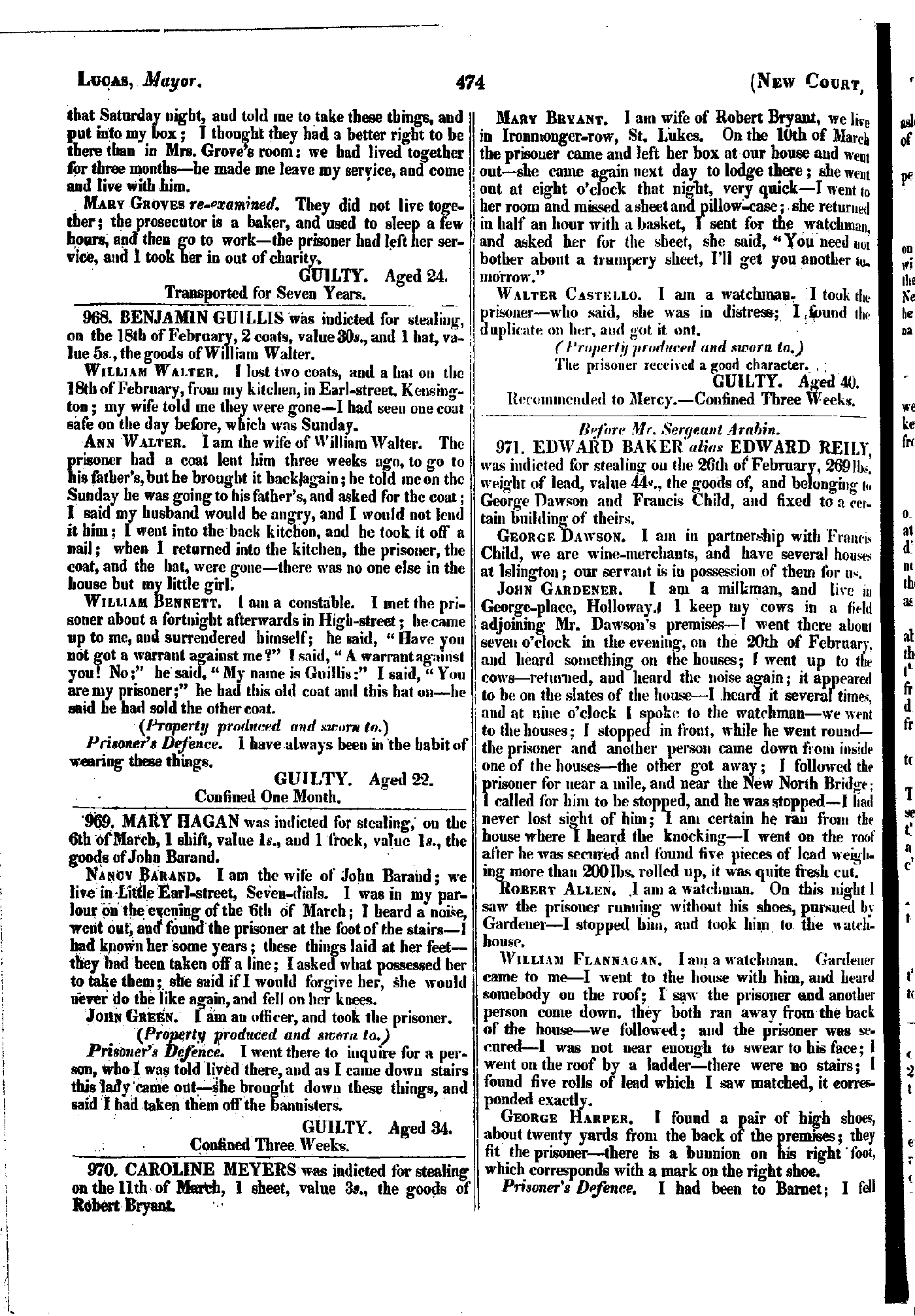
Original Court Papers – Old Bailey 10th April, 1828
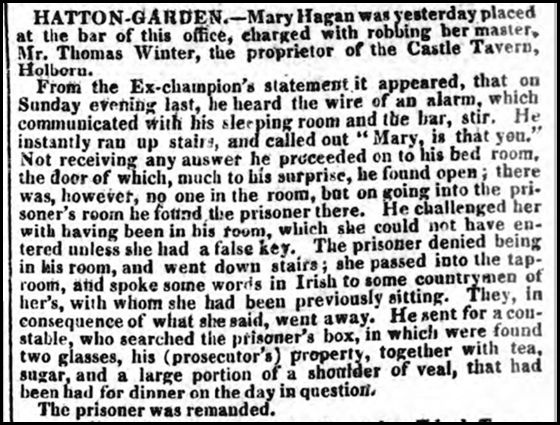
Morning Advertiser 13 May 1829 Further record of Mary Hagan
Juvenile Delinquency.— Susan Gartridge, a good-looking girl, about 13 years of age was brought before Mr. Burchill, charged with stealing a Cheddar cheese, the property of Mr. Barrand, wholesale cheesemonger, in Clare Market, Drury Lane. George Holmes, police-constable 252 M, said that about six o'clock he saw the prisoner carrying a cheese up Vere Street, and, suspecting she had stolen it, he stopped her and asked her where she got it from. She replied that she had just picked it up, and was carrying it home. He took her to the station-house, and afterwards ascertained that the cheese had been stolen from Mr. Barrand's warehouse. William West, a warehouseman in Mr. Barrand's employ, said that between four and six o'clock three cheeses were stolen from their cellar. The flap was partially open to admit the air. In answer to the charge, the Prisoner said she picked up the cheese in the street, and was carrying it home, when the constable stopped her. The Officer here informed his worship that another girl was with the prisoner when he first saw her, but she escaped. The prisoner also gave him a smart chase before he was able to secure her. Since then he had made inquiries about her, and found that she had left her mother and was living at Castellan's lodging-house, Falcon-Court. Mr. Burchill observed that he had some recollection of that lodging-house. It used to be the resort of the worst of characters, and the house of call for garotters. The Constable said that bad characters were in the habit of frequenting that house, and he had reason to believe that the robbery was concocted there. The Prisoner declared that she had not left her mother's residence, and she was about to take the cheese there. Holmes said that he had seen the prisoner's mother that morning. She was an industrious, hard-working female, and she positively told him that her daughter had run away from her weeks ago. The keeper of the lodging-house also told him that she had lodged there for some time. Mr. Burchill said there could be no doubt as to her companions; and if she did not alter her course of life she would soon be overtaken by misery and disease of a most frightful character. He should sentence her to three months hard labour in the House of Correction, and he hoped that would have a beneficial effect on her.
London Standard October 29, 1829
It is noted from the above newspaper article that John Barrand had a warehouseman called William West. William West was a son of Solomon West and Eleanor Routeledge (a sister of Nancy Routeledge). John Barrand and Nancy Routeledge had a son John, and he married Eleanor West (daughter of Solomon West and Eleanor Routeledge) Both John Barrand and Eleanor West were witnesses to the marriage of William West and his wife Charlotte Shrewbridge on the 16th April, 1854 in St. Pancras Church. John Barrand and Nancy took-in several of the younger children of Solomon West after Solomon’s death in 1832.
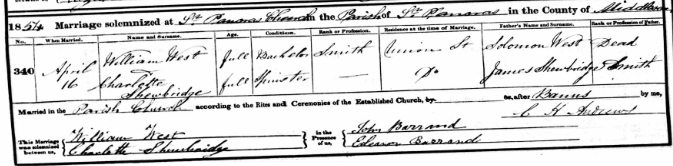
Marriage of William West and his wife Charlotte Shrewbridge
A William Thomson was sentenced to be transported for seven years for obtaining two firkins of butter from Mr Barnand (sic) a cheesemonger in Clare Market under false pretences.
20th June 1829, Page 4 London Standard
Inquest on James Rogers and Henry Hay – two young boys drowned in the Thames (John Barrand was a witness)
T h e Adjourned Inquest on Henry Hay . —
Wednesday night an adjourned inquest was held at the Savoy Palace, Savoy-street, Strand, before Mr. Higgs, the coroner for the Duchy of Lancaster, and a jury of 14 gentlemen, resident within the precinct of the Savoy, to further prosecute an inquiry into the circumstances attendant upon the death of Henry John Hay, aged 18, an apprentice at Messenger office who, together with youth, named James Rogers, also employed in the same office, who was unfortunately drowned, by being run down by the Starlight steamer on the evening of the 14th inst.
—Mr. Barrand, of Clare-Market, egg merchant, stated that on Wednesday evening, the 14th instant, he went on board the Starlight at about half-past eight o’clock, and arrived off Somerset House about a quarter to nine o’clock. The steam-boat was in a line with the third arch of Waterloo Bridge. He then perceived a boat containing two persons shoot through the third arch, and bear down towards them. Witness called out “There is a boat ahead,” as did several other persons on board. The captain, or some person acting in that capacity, was standing on the paddle-box, and he called out “Ease her,” “Stop her,” and then he jumped down and came to the head.
These instructions were attended to at that time the boat was nearing the steamer very fast, and the tide was running down fast. The steamer then had scarcely any way, and the boat in which the deceased was ran against the steamer, the collision was slight on the starboard bow, and witness does not consider the accident would have terminated fatally if the boys in the boat had kept their seats; but when they rose she lurched over, and they both sank, one of them holding on to the steamer only a few seconds. The captain endeavoured to catch one of the deceased, and afterwards opened the paddle flap to see if either of them clung to the wheel. The boat then floated down, and the steam-boat had backed astern as far as the Thames Police Station.
—A Juror: For my part, I think that the verdict ought to be manslaughter against the people navigating the steamer.—
Mr. Gibbins, of Bartlett’s buildings, who gave evidence on a former occasion, was again recalled, and said that the evidence given by the last witness was, in some respects, in contradiction with that he (the witness) had given. He would again assert that the conduct of the parties connected with the steam-boat was highly reckless and insolent. The solicitor to the company here observed that it was wrong of the witness to impute such conduct to the company. Had the witness seen that a denial had been made publicly by Mr. Adams, the money-taker, that no such observation as “Serve ’em right” had fallen from him, for he was then at home ?—Mr. Gibbins said he was aware such notice had appeared, and he believed the young man who spoke to him was not the regular money-taker.——
Mr. Barrand, in reply to a question put to him by the solicitor, said in his opinion more precaution could not have been taken by the persons in care of the boat than what was taken. The crew to witness's belief consisted of three men and a boy.
London Planet August 25, 1839
The Starlight, Thames steamer, ran against Westminster Bridge - Sunday evening, and sank before she could reach the pier. Fortunately, it was low-water, so that the vessel was not quite submerged; and the passengers got ashore by means of planks.
London Magnet 3rd August, 1844, Page 6
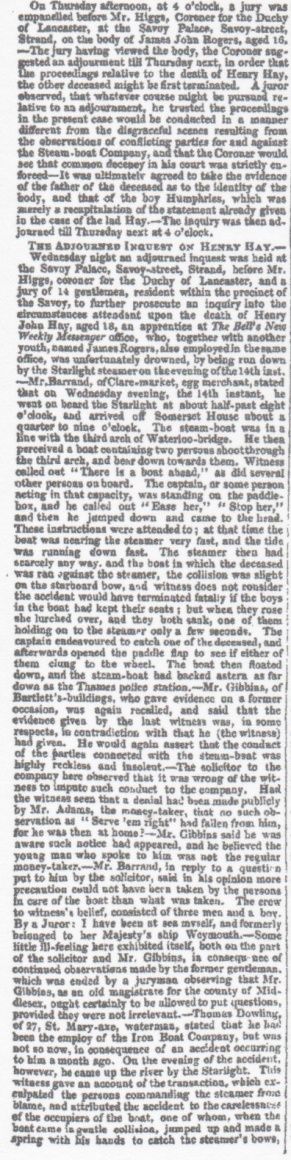
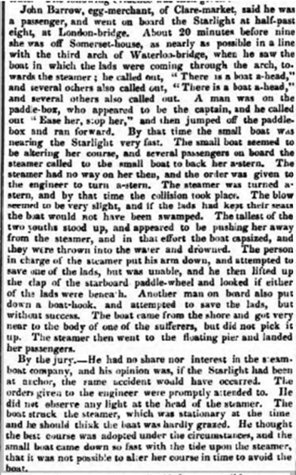
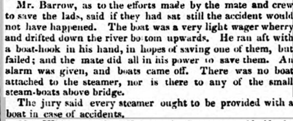
Morning Advertiser 22 August 1839 + Bell's Weekly Messenger 24 August 1839
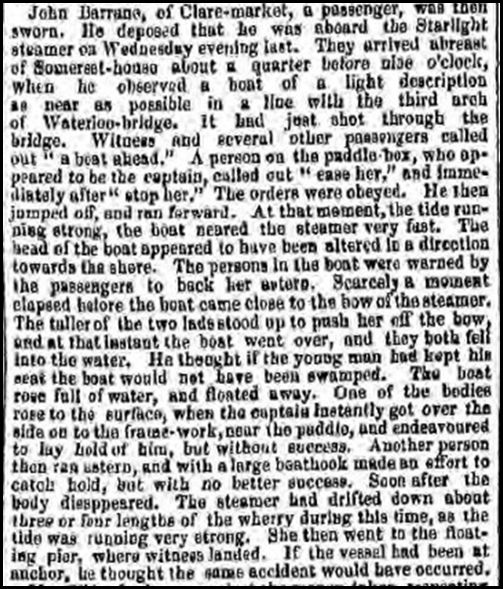
Morning Chronicle 22 August 1839
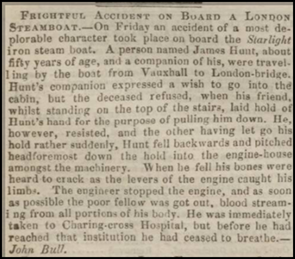
Manchester Courier and Lancashire General Advertiser 10 March
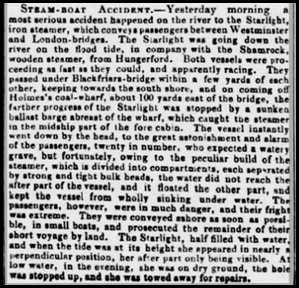
Morning Advertiser 29 March 1839
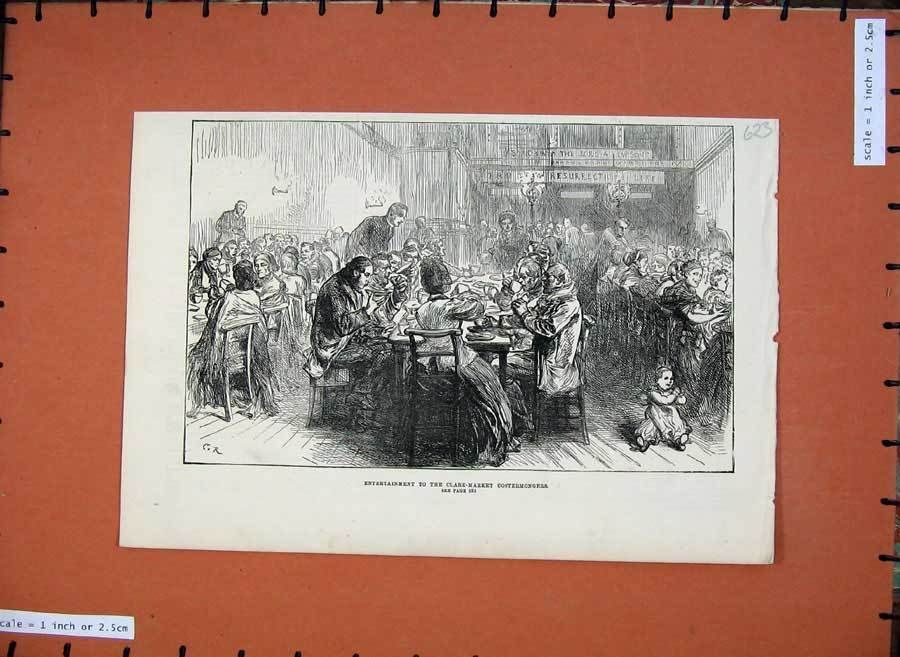
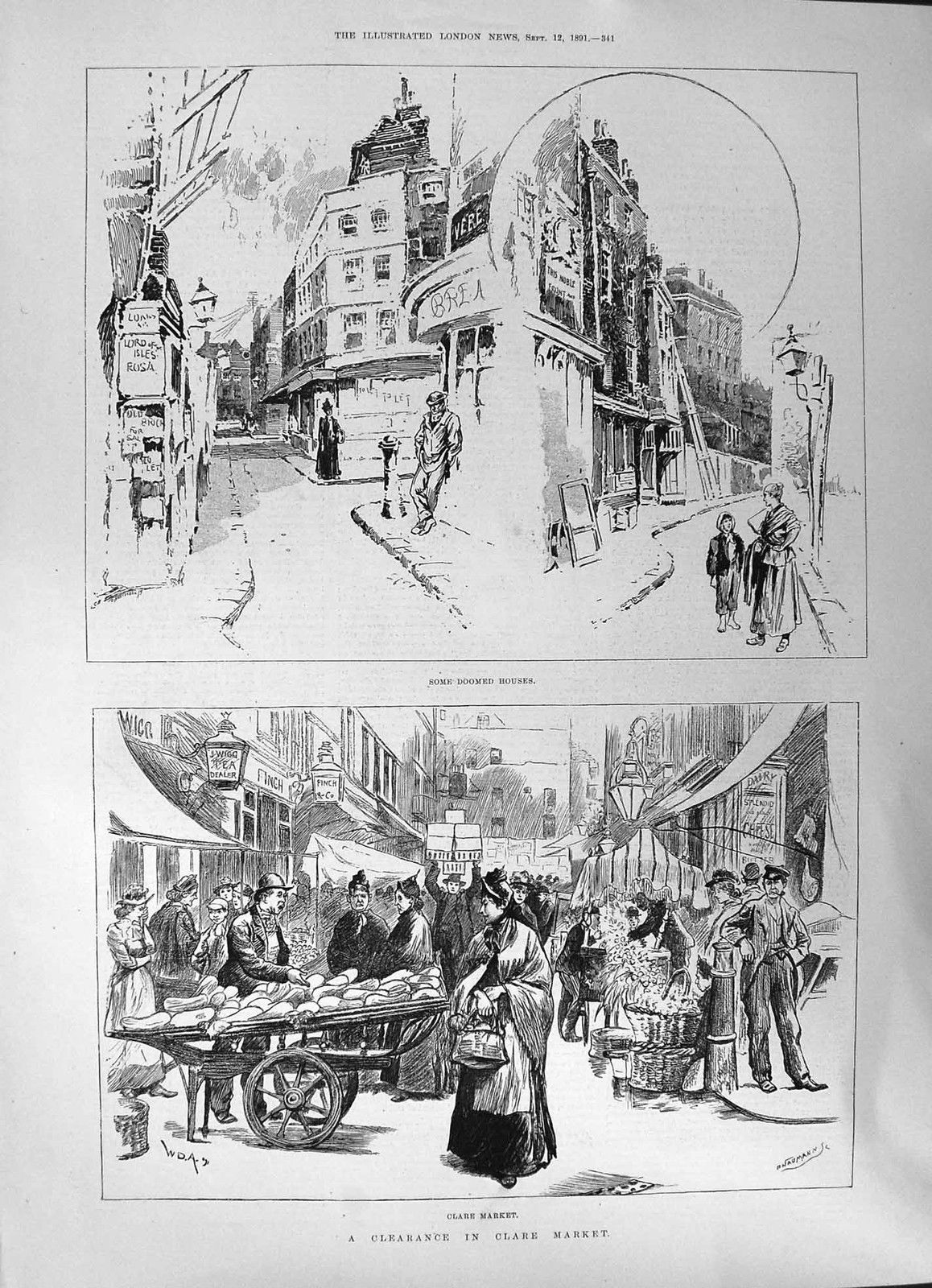
Images of Street life in Clare Market
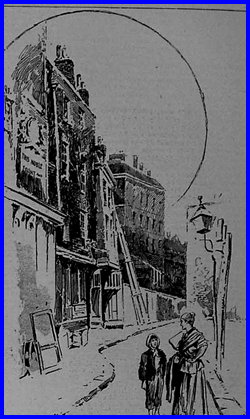
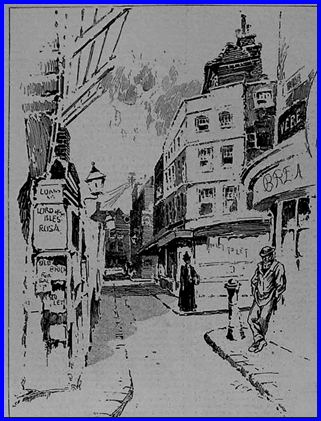
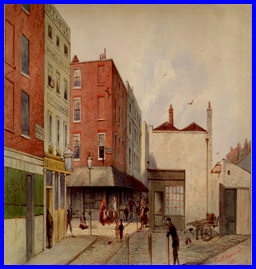
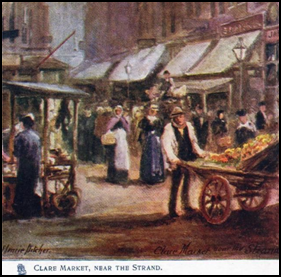
Images of Clare Market
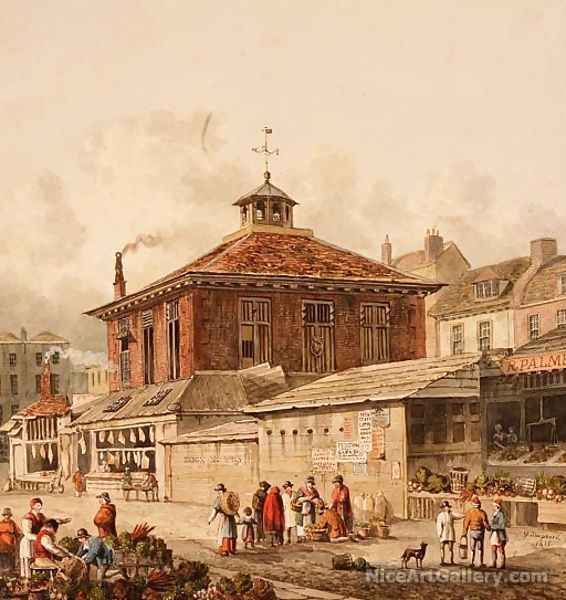
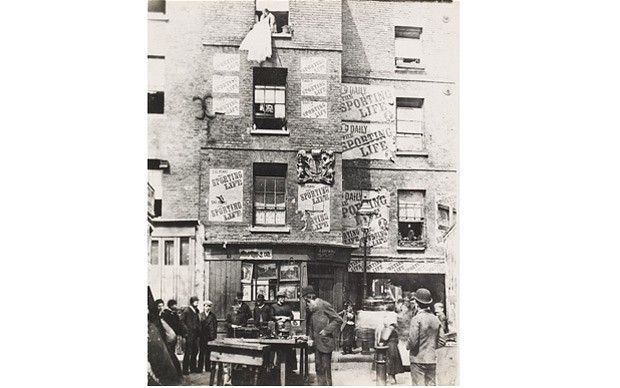
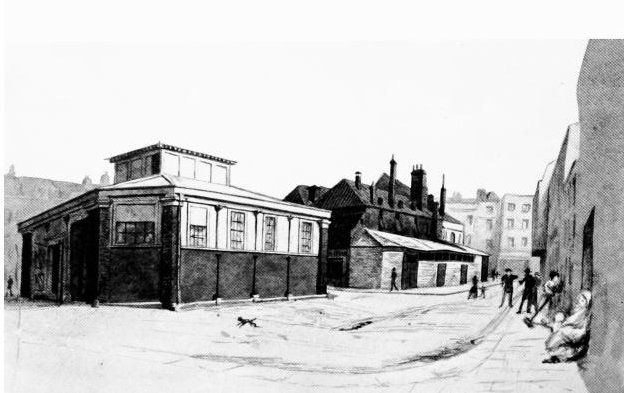
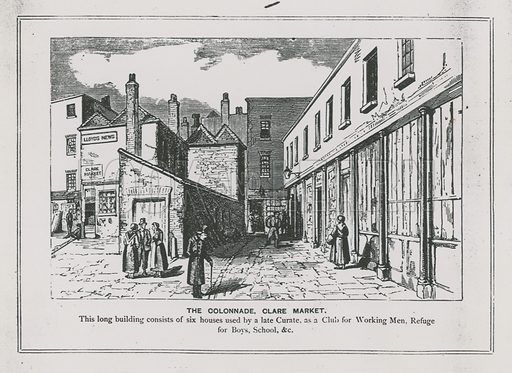
Images of Clare Market – Colonnade
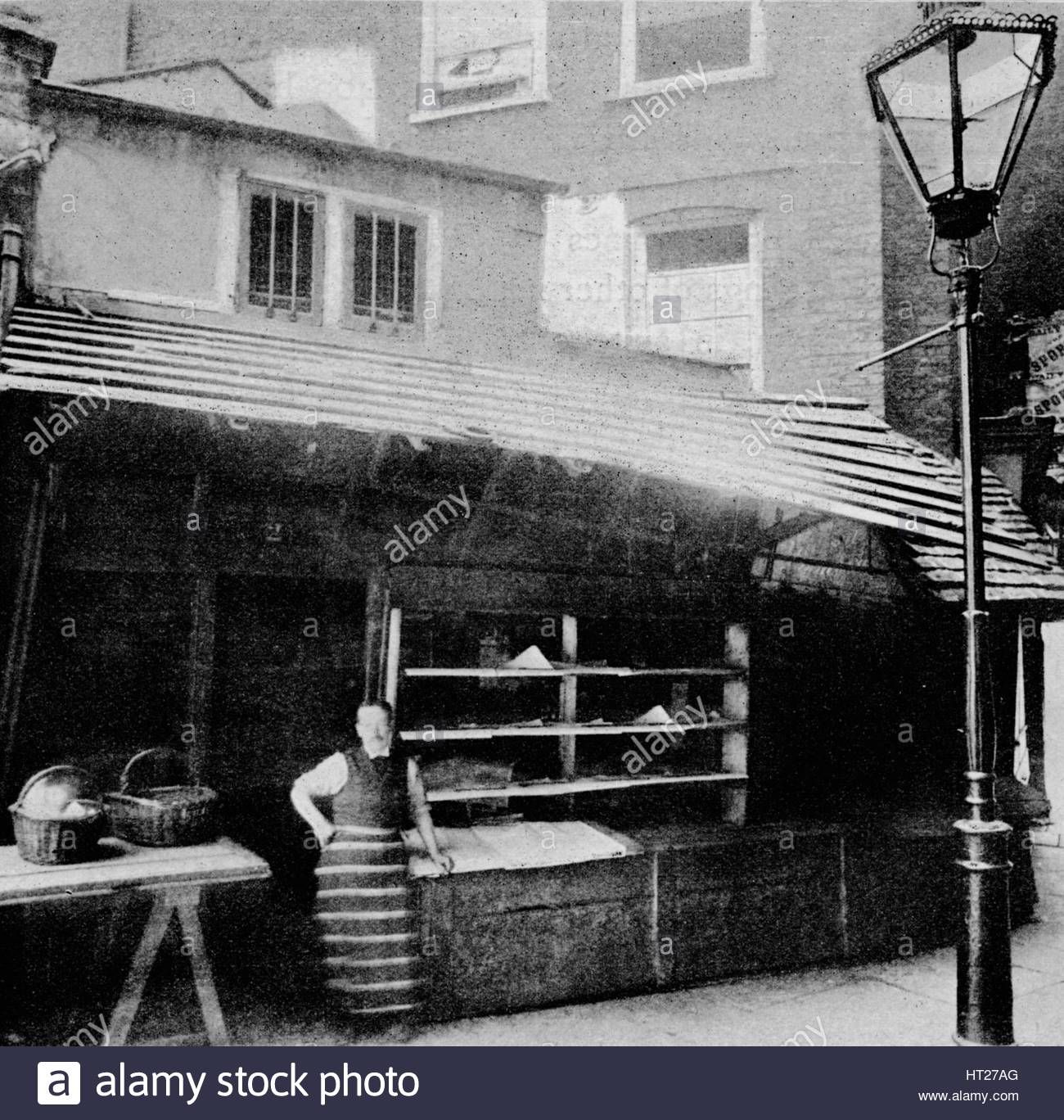
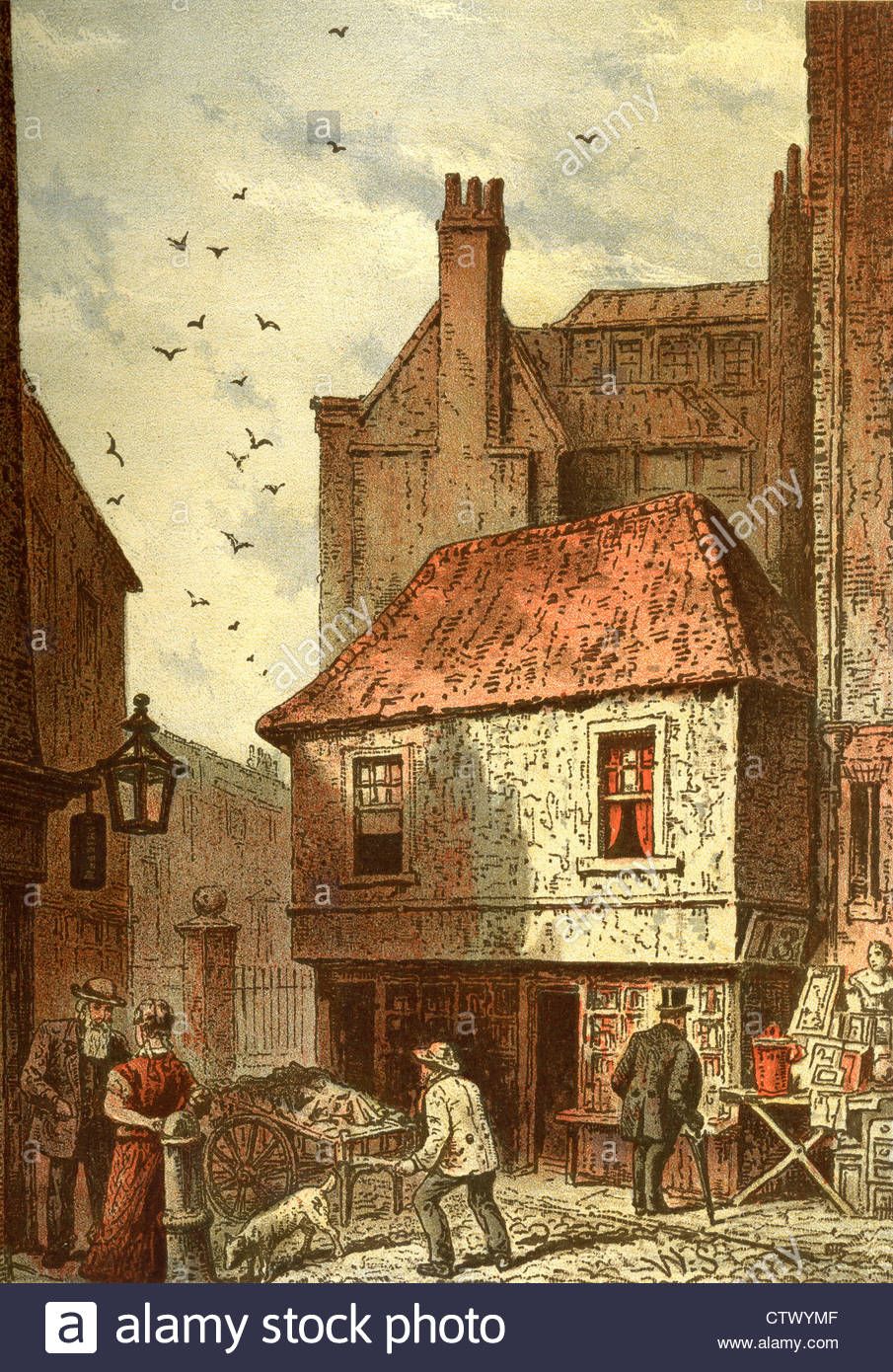
Shop, Clare Market, London, since demolished, 1895
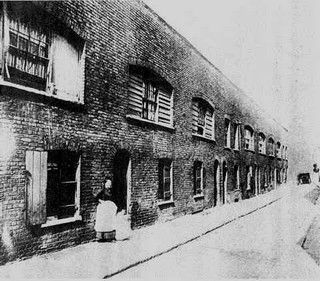
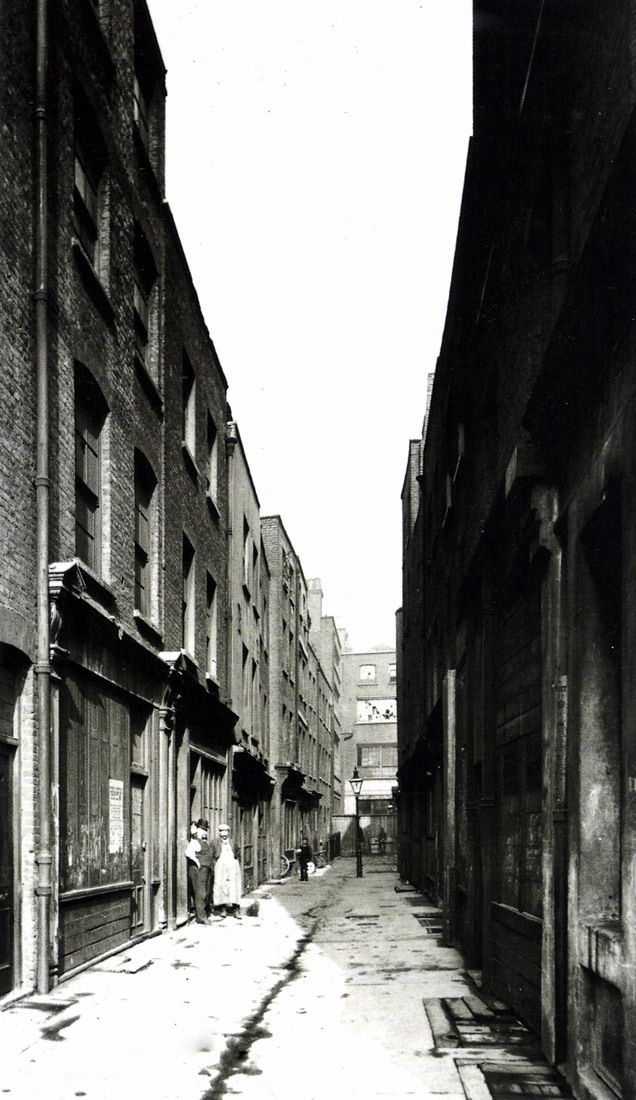
Clare Market, London Clare Court
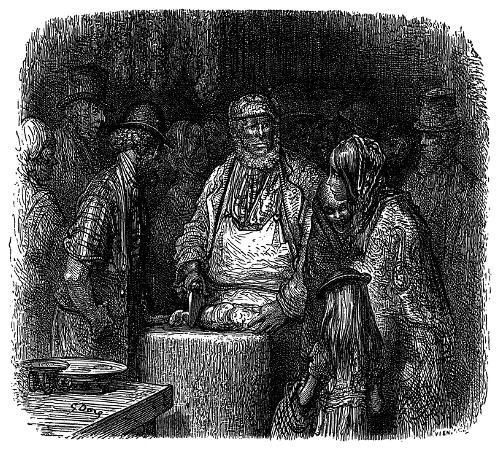
Butcher’s shop in Clare Market
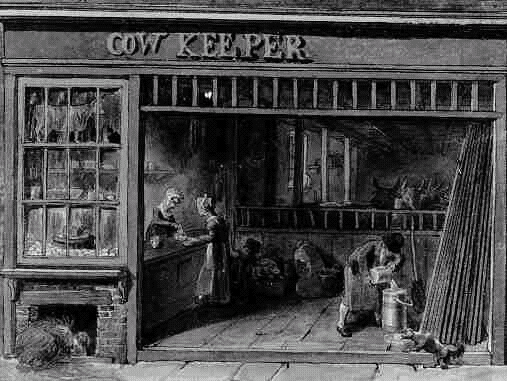
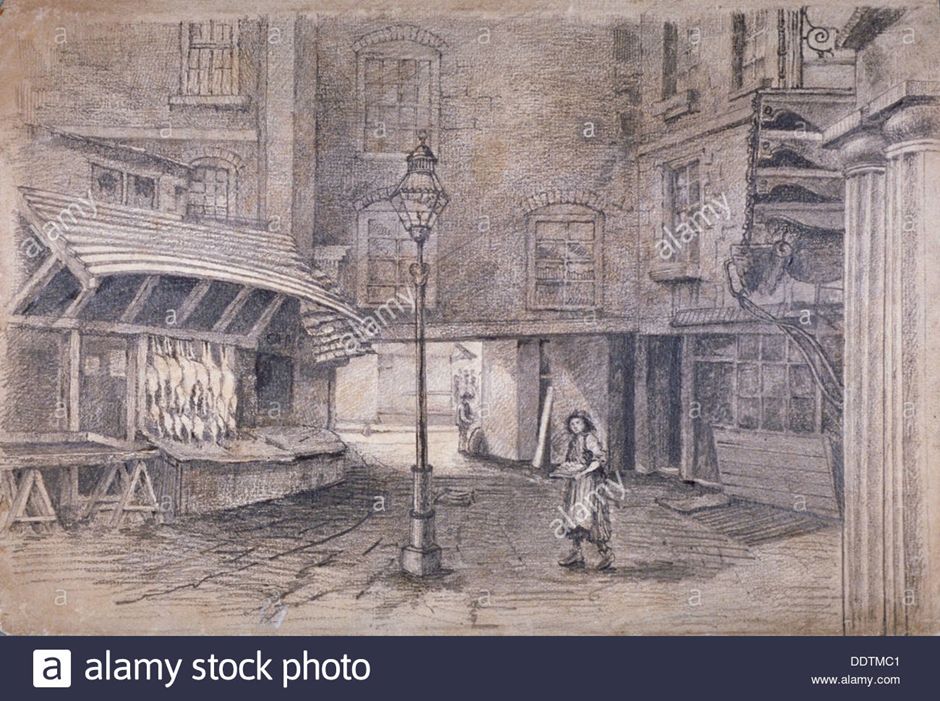
Shop in Clare Market Poulterer’s Shop, Clare Market
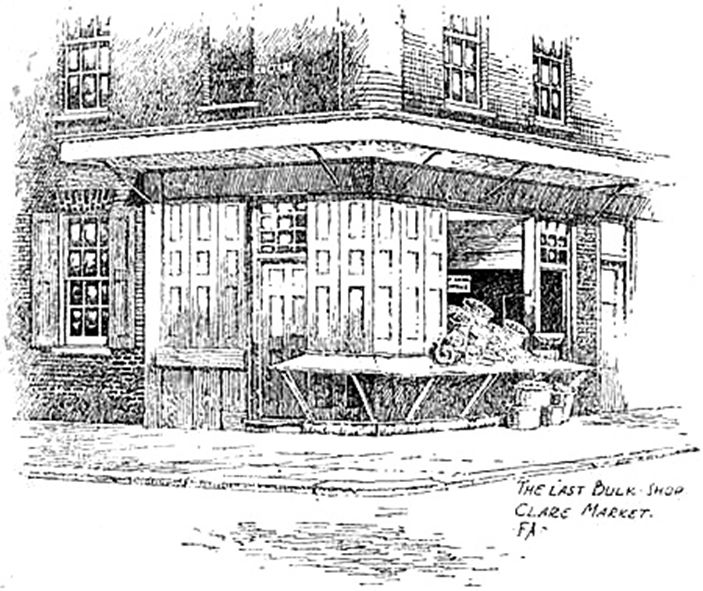
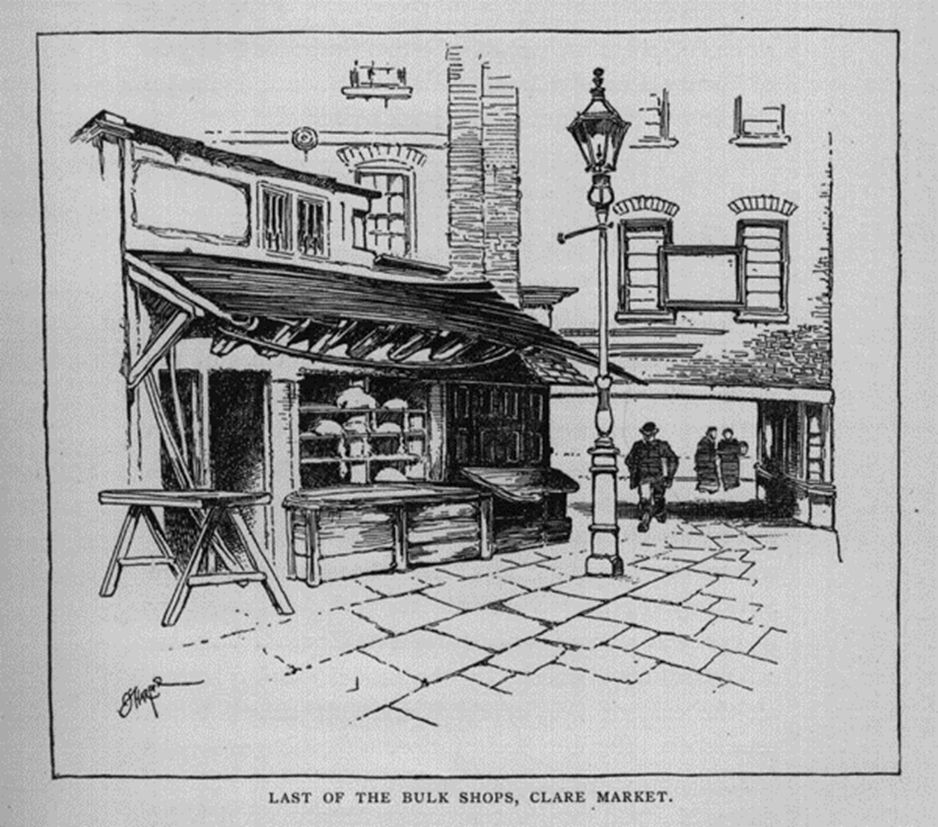
Shop, Clare Market
Sardinia Place, (formerly Duke Street) near Clare Market PHOTO/ Peter Berthoud
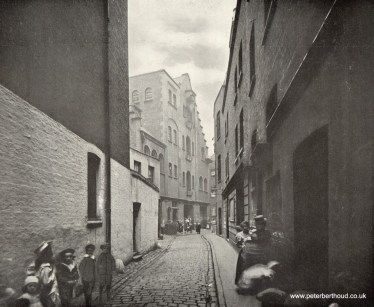
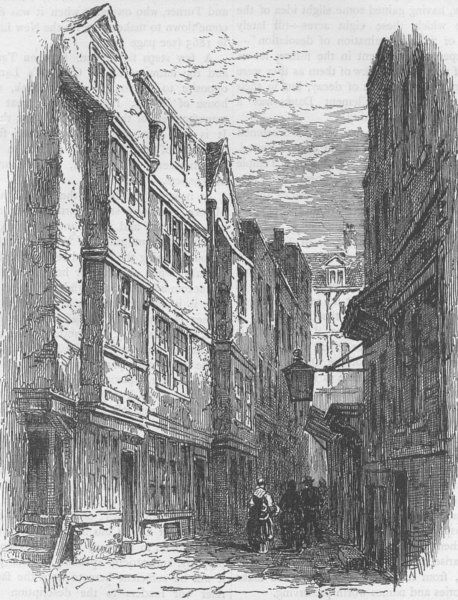
Searles Place - near Clare Market
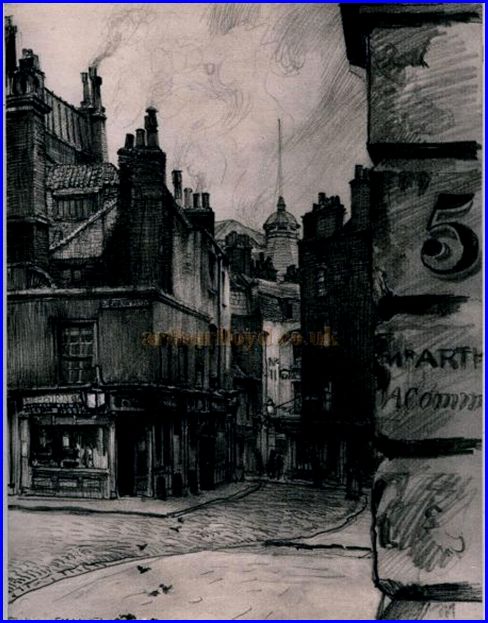
Corner of Clare Market and Lincoln Inns
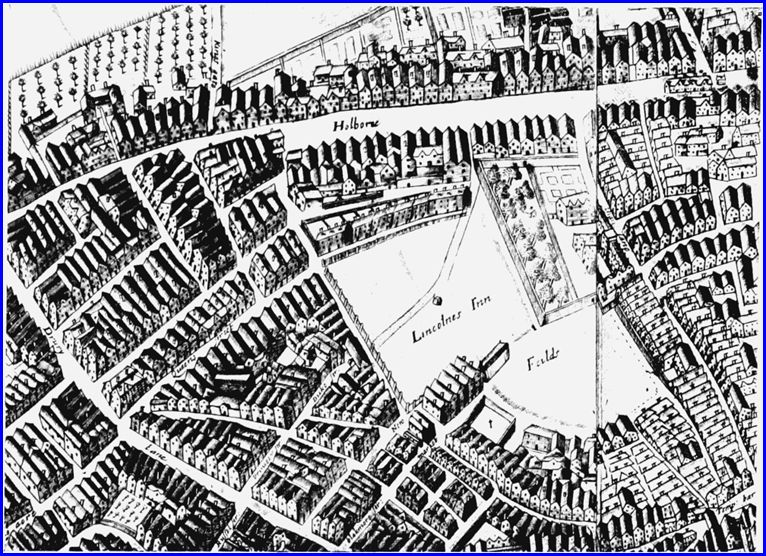
Drury Lane Coal Yard Clare Market Duke Street
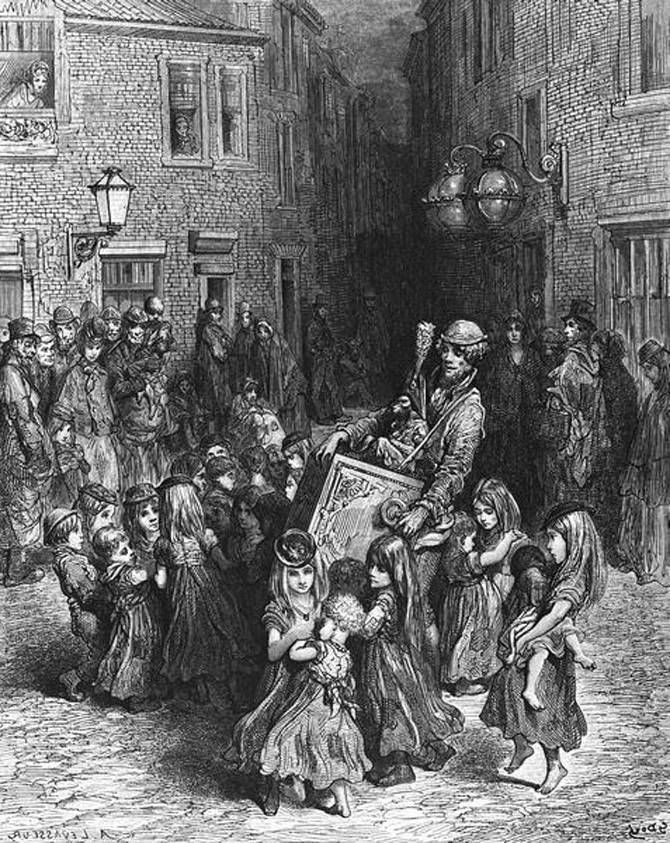
An engraving of a Court near Clare Market by the French artist Gustave Doré probably clearly shows what a typical Court looked like. The children dance barefoot around an organ grinder and his monkey, who will require a few pennies in exchange for his performance. This is something John Barrand and Nancy Routeledge’s children would have experienced. In the background there are two very fancy gas lamps illuminating the street. This generous gesture of free public lighting usually signals the welcoming embrace of a pub, the grand spectacular versions of which were known as gin palaces or a gin shops, a major feature of the Drury Lane area.
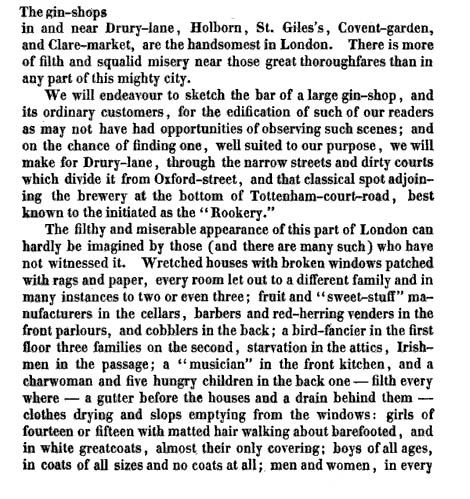
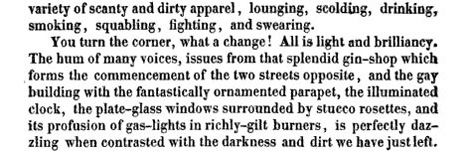
Gin Shops.

The above clipping is from The Pictorial Handbook of London by John Weale, published in 1853.
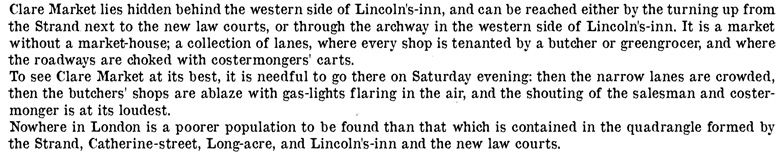
Writing in 1879, Charles Dickens Jr. gives a warts-and-all account of Clare Market in his Dictionary of London:
Clare Market was ostensibly a small-scale flesh market (both living and slaughtered flesh) during the day it was much as you’d expect: colourful language, lewd whores, animal carcasses and scurrying workers amongst whom wastrels and ne’er-do-wells would congregate and misbehave.
Clare Market sold cheap meat, vegetables and provisions. Illuminated at night by gaslight, the market sprawled in and around the white buildings. This also includes the district immediately adjacent to Houghton Street referred to by author Ebenezer Howard in 1898 as the 'notorious Clare Market Slum':
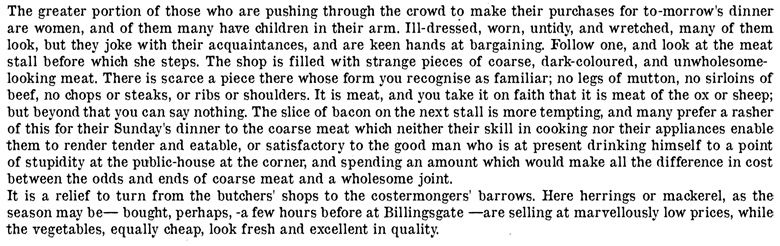
In 1839, one would battle our way through the jostling crowds with a meagre shopping budget in search of some cheap food. We will need a strong constitution; the smell is terrible as the market is also a shambles - a place of slaughter - as the author of the following clip describes it as a 'nuisance' ... the unfortunate sheep and cows are brought alive to the site, and slaughtered there, right in the crowded heart of London:
The last of the Clare Market slaughter-houses was in Bear Yard, and which was pulled down, circa 1889, for the erection of the Strand Union Workhouse on the north side of the yard, and the casual wards in the centre of it. Early in this century it was described as “a filthy place, occupied by tallow-melters, cowkeepers, slaughtermen, tripe-boilers, and stables.”
There were some very grim events going on here; the Old Bailey records no fewer than 499 crimes committed in Clare Market ranging from drunkenness to bigamy to counterfeiture to murder. One noteworthy case which illustrates the type of people who were to be found here centres on an argument about an ox tongue which led to the murder of one trader and the death sentence for another trader, his murderer. Court records from 16 April 1740 tell us that William Warner was struck on the thorax by a meat cleaver hurled by Thomas Clements; a witness statement from the trial states: “I ran to the Prisoner’s Shop, and saw the Deceased in a stooping Posture, with his Hand on his Side. I asked him, if he was hurt? He said, yes, I believe I am. I opened his Breast, and saw a Wound just below his short Ribs; the Blood ran out of the Wound into his Breeches, and a Lump of Fat, or Caul, appeared out of the Wound about the Bigness of an Egg.” And in delivering the guilty verdict to Clements the jury quoted another witness: “The Knife was flung at the deceased, with as much violence, and force as he was able to do it, I don’t know whether it was flung in sport, or not.” This incident is echoed many times in this dangerous neighbourhood across the years until the 1890s so, when the area was flattened to build Kingsway. Many people were relieved but perhaps not the 3,700 working-class people who were rendered homeless.
Sardinia Street, formerly Duke Street, was a street that ran from Prince's Street in the south to the western side of Lincoln's Inn Fields in the north. It was joined on its western side by King's Head Yard and Great Wild Street, and on its eastern side by Vere Street. On the eastern side at the northern end was a Roman Catholic chapel and Chapel Yard.
For several centuries it was customary to bury people who had committed suicide alongside roads or even under roads, particularly at crossroads. This type of burial seems to have been done to prevent the spirit or ghost of the dead person from returning to haunt the living. The idea was that by being buried at the crossroads, and during the night, would confuse the ghost. It was also common to drive a stake through the dead body, pinning it into the grave, as part of the attempt to stop the ghost walking. This custom grew out of the practice of burying criminals during the night by the roadside or even under the road itself, often at the nearest crossroads to where the offence occurred, and the practice dates back to at least Saxon times. Later this type of burial was mainly reserved for those who had committed suicide (which until 1961 was a criminal offence, ‘self-murder’). In towns and cities cases of suicide brought before the courts were often reported in newspapers, and one incident relating to a suicide in London’s Clare Market (now beneath the buildings of the London School of Economics) appeared in the Morning Post for 27th April 1810: ‘The Officers appointed to execute the ceremony of driving a stake through the dead body of James Cowling, a deserter from the London Militia, who deprived himself of existence, by cutting his throat, at a public-house in Gilbert Street, Clare Market, in consequence of which, the Coroner’s Jury found a verdict of Self-murder, very properly delayed the business until twelve o’clock on Wednesday night, when the deceased was buried in the cross roads at the end of Blackmoor Street, Clare Market.’
In Clare Market, London there was a scandal surrounding a gay male brothel called the White Swan, Clare Market in London was established as a Molly House in early 1810 by two men, James Cook and Yardley, who realised the lack of gay brothels in the city offered a business opportunity for them (Yardley claimed to be straight with a wife and purely in it for the money). Part tavern, part brothel, the White Swan was notable for the wide assortment of attractions it offered for homosexual men. In the basement, there was a room with four beds in it, a lady’s dressing room with a wide array of cosmetics and make up, and a makeshift chapel where the Reverend John Church performed wedding ceremonies — considered by some to be the first same-sex marriages in England, although they weren’t recognized by the government. Although guests of the White Swan were allowed to participate in sexual activities together free of charge, there were also a number of prostitutes offering services for a charge. No “unusual services” were offered. The club had been operating for less than six months when, on 8 July 1810, it was raided by the Bow Street police. During the raid, a crowd gathered outside — reportedly mostly of women — which was such a vicious mob that some of the prisoners were nearly killed being transported out of the molly house. Twenty-seven men were arrested, but in the end, the majority of them were released, eight were tried and convicted. All of the men were given a sentence of one hour on the pillory in addition to terms in prison. A William Amos was given three years, as it was his third conviction and the rest were sentenced to two years. Six of the convicted men, who had been found guilty of attempted sodomy, were pilloried in the Haymarket on 27 September that year. The crowds who turned out to witness the scene were violent and unruly, throwing various objects (including vegetables, fruit, dead and rotten fish, dead cats and dogs, feces, spoiled eggs — basically anything disgusting that they could get their hands on. The women in the crowd were reported as being particularly vicious. The city provided a guard force of 200 armed constables, half of them mounted and the other half on foot, to protect the men from even worse mistreatment.
During the proceedings, the authorities were told of two additional men who were not at the White Swan the night of the raid. Both were members of the British Navy - 42 year old Ensign John Newbolt Hepburn and 16 year old Thomas White, a drummer boy. They had a sexual relationship of some sort at the White Swan. Unlike the others, they were both executed at Newgate Prison on March 7, 1811.
The Colonnade in Clare Market consisted of six houses which were, for some time before their demolition, turned into a single building, and used as a club for working men, a refuge, and school for boys.
The blocks of houses in Clare Market, between Clement's Lane and Clare Market have long since disappeared, and what is now left is an agglomeration of the most squalid and woe-begone tenements.
The only relic of former greatness is the coat-of-arms, over the first-floor window of what was one of the dingiest broker's shops — now shut up — at the corner of Gilbert Passage, leading into Portugal Street. On the angle of the baker's shop at the corner of Vere Street and Clare Street is a curious stone sign in low relief which represents two negroes' heads facing each other, with the date 1715 and the initials W S M .
Clare Market and Drury Lane were a tangle of disreputable alleys until the new streets cut them in half. The area with its narrow Elizabethan streets and toppling houses, overflowing with produce and people, declined gradually into what was called, the Clare Market Slum. It was called “a murky district”, “that once notorious haunt of vice and misery.” The street name Clare Market still exists, although no longer a market, but a thoroughfare through the London School of Economics buildings.
On St. Patrick’s Day 1840 there was a fierce battle between the local Irishmen and the butchers and residents of Clare market. The Irishmen were objecting because they were not being employed or treated fairly by local traders and the cutchers were parading the streets with a grotesque effigy of an Irishman. The riot was put down by a “File of Musqueteers” from the St, James’s barracks.
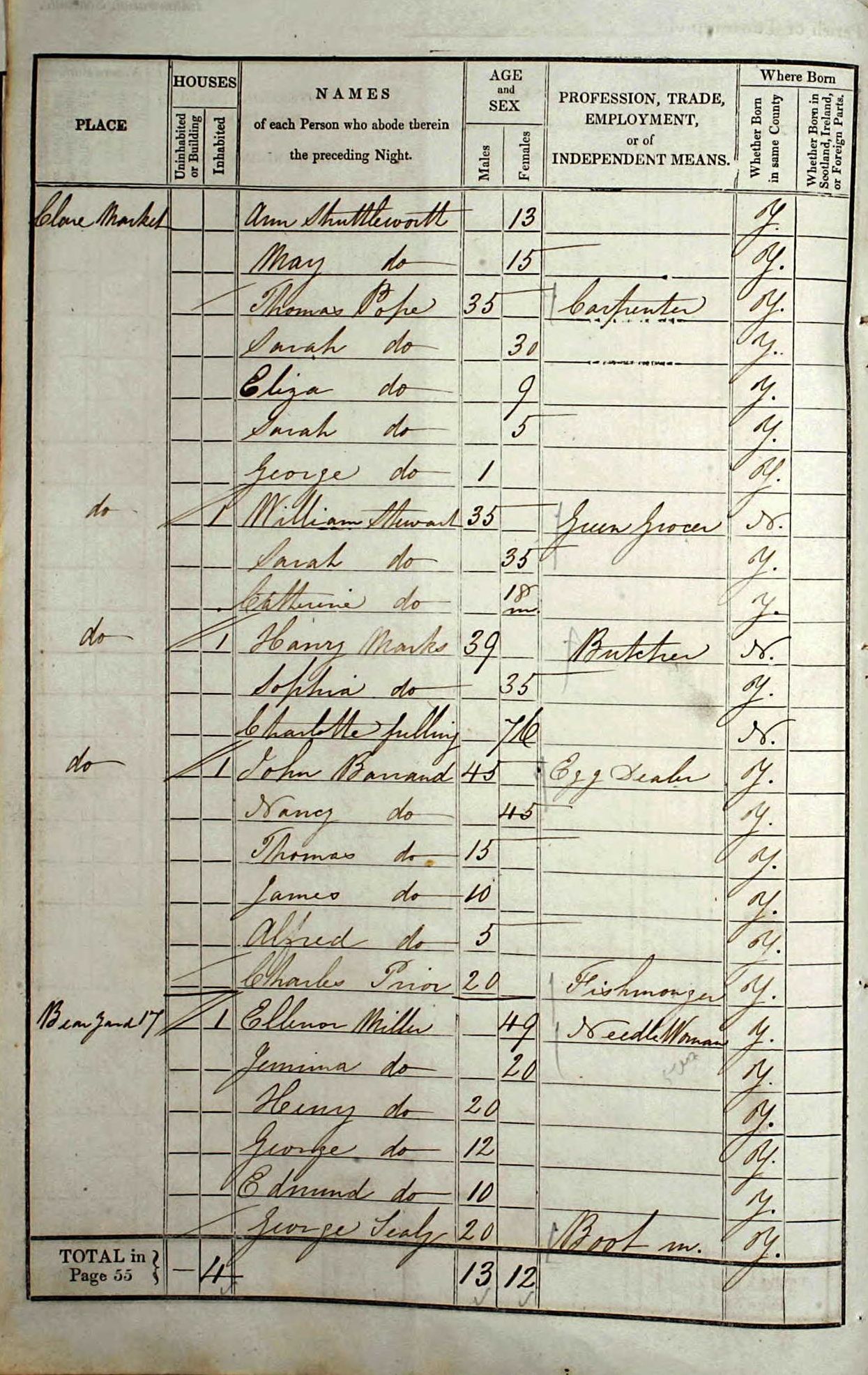
1841 Census John Barrand at Clare Market
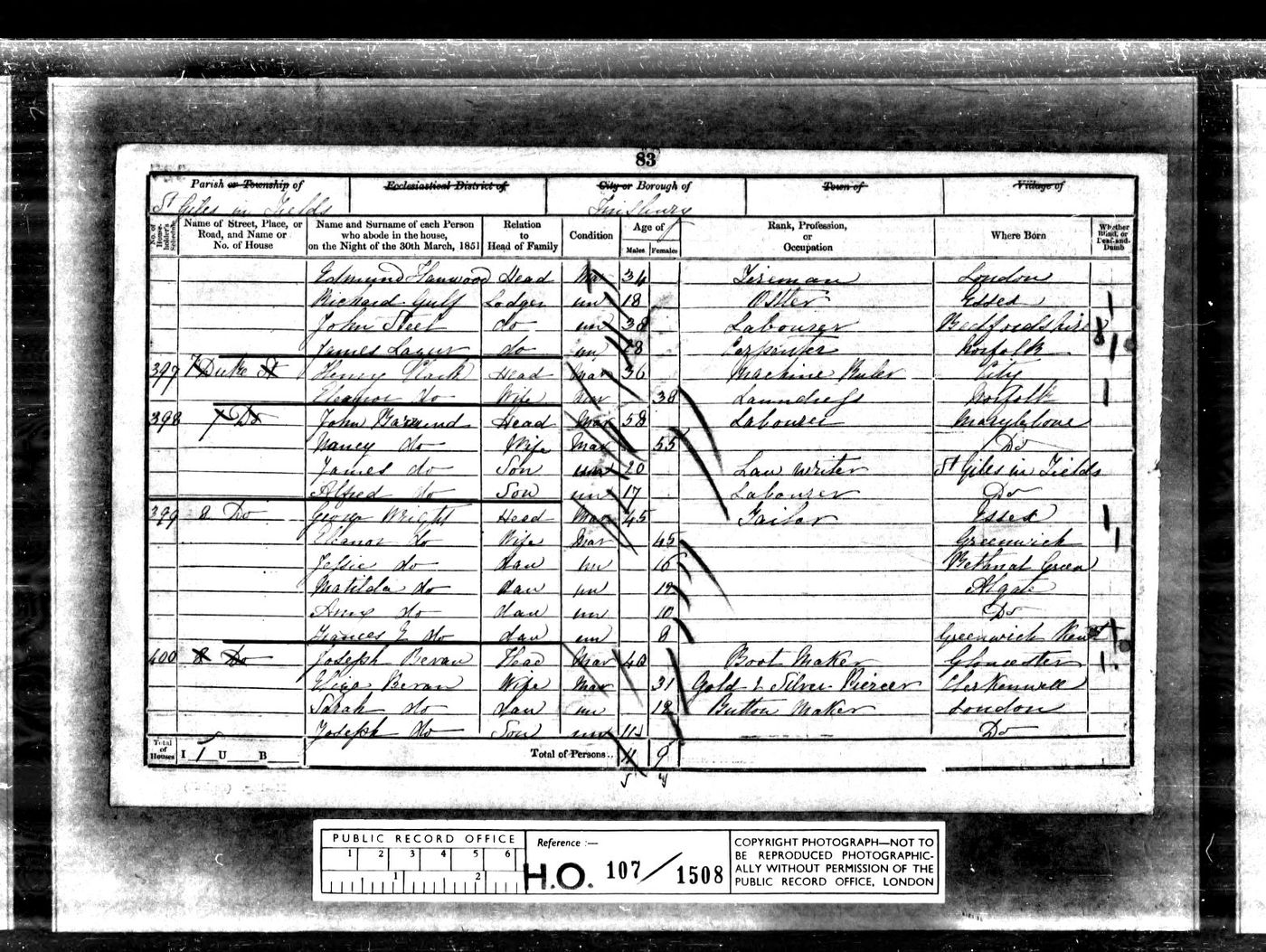
1851 census – John Barrand at 7, Duke Street as a labourer
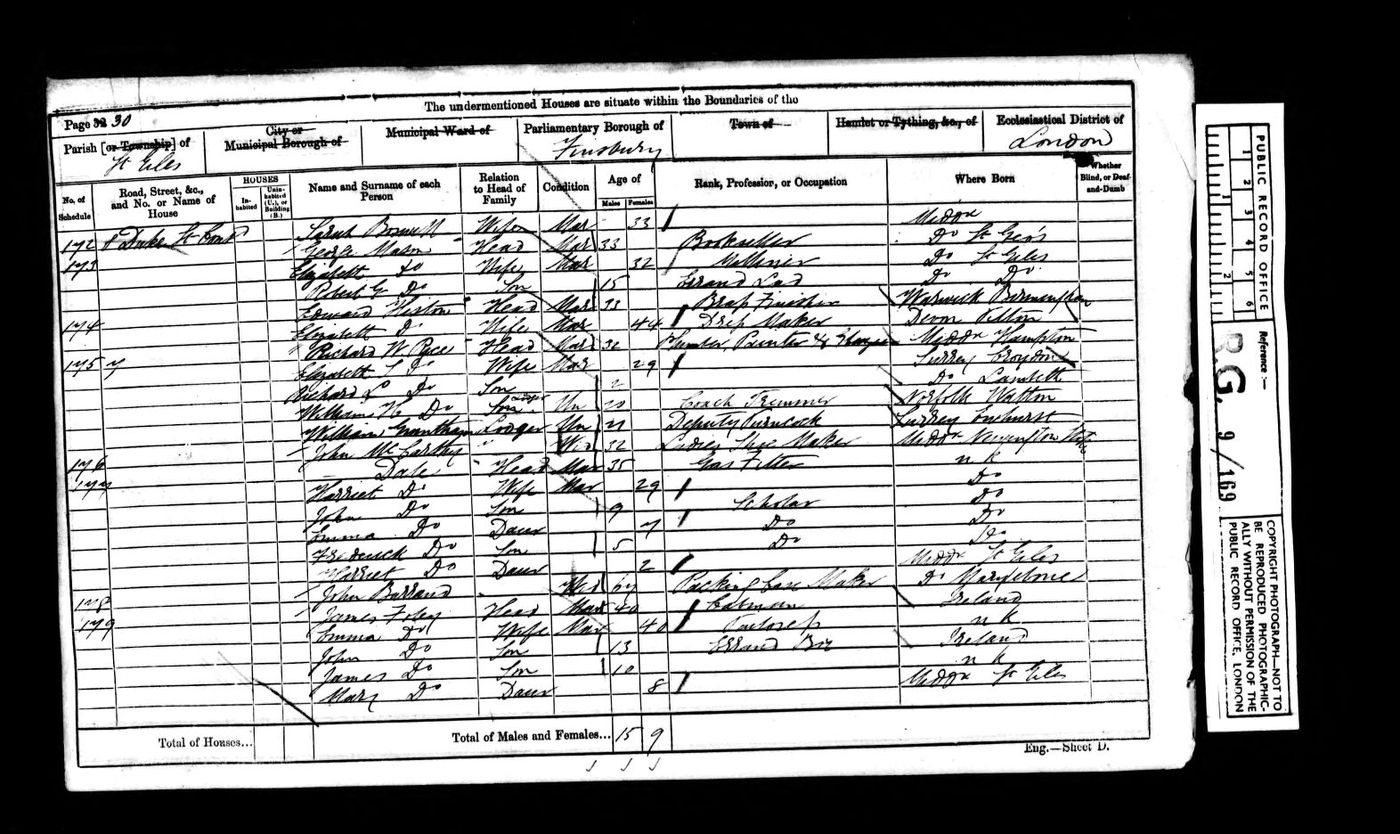
1861 census – John Barrand as Packing Case Maker – Duke Street
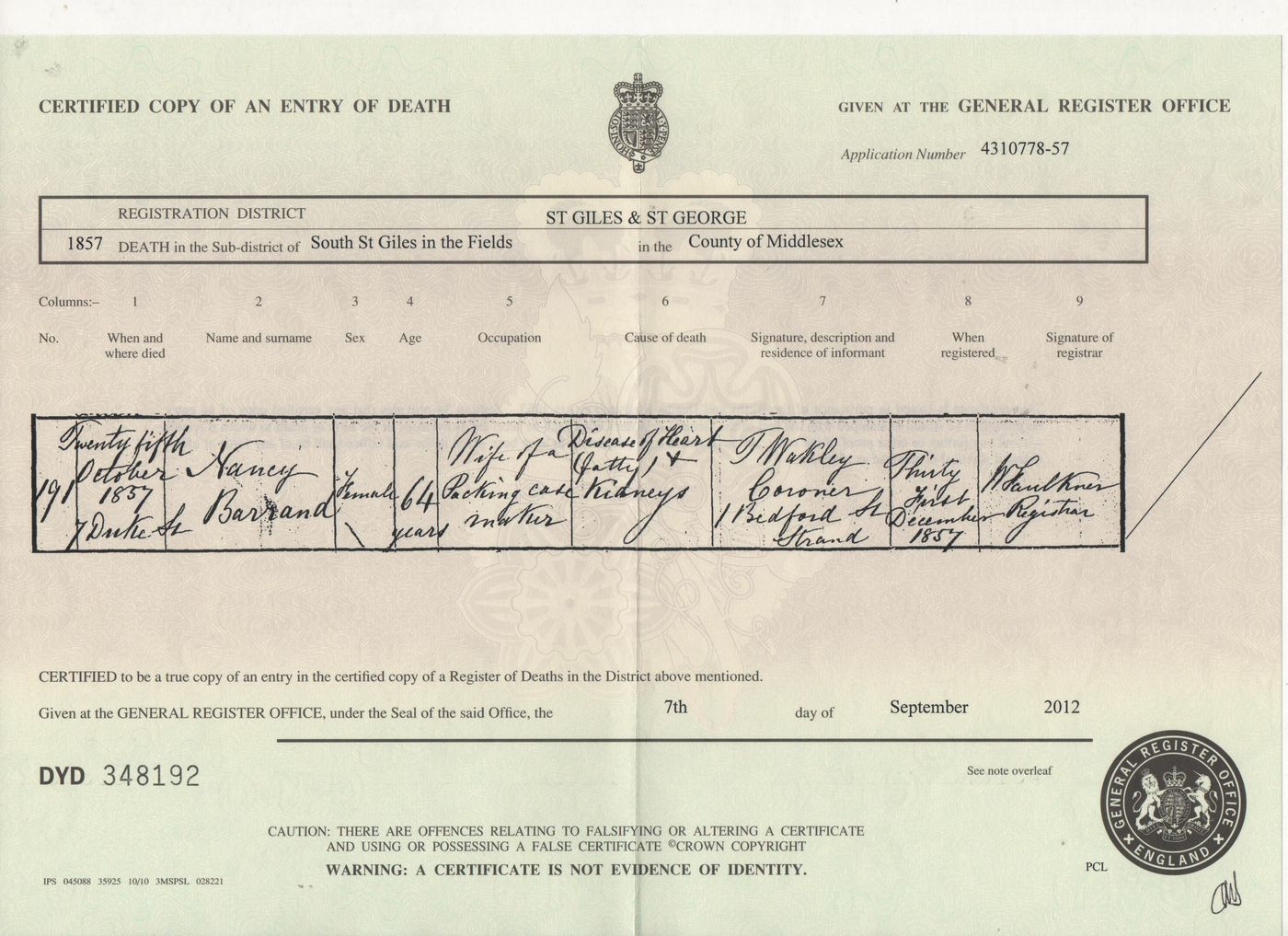
Death Certificate of Nancy Barrand
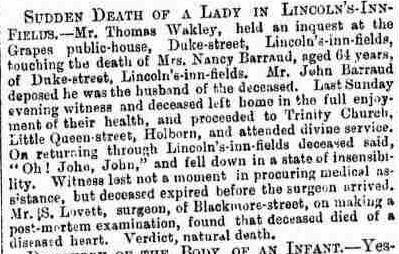
Morning Chronicle Friday 30th October, 1857
The death of Nancy Routeledge was also printed in the following newspapers:
The British Standard 6th November, 1857
The Standard 29th October, 1857
The British Banner 5th Novemver, 1857
The Patriot 3rd November, 1857
The London Morning News 30th November, 1857
The Atlas, 31st October, 1857
The Evening Herald 29th October, 1857
The Christian Cabinet 6th November, 1957
The London Mail 10th November, 1857
Nancy Ann Barrand
Died at 7, Duke Street, St. Giles
Death: 1857, aged 64.
DOB Shown as 1796
Parish record of the burial of Nancy Ann Barrand
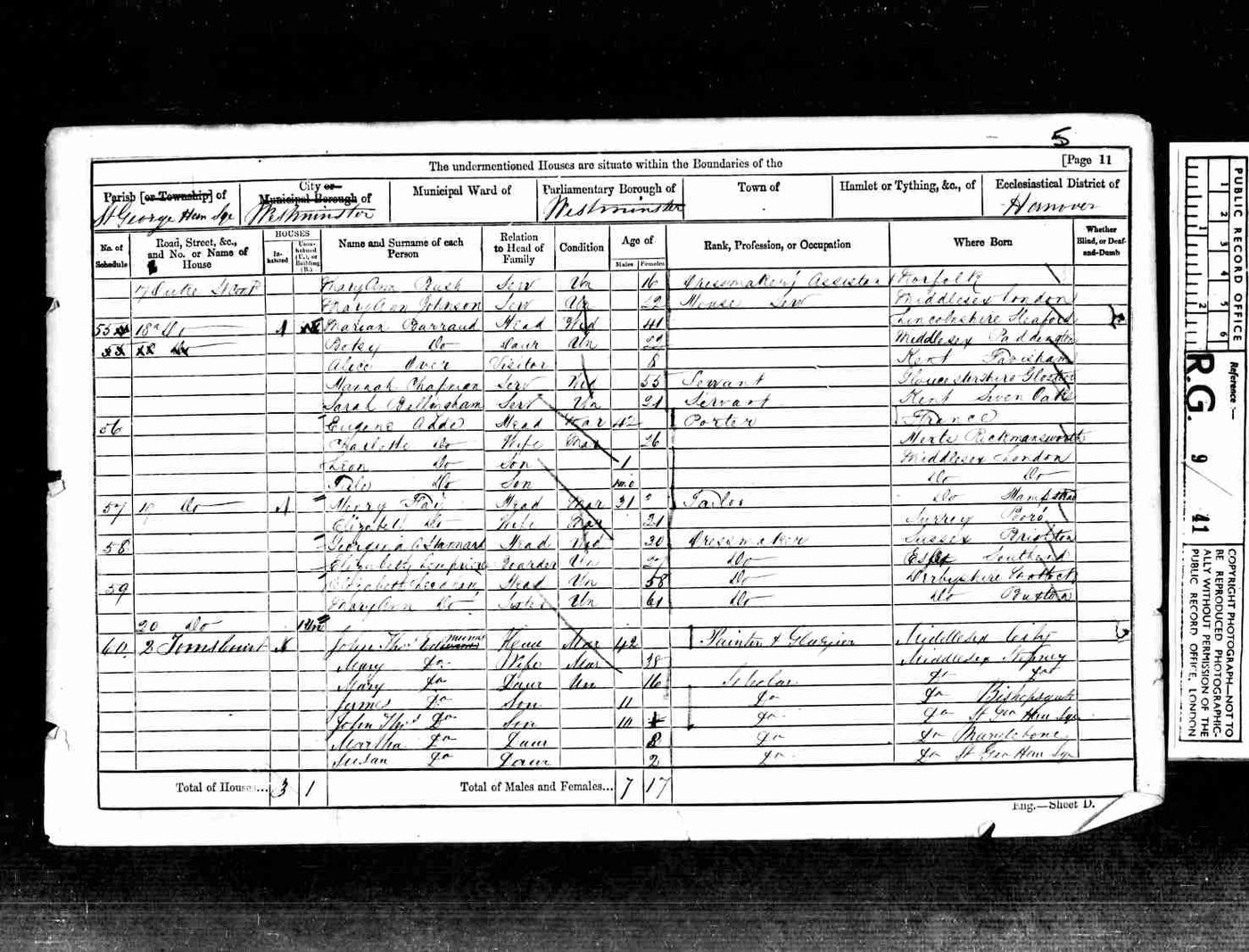
Becky Barrand + mother Marian Barrand from Lincolnshire living at 18, Duke Street 1861
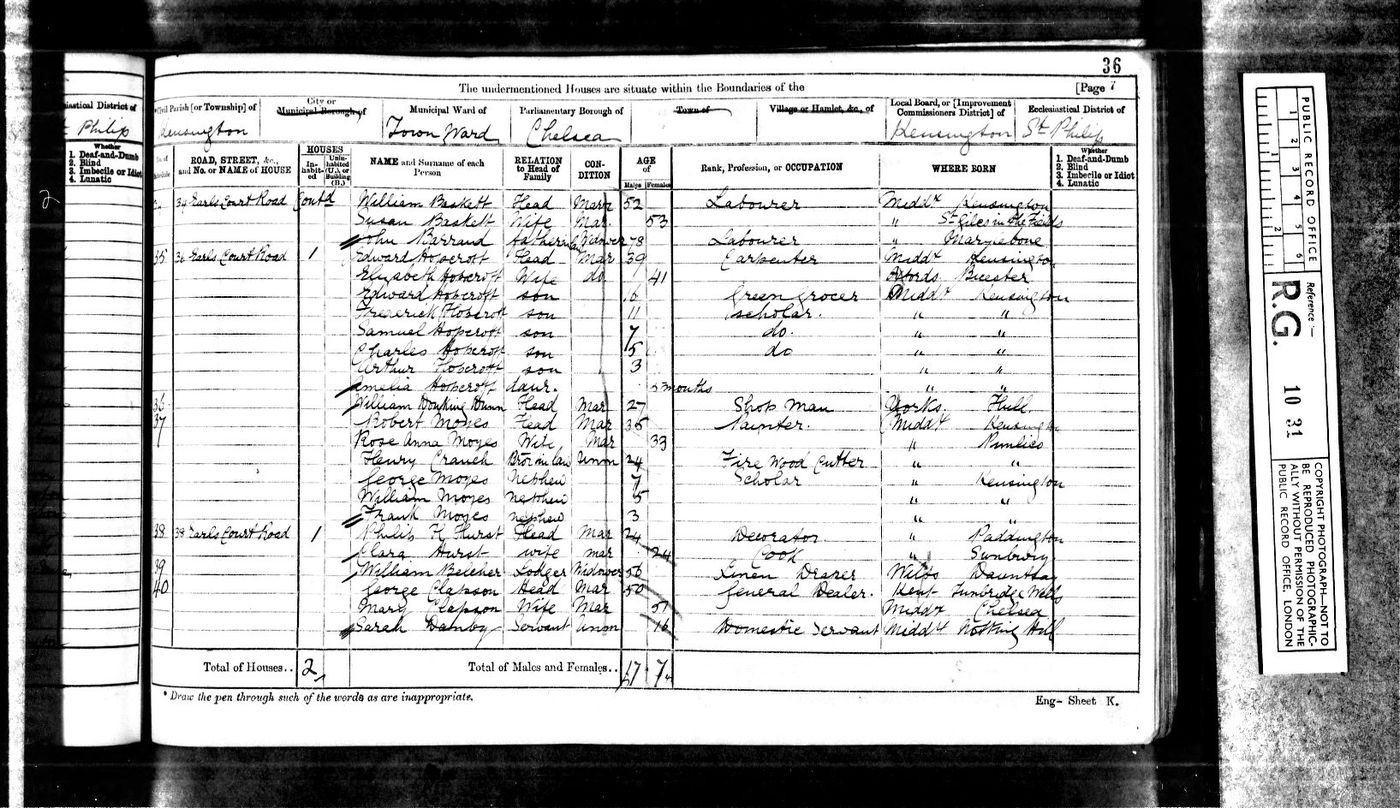
1871 census showing John Barrand with daughter Susan and Son-in-law

Morning Advertiser 23 June 1863
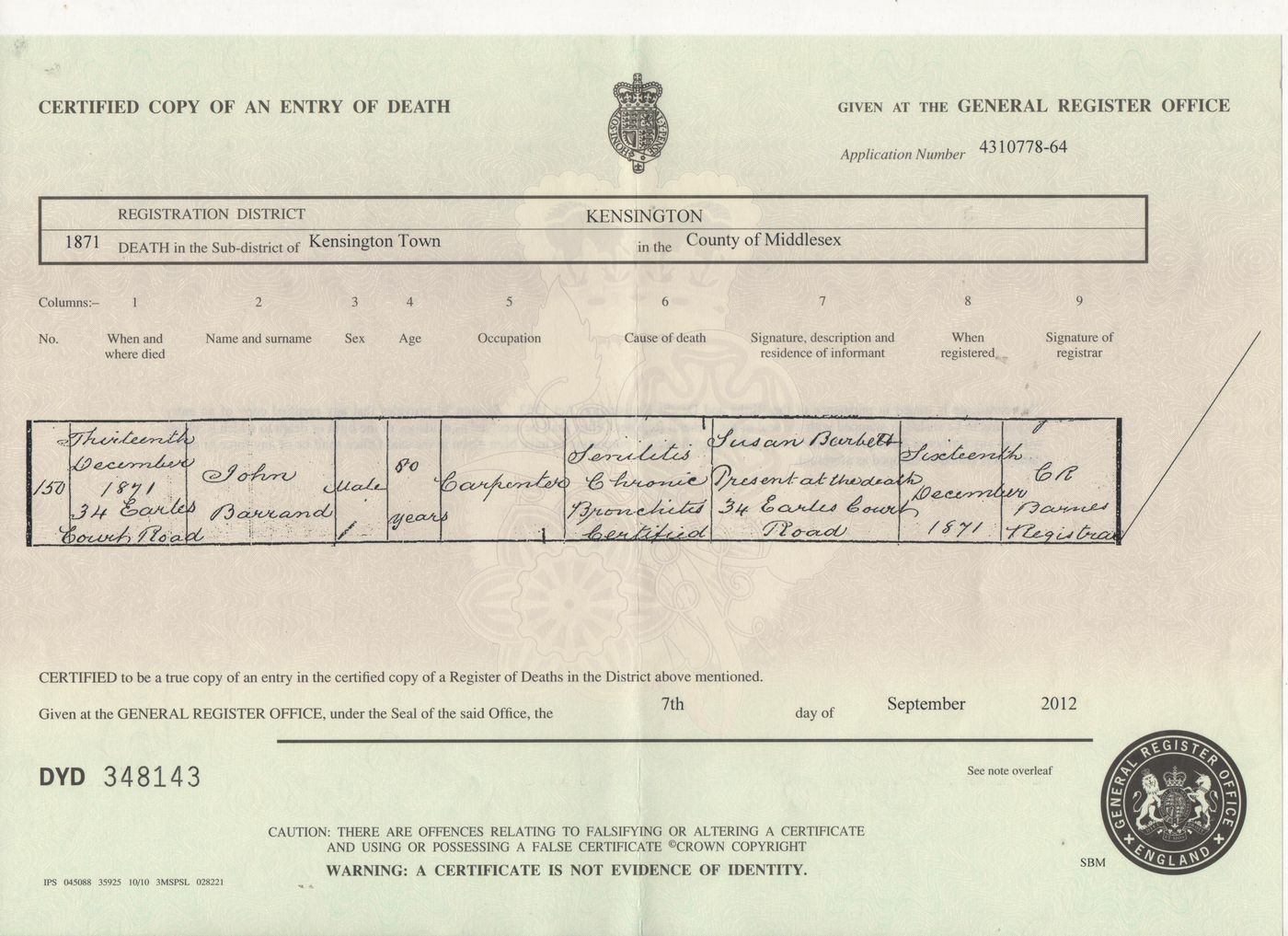
Death Certificate – John Barrand
Duke Street, Lincoln Inns
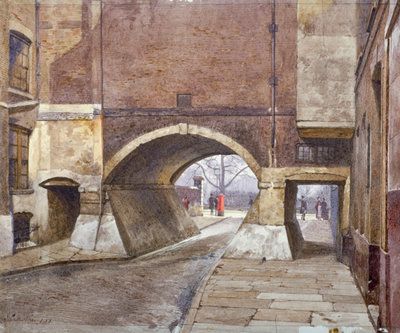
Entrance into Lincoln Inns Fields from Duke Street (John Crowther)
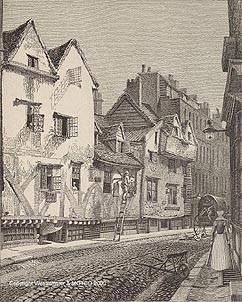
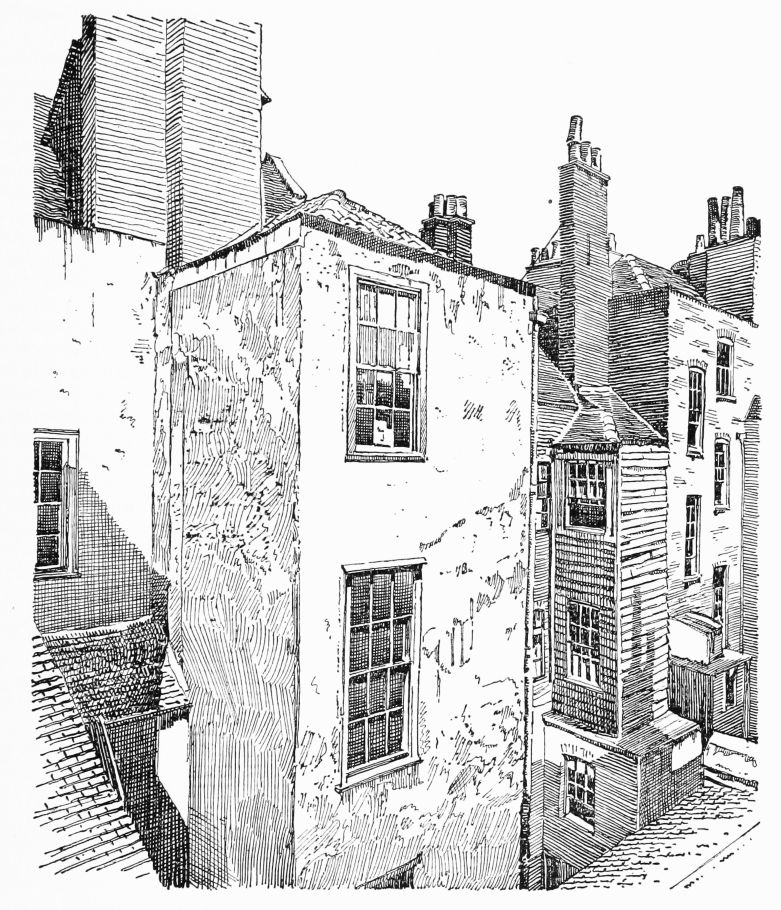
Old houses in Duke Street (Lincoln Inns ?)
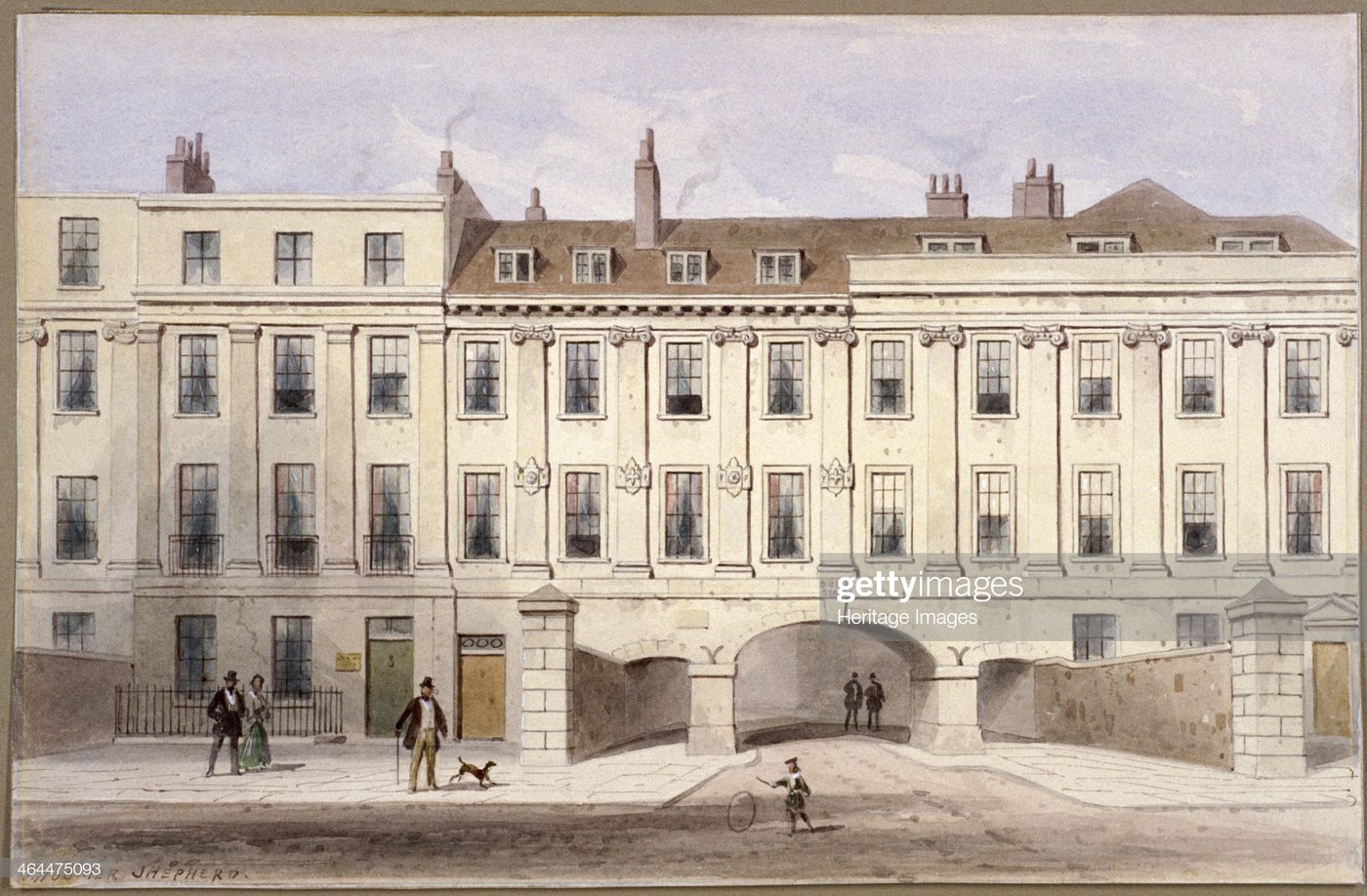
The archway from Lincoln Inns into Duke Street
7-Dials Coal Yard Duke Street Clare Market
ST. CLEMENT'S CHURCH, Strand. - There is a vault under this church called the "Rector's Vault," the descent into which is in the aisle of the church near the communion table, and when opened the products of the decomposition of animal matter are so powerful, that lighted candles, passed through the opening into the vault, are instantly extinguished; the men at different times employed, have not dared to descend into the vault until two or three days had elapsed after it had been opened, during which period the windows of the church also were opened to admit the perflation of air from the street to occupy the place of the gas emitted; - thus a diluted poison is given in exchange from the dead to the living in one of the most frequented thoroughfares of the metropolis. The other vaults underneath the church are also much crowded with dead. From some cause, at present doubtful, these vaults were discovered to be on fire (1) upwards of fifty years ago; they continued burning for some days, and many bodies were destroyed. At the eastern side of this church a pump was formerly fixed; this, within the previous month, has been removed, and a brick erection placed upon its site; the well was sunk in the year 1807, but the water had become so offensive, both to the smell and taste, that it could not be used by the inhabitants, owing, most probably, to the infiltration of the dissolved products of human putrefaction. Graves certainly have been dug very near to this well, and the land springs have risen to within a few feet of the surface.
From information recently obtained, it appears that several persons have been buried near this spot, and that in particular, the coffins of two very respectable inhabitants of the parish, as soon as let down into the graves, sunk below the surface of the water which had percolated into them; it is even stated that the deceased, from a wish to be buried in a watery grave, and knowing the situation, had particularly fixed upon it for the interment of their bodies.
Can it be surprising, then, that the water of this well should have become impregnated and corrupted?
An act was passed in 1851, prohibiting burials in urban areas. Shortly after this the overseers made a general clearance of the cells and their contents. The best of the coffins were re-enclosed in a newly formed chamber, and all else uniformly spread to a depth of 30 inches in a layer over the floor, always closely packed with earth, and covered with quicklime. Thus leaving all seemly, as we find it today.
Portugal Street Burial Ground at the rear of Clare Market was a notorious ground, and a regular source of corpses for bodysnatchers. In February 1820 three bodies were seen being bundled over the wall. A warrant was issued to search St Thomas's hospital, where the yard and dissecting room 'resembled a slaughter house' with scattered heads, torsos and limbs. The gravedigger and assistant were implicated in the bodysnatching, but were acquitted.
(The Times, Feb 18th 1820)
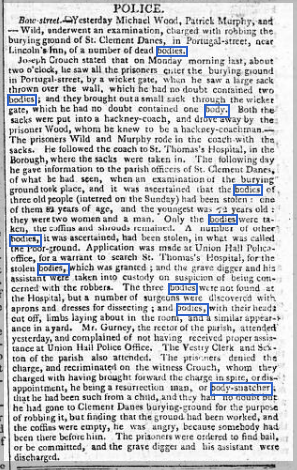
Saint James's Chronicle 19 February 1820
BURYING GROUND, PORTUGAL STREET.- This ground belongs to the parish of St. Clement Danes ; it is commonly known by the name of the " Green Ground," and has been in use as a burying place for residents of the Clare Market beyond the memory of man. The soil of this ground is saturated, absolutely saturated, with human putrescence. On Saturday, the 27th April, 1839, at 5pm, I went, accompanied by a friend, to Nos. 30 and 31, Clement's Lane, and, upon looking through the windows of the back attics, we saw two graves open, close to the south-eastern extremity of this burying ground. Several bones were lying on the surface of the grave nearest to us-a large heap of coffin wood was placed in readiness for removal, and, at a small distance, a heap covered with coarse sacking, was observed, which, when the covering was taken off, proved also to be long pieces of coffin wood, evidently not in a decayed state. The nails were very conspicuous. Several basketfuls of this wood were taken to a building at the south-west extremity of the ground. We were informed that this sight was by no means a novel one; it was commonly-almost daily, observed. The cloth covering of the wood appeared to be nearly as fresh as when interred. The grave diggers were seen to take off tin plates from the coffins broken up.
This desecration of the grave has not escaped the notice of the passer-by, as is proved from the following letter to the editor of the Times newspaper, which was published on the 25th of June last:-
Passing along Portugal Street on Saturday evening, about ten minutes before seven, I was much shocked at seeing two men employed in carrying baskets (1) of human bones from the corner of the ground next the old watch-house (where there was a tarpaulin hung over the rails to prevent their being seen, and where they appeared to be heaped up in a mound), to the back of the ground through a small gate.
Sir,- I feel more particularly than many might do, as I have seen twelve of my nearest and dearest relatives consigned to the grave in that ground; and I felt that, perhaps, I might at the moment be viewing, in the basket of skulls which passed before me, those of my own family thus brutally exhumed.
The effluvia from this ground, at certain periods, are so offensive, that persons living in the back of the Lane are compelled to keep their windows closed; the walls even of the ground which adjoins the yards of those houses, are frequently seen reeking with fluid, which diffuses a most offensive smell. Who can wonder, then, that fever is here so prevalent and so triumphant?
In the beginning of the present year, I was called upon to attend a poor man, who lived at 33, Clement's Lane; his health was broken, his spirits depressed, and he was fast merging into that low form of fever of which this locality has furnished so many examples. I found him in the back room of an extremely dirty house, his wife and family with him. On looking into the " Green Ground," through the window of his room, I noticed a grave open within a few feet of the house; the sick man replied to my observations, " Ah, that grave is just made for a poor fellow who died in this house, in the room above me; he died of typhus fever, from which his wife has just recovered,-they have kept him twelve days, and now they are going to put him under my nose, by way of warning to me."
W. Chamberlain, grave-digger at St. Clement's, testified that the ground was so full of bodies that he could not make a new grave "without coming into other graves." He said:
"We have come to bodies quite perfect, and we have cut parts away with choppers and pickaxes. We have opened the lids of coffins, and the bodies have been so perfect that we could distinguish males from females and all those have been chopped and cut up. During the time I was at this work, the flesh has been cut up in pieces and thrown up behind the boards which are placed to keep the ground up where the mourners are standing - and when the mourners are gone this flesh has been thrown in and jammed down, and the coffins taken away and burnt."
An assistant grave-digger testified that, happening to see his companion one day chopping off the head of a coffin, he saw that it was his own father's! Another digger testified that bodies were often cut through when they had been buried only three weeks. Another testified to things more horrible than ever Dante saw in Hell. He says: "One day I was trying the length of a grave to see if it was long and wide enough, and while I was there the ground gave way, and a body turned right over, and the two arms came and clasped me round the neck!" “Newspaper report”
The area became known as St. Clement Danes - home to both the disorderly population of Clare Market and Wych Street, and the much more orderly citizens of the Inns of Court. The parish was large, densely populated and made up of a series of distinct neighbourhoods defined by class and economic function. To the north were the Inns of Court, giving the parish a strong legal presence. Lincoln’s Inn itself was beyond the parish boundaries, but several smaller Inns, including the New Inn, Angel Inn and Clement's Inn were within St Clement Danes. Just to the west of this legal district lay Clare Market, the second largest meat market in London after Smithfield, and the centre of the victualling trades within the parish. The market formed part of a north-south axis along Vere Street, dominated by food retailing. The butchers’ boys from the market were famous in the eighteenth century for monopolizing the playing of rough music at weddings and playing the role of groundlings in the theatres of the neighbourhood. Clare Market was also a notable point of origin for many of the men and women tried for participating in the Gordon Riots. To the east of Drury Lane, hid ongoing and intractable pockets of real squalor and part of the problem lay with the housing stock. Butchers' Row and Wych Street, in particular, were famous for the cramped and damp medieval wooden-framed buildings which overhung the roadway, and were thought of, even in the eighteenth century, as reflecting a quaint "Old London". Even into the period of modern photography.
St Clement Danes had one of the worst survival rates for abandoned infants of any London parish.
In the years, the inhabitants of the houses round the churchyard in Portugal Street complained loudly of the revolting stench to which they were exposed. In the year 1839 the matter again came into notice: the inspector who was intrusted with the inquiry, himself saw the vapour rising from a large common grave, and convinced himself of the injurious effects of this vapour on the inhabitants of the neighbouring house. This area was so unhealthy, that of five-and-twenty or thirty inhabitants visited, about twenty were seriously affected, of whom five died.
"Often," says the author of a paper which we have before often alluded to, "the complexions of the young people who remain in this neighbourhood grow pale. Meat sooner becomes putrid there than elsewhere, and many persons cannot get accustomed to these houses." In the year 1830, in the cemetery which yearly received from 2000 to 3000 corpses, they dug an immense common grave near to that part of the cemetery which touches upon the houses.
The grave was 50 feet deep, and made to receive from 1500 to 1600 bodies, but in February 1835, the whole of the cellars in the street were no longer fit to use. Candles were extinguished by the air in these cellars; and those who only approached the apertures were immediately seized with the most alarming attacks. The evil was only diminished on the bodies being covered with half a foot of lime, and all further interments forbidden but even that must have been found insufficient, as, after some years, the great work of disinterring the bodies from this churchyard was determined upon.
I cannot refrain from giving, also, the information which was gained from the grave-diggers of the churchyard. Generally they did not seem to rate the danger of displacing the corpses very high: they remarked, however, that some days after the disinterment of the corpses the abdomen would swell, owing to the great development of gas; and that, if an opening forced itself at the navel, or anywhere in the region of the belly, there issued forth the most horribly smelling liquid, and a mephitic gas; and of the latter they had the greatest fear, as it produced sudden insensibility and faintings. They stated that, at a certain distance, this gas only produced a slight giddiness, a feeling of nausea, languor and debility. These attacks lasted several hours, and were followed by loss of appetite, weakness, and trembling. "Is it not very probable, "That a poison so terrible that, when in a concentrated state, it produced sudden death, should, even when diluted and diffused through the atmosphere, still possess a power sufficient to produce depression of the nervous energy and an entire disorder of their functions? Let any one witness the terror of these grave-diggers, and also see the cadaverous appearance of the greatest number, and all the other signs of the influence of a slow poison, and they will no longer doubt of the dangerous effects of the air from churchyard on the inmates of neighbouring houses."
A man who had lived in Bear-yard, near Clare-market, which was exposed to the combined effluvia from a slaughter-house and a tripe factory said he had previously lived for a time in the same neighbourhood in a room over the crowded burial-ground in Portugal street; at times in the morning he had seen a mist rise from the ground, and the smell was offensive where there were bodies of persons who have died of small-pox, typhus, scarlatina, and every species of disease.
Neither the men who handle, or who "coffin," the remains; nor the barbers who are called in to shave the corpses of the adult males; nor the bearers of the coffins although, when the remains are in an advanced state of decomposition, the liquid matter from the corpse frequently escapes from the coffin, and runs down over their clothes, are observed to catch any specific disease from it, either in their noviciate, or at any other time. When decomposition is very far advanced, and the smell is very offensive, the men engaged in putting the corpse into the coffin smoke tobacco; and all have recourse to the stimulus of spirituous liquor.
One Sunday, a gentleman went into the dissenting chapel, where the principal parts were buried in the ground or vaults underneath. I was called to him on Tuesday evening, and I found him labouring under symptoms of malignant fever; either on that visit or the visit immediately following, on questioning him on the circumstances which could have given rise to this very malignant form of fever, for it was then so malignant that its fatal issue was evident, he said that he had gone on the Sunday before (this being on the Tuesday after-noon) to this dissenting'chapel, and on going up the steps to the chapel he felt a rush of foul air issuing from the grated openings existing on each side of the steps; the effect upon him was instantaneous; it produced a feeling of sinking, with nausea, and so great debility, that he scarcely could get into the chapel. He remained a short time, and finding this feeling increase, he went out, went home, was obliged to go to bed, and there he remained. When I saw him he had, up to the time of my ascertaining the origin of his complaint, slept with his wife; he died eight days afterwards; his wife caught the disease and died in eight days also, having experienced the same symptoms.
Some years since a vault was opened in the churchyard, and shortly after one of the coffins contained therein burst with so loud a'report that hundreds flocked to the place to ascertain the cause. So intense was the poisonous nature of the effluvia arising therefrom, that a great number were attacked with sudden sickness and fainting, many of whom were a considerable period before they recovered their health.
The vaults and burial-ground attached to the chapel, are much crowded with dead, and from the accounts of individuals residing in the adjoining houses, it would appear that the stench arising therefrom, particularly when a grave happens to be opened during the summer months, is most noxious. In one case it is described to have produced instant nausea and vomiting, and attacks of illness are frequently imputed to it. Some say they have never had a day's good health since they have resided so near the chapel-ground, which, I may remark, is about five feet above the level of the surrounding yards, and very muddy” so much so, that pumps are frequently used to expel the water from the vaults into the streets.
I myself know of the clergyman's family, whose dwelling- house is so close to the extremely full churchyard that a very disagreeable smell from the graves is always perceptible in some of the sitting and sleeping rooms. The mother of this family states that she has never had a day's health since she has resided in this house, and that her children are always ill and their ill health is attributed, both by the family and their medical friends to the offensive exhalations from the churchyard These offensive emanations have been noticed at all hours of the night and morning; and even during the day. The smell of the churchyard has been considered to have reached the vaults in the House of Commons The sense of smell in the majority of inhabitants seems to be destroyed, and having no perception, even of stenches which are insupportable to strangers.
Extract from report by Dr. Southwood Smith physician to the London Fever Hospital,