George “R” Barrand was the 4th child of John Barrand and Nancy Ann Routledge, born on the 29th July, 1820 and baptised on the 20th August, 1820 in St. Anne’s Church, Soho. John Barrand’s occupation is shown on the baptism record as a cheesemonger, but no actual address is shown apart from St. Giles, but it is known from the tenant’s records at the time that it was in fact Little Earl Street. Although he was baptised as George Barrand, the “R” is mentioned in other records and it is not known for certain what the “R” in the name stood for, but it may be of significance that George had a son in 1845, and his name was George Richard Barrand. The “R” may of course be Robert as that was the name of Nancy Ann’s father – Robert Routledge. George did not become involved in his father’s occupation of egg and cheese dealing but became a carpenter like his Grandfather Thomas, and his uncles, William and Peter. There is a record in the Old Bailey Courts of 1838 which shows George Barrand as a victim of theft at the age of just 17 and employed as a carpenter (see below).
In the 1841 census, George is found in the “House of Correction”, Whitecross Street, Camberwell aged 20. This record certainly shows “born in the area of St. Giles.” The London and Middlesex debtors’ prison was in Whitecross Street (on the corner of Fore Street) I have not found any criminal record for George, so it is unclear why he was in the “House of Correction.” but this was a debtors’ prison rather than a criminal prison (see description below) and mostly housed bankrupts and others in debt. Some prisoners were kept in Whitecross prison for debts of less than one shilling, but interest could eventually make the amount up to 5 times the actual debt, or they could serve a months’ imprisonment. If George Barrand was guilty of some crime, then it was possibly of a very minor nature and was released very soon as, in 1842, George Barrand paid rates for 2, Colonnade in Westminster. This seems to refer to buildings along the North side of the Thames forming the embankment at the Houses of Parliament. In the early 1840s, plans were submitted to substantially build-up the embankment and reduce the width of the river. The Colonnade at Westminster was then to be transformed into a roadway.
On the 19th May, 1844, he married Emma Chivers, Marriage Ref: Marylebone 1841 -2nd Qtr (1 - 255) and at the time of his marriage, George was employed as a Coach Carver, and although his address at the time of his marriage is not shown on the marriage certificate, it is possible it was still “2, Colonnade” or even Lower Boston Place as that is where their first son, George Richard was born in 1845. The address of “Lower Boston Place” is not found on the 1841 or 1851 census for London, only Boston Place and Upper Boston Place although newspaper references are made of a Lower Boston Place near Dorset Square. On the 18th December, 1846, George suffered from deep depression and was admitted to the St. Luke's Lunatic Assylum as a private patient, but was released the following year. On the 1851 census, George and Emma were certainly living with Emma’s parents George Mountstephen Chivers and Elizabeth (nee Price) at 6, Coal Yard off Drury Lane, and by this time they had 2 children, George Richard and Henry James.
George Mountstephen Chivers (b 1792) was a son of George Chivers and Ann Mount-Stevens and was a bricklayer by trade and married Elizabeth Price on the 18th November, 1823, but they had 3 children before their marriage, all baptised on the 22nd May, 1822. At the time of the 1841 census, they were already living in Coal Yard, and living with them were their children, Charles, Emma and Henry. They had a total of 8 Children: Emilia, John James, William, Henry, Charles Daniel, Georgiana, Emma and Elizabeth Clara, but it seems that only 4 survived. George Mountstephen Chivers was also an accomplished ballroom dance master and qualified dance teacher. Of their children, Henry Chivers never married, and died in 1893: Charles Daniel Chivers, was a printers’ warehouseman by profession, and he was a witness to the marriage of George Barrand and Emma Chivers. He married twice - an Eliza Millard in 1844 who was 10 years older than him, and they had 1 daughter Emily. He then married an Eleanor Brown in 1892 in Kent but Charles Daniel died the following year. He was described as “a gentleman” and his estate was £265. 00 and was administered by his widow, Eleanor.
Georgiana married John Scoles, a widower and french polisher in 1853, moved to Australia and died in 1906.


By 1861, George Barrand and Emma Chivers had moved from 6, Coal Yard to No 11, Coal Yard, and they now had 4 children; George Richard, William, Emma and Caroline, (Henry James having died in 1854). George is described as a wood carver and he had previously worked for David Ivall, a very wealthy coach-builder and harness maker who also lived in Coal Yard, but had premises as a coach maker on Tottenham Court Road. David Ivall died in 1850 a very wealthy man, and after David Ivall’s death, this made George Barrand decide to work for A.J.H. Goldring an independent coach builder in Long Acre as a crafted guilder. Coach-building gave George Barrand a great scope for his talent in devising a safe, comfortable, shapely, and artistically decorated coach. One of his greatest talents was the decoration of the panels which made up part of the coach and this was one of the most skilled jobs in coach-making using gold leaf. Not only did George Barrand decorate many coaches, but also made jewelry boxes with gold leaf inlays and these were displayed in several shops around Coal Yard. Long Acre was already dominated by the coach building industry and certainly Samuel Pepys had bought a coach there in the seventeenth century. Many larger workshops of master coach builders intermingled with smaller workshops for ancillary crafts such as harness makers, joiners, carvers, guilders and wheelwrights. Coachbuilders continued to occupy most of the premises in Long Acre itself. Early nineteenth century directories list over 30 coachbuilders' premises.
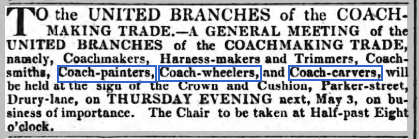
In 1866, George Barrand attended the general meeting of the United Branches of the Coachmaking Trades in Drury Lane and he was elected as secretary of the North London Branch, and in 1867 was elected as chairman of the North London Branch, a position he held until his death.
According to the 1861 census, there were 77 families altogether living in Coal Yard. In 1871, George is now aged 50 and a carver/gilder and living at 12, Coal Yard. There is no sign of Emma Chivers on the census at their address as she is shown working as a private nurse on the 1871 census in Bloomsbury but, as George Richard (their son) had already moved away, the remaining three children are still there, William, Emma and Caroline. George R. Barrand died on the 22nd October, 1872, of a stroke aged only 52, at the family address of 12, Coal Yard. The death certificate confirms he was still a coach carver and William Alfred Barrand (his son) was present at the death. Death Ref: St. Giles 1872 - 4th Qtr (1b - 292)
In 1881, Emma (Chivers) shown as a widow, was now living at No 2, Smarts Buildings and working as a mangler working drying clothes for the neighbourhood. Smarts Buildings was situated next to Coal Yard, off Drury Lane. (see map) Living with Emma was her daughter Caroline (no profession) and a George William Phillpott, a lodger from Birmingham. Caroline eventually married George William Phillpott in 1885. In 1890, Emma Barrand (nee Chivers) died, aged 65 at 2, Smarts Buildings of cardiac disease and congestion of the lungs Death Ref: St. Giles 1890 - 4th Qtr (1b - 452) and, like her husband, William Alfred Barrand (their son) was present at the death. Emma’s will was administered by her son, William Alfred, and she left an estate of only £90.00.
"Whitecross Street Prison, in 1850: London had become notable for the levels of poverty and squalor associated with it at various points in its history. As a result, the early 1800s found large numbers of the populace being imprisoned for being unable to cope with their levels of debt. Being a debtor and unable to pay in these times was very serious, you faced the prospect of being imprisoned in the notorious Newgate Prison with any number of violent criminals. Mixing debtors and more common criminals began to be widely considered to be unjust and following a campaign by Sir Richard Phillips the construction of a new debtors’ prison was ordered. The location for this prison was: Whitecross Street .
The prison, designed by William Montague, was constructed in 1813. The wards were quite separate, and no communication was permitted between the inmates of one and another. The establishment was capable of holding 500 persons. It is, however, very seldom that half that number is confined at one time within its walls. At this period in 1848 it had 147 inmates; the pressure of the times has since considerably increased the sum-total. There are now 205, of which number eight are females. The population of this prison is, moreover, very migratory. In 1849 there were no less than 1,143 commitments. This shows an advance upon previous years—the result of the operation of the Small Debts Act—a part of the building having been set apart for persons committed under that Act. Many debtors are now sent hither for a fixed term, mostly ten days, at the expiration of which they are discharged. This punishment is principally inflicted for contempt of court. A woman was recently locked up here for ten days, for contempt, because unable, or unwilling, it was difficult to say which, to discharge a debt of seven pence! In all such cases a more penal discipline is enforced; the person incarcerated is not allowed to maintain him or herself, but is compelled to accept the county allowance.The position of debtors in prison was slightly different to that of the regular prison population. The idea of the debtors being in prison was to confine them, not to punish them. Consequently, they were housed separately from the rest of the prison inmates; and the way that they lived in prison was dependant on their affluence and the generosity of friends and family. They paid an admission fee to a certain room and the more expensive the room, the better the conditions. There were no strict rules as there were in the rest of the prison, and the debtors were free to buy food from a miniature market. Life could actually be, and generally was, very relaxed. The theory being that men in there would be able to work in order to pay off their debts, however, in reality, this was often impossible. "Round the yard are the lofty walls of the prison, and the general pile of the prison buildings, several storeys high. Some of the poorer of the prisoners have to make the beds, clean the floors, and do other menial offices for the rest. Passing through a door in the yard, we would enter the day-room of this ward. There are benches and tables down the sides, as in some of the cheap coffee-houses in London, and a large fire at the end, at which each man cooks, or has cooked for him, his meals. On the wall a number of pigeon-holes or small cupboards are placed, each man having the key of one, and keeping therein his bread and butter, tea and coffee, and so forth. These things are all brought in, and no stint is placed upon the quantity consumed. A man may exist in the prison who has been accustomed to good living, though he cannot live well. All kinds of luxuries are prohibited, as are also spirituous drinks. Each man may have a pint of wine a day, but not more; and dice, cards, and all other instruments for gaming, are strictly vetoed."The prison was finally closed down in 1870 and the prisoners released. Of the ninety-four remaining prisoners, thirty one asked to remain and not be released. The prison was demolished shortly afterward and prisoners moved to Holloway Prison.
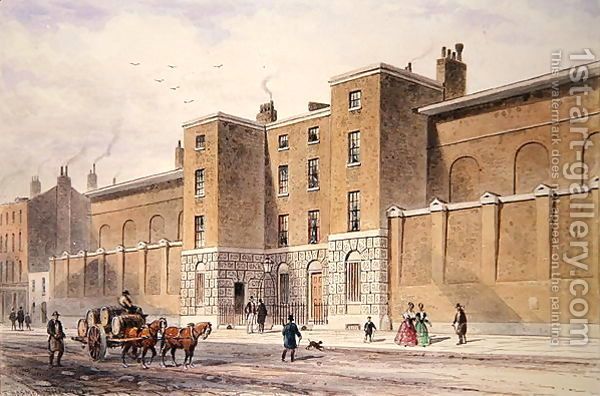
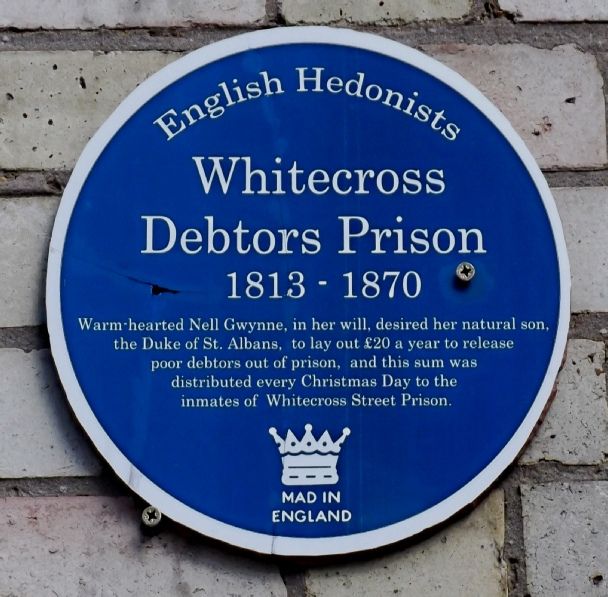
Debtor's Prison - Whitecross Street
Geo Barrand
England, Westminster Rate Books
| Name: | Geo Barrand |
| Event Type: | Tax Assessment |
| Event Place: | Westminster, Middlesex, England |
| Event Date: | 1842 |
| Address: | 2 Colonnade |
| Note: | Poor Rates 1842 |
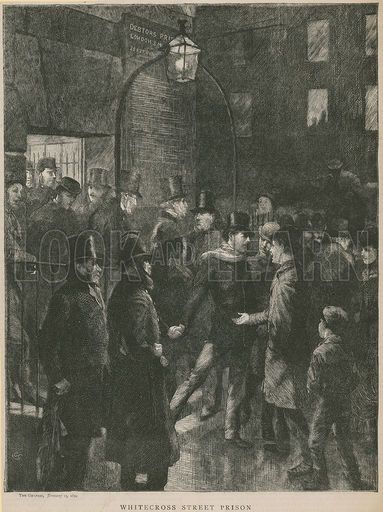
A prisoner being released from Whitecross Street Prison
High Holborn
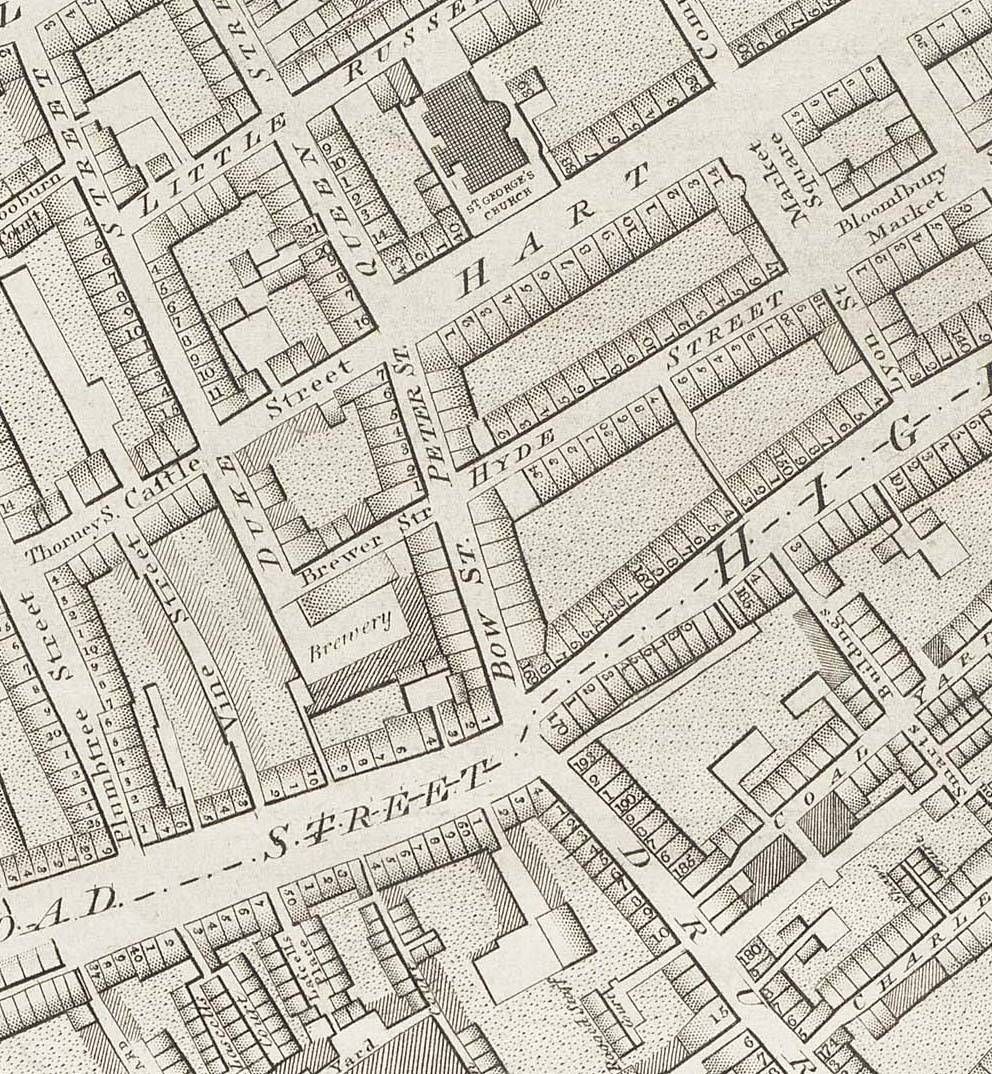
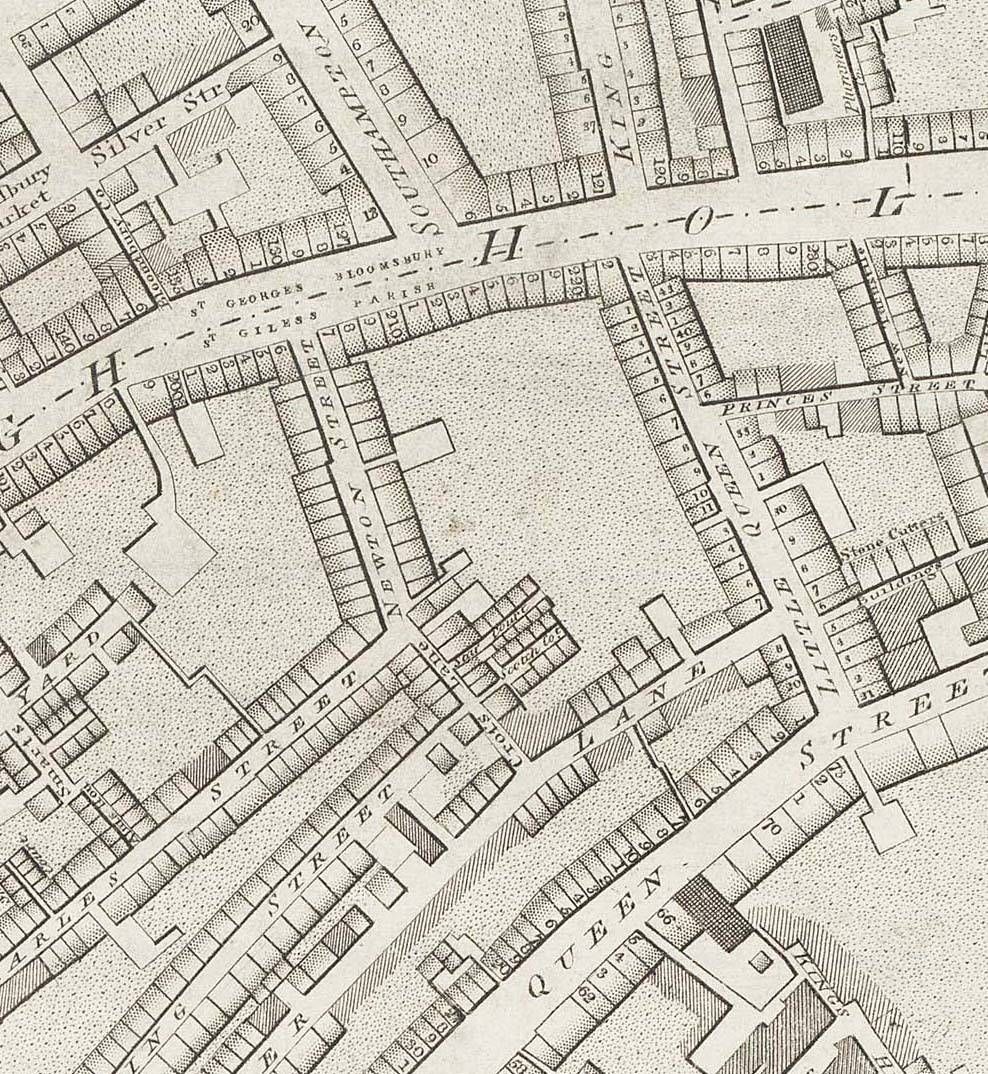
Drury Lane Ashlins Place Smarts Buildings Coal Yard Shaws Court Barley Court
What Coal Yard was like :-
In the Coal or Cole Yard, on the eastern side of Drury Lane, near the Holborn end, Nell Gwynne is said to have been born. The Coal Yard was a row of miserable tenements, at the end of which there was a turning to the south, by which we enter the Almshouses belonging to this parish and St. George's, Bloomsbury. A part of these has been formed out of the old "Round House," in which highwaymen and other dangerous personages were confined until they could be brought before the sitting magistrates and formally committed to prison. St. Giles's Roundhouse was a small, circular prison used mainly to hold suspected rather than convicted prisoners. From: 'St Giles-in-the-Fields', Old and New London: Volume 3 (1878), pp. 197-218.
“The Rookeries of London “characterised Coal Yard as offering ‘the lowest conditions under which human life is possible.’
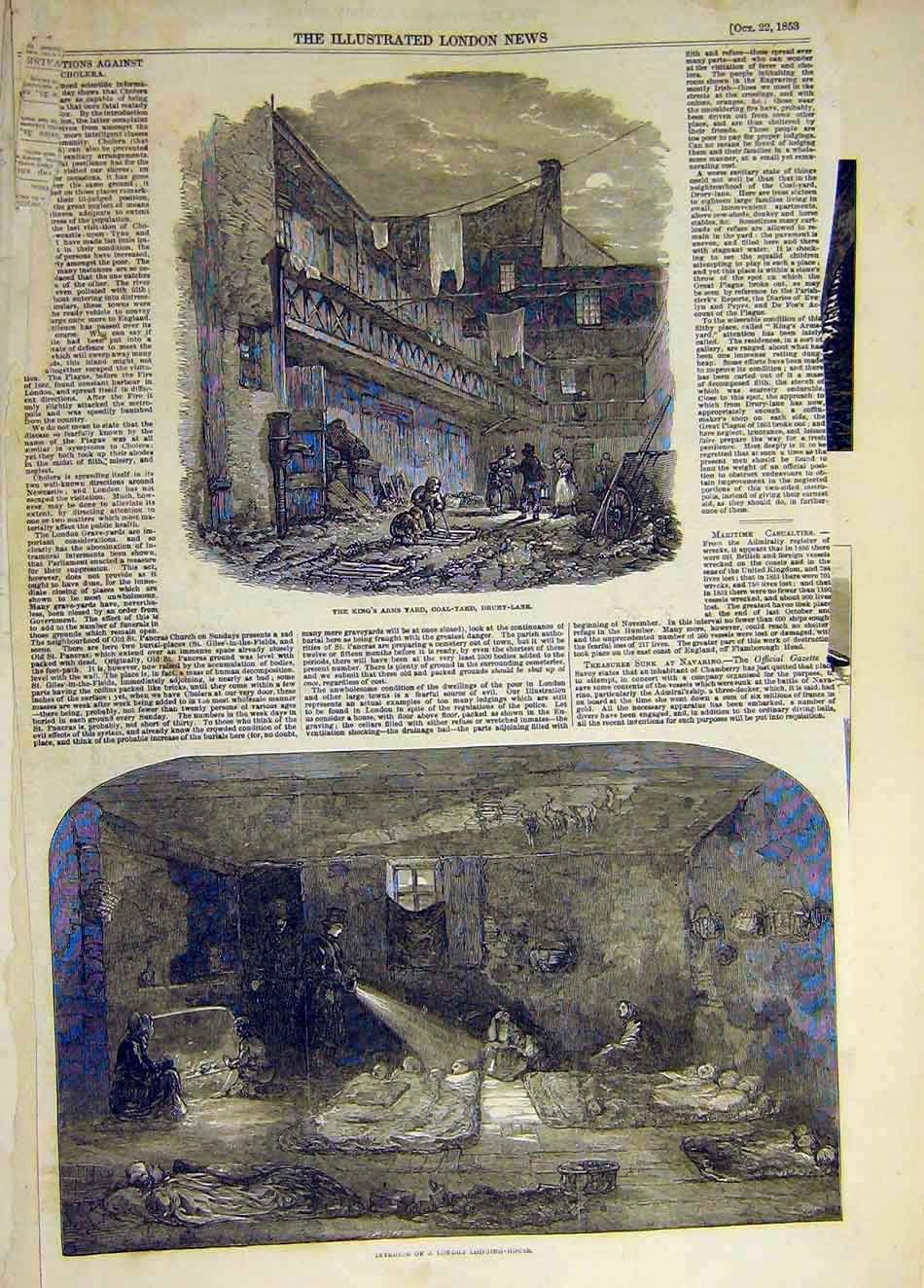
In October 1853 the “Illustrated London” News sent a reporter and an artist to Drury Lane to report on the poverty in the courtyards which festered behind the cheerful shopfronts. They went to Coal-Yard, at the north end of Drury Lane and they stated: 'A worse sanitary state of things could not well be than in the neighbourhood of the Coal-Yard Drury-Lane. Here are lying sixteen to eighteen large families living in small inconvenient apartments, above cow-sheds, donkey and horse-stables. Sometimes many cartloads of refuse are allowed to remain in the yard. The pavement is uneven, and filled here and there with stagnant water. It is shocking to see the squalid children attempting to play in such a place.' I can smell this place from here, 500 miles away and into the second millennium."
Wretched houses with broken windows patched with rags and paper: every room let out to a different family, and in many instances to two or even three. In the cellars, barbers and red-herring vendors, in the front parlours, cobblers in the back; a bird-fancier in the first floor, three families on the second, starvation in the attics, Irishmen in the passage, a 'musician’ in the front kitchen, and a charwoman and five hungry children in the back one - filth everywhere - a gutter before the houses and a drain behind - clothes drying and slops emptying, from the windows; girls of fourteen or fifteen, with matted hair, walking about barefoot, in great-coats, almost their only covering; boys of all ages, in coats of all sizes and many with no coats at all; men and women, in every variety of scanty and dirty apparel, lounging, scolding, drinking, smoking, squabbling, fighting, and swearing.
The gutters were stagnant and choked up with filth and cabbage stalks and other vegetables, the houses mouldy and discoloured with slime.
A well-known local tenement was known as Rats’ Castle, a large disgusting building occupied by criminals and prostitutes, and doubtless justified its name. It was so-called from the rat-catchers and dog skinners who inhabited it and who skinned the stray dogs which had died the previous day.
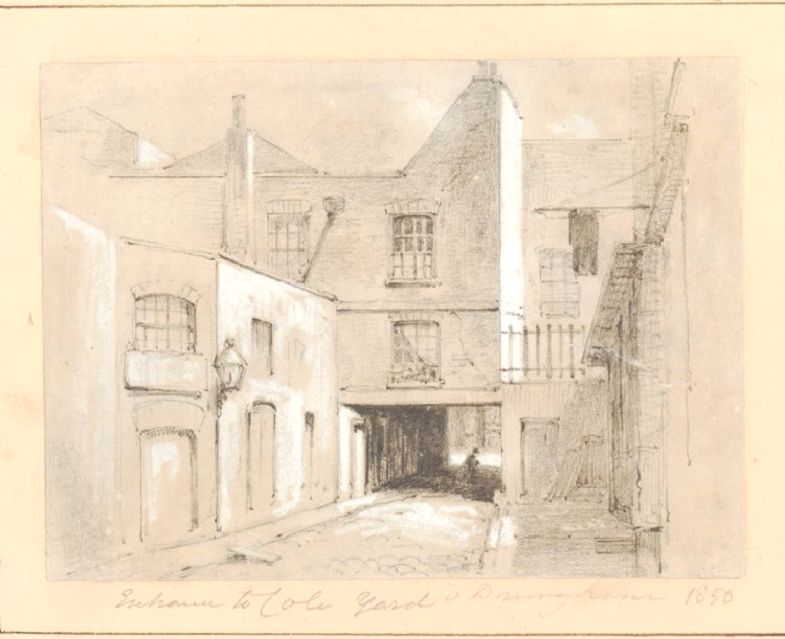 | 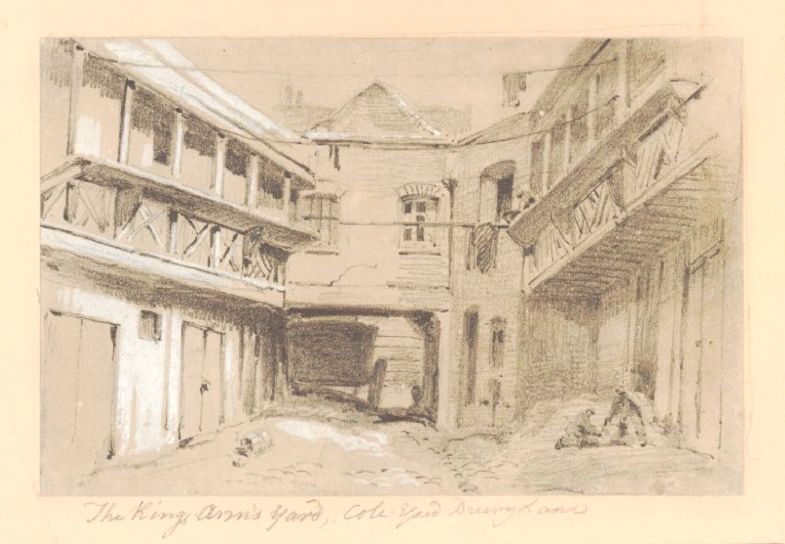 | ||||||||||||
| Entrance to the Coal Yard on the east side of Drury Lane - British Museum | The inner yard of the King's Arms, in Coal Yard, Drury Lane - British Museum | ||||||||||||
Illustrated London News 1853
Middlesex: Holborn (now in London Borough of Camden) have a plan of Coal Yard, King's Arms Yard and Smart's Buildings in the Division of Saint Giles and Saint George – available at the National Archives.
Let us ponder for just a moment, back to around 1853 when the drawing of The King's Arms Public House in Coal Yard was made, and let us imagine that the two children shown in the picture are those of George Barrand and Emma Chivers: George Richard and Henry James. Thery are playing in the yard and just what would they see if they looked around. The entrance to Coal Yard consisted of an archway, under which was a large amount of stable and cow-shed refuse. Once through the archway, the King's Arms Public House was No 5, Coal Yard, and the Barrands lived at No 6, Coal Yard. In the miserable condition of this filthy place, the residents live in one immense heap of rotting filth. Some efforts had been made to improve its condition, and there has been a mass of decomposed matter removed, the stench of which was scarcely endurable. Close to this spot at the entrance to Drury Lane a coffin maker's and undertaker's shop are placed most ominously at each side of the entrance. On the right-hand side, is the following rudely- painted notice: “Old Original Oyster, depot - Live and Let Live."
The ancient wooden houses are occupied as cow-sheds, and there is an archway, under which contains at least a dozen houses on each of the two sides, and a large collection of stable and cow-shed refuse. This is “King's Arms Yard,” a narrow place erected with a sort of gallery in front over stables. Most of the houses have rooms with only one window, located on the back wall, to let fresh air in. These windows however, are nearly always shut, creating a suffocating atmosphere by trapping noxious vapours. The rooms are filled with men and women sharing the same space. There are from sixteen to eighteen large families living in small, inconvenient apartments, above cow-sheds and horse stables.
Once inside the buildings, the state of the houses show a squalid, low-ceilinged interior filled with women and children wrapped in blankets, and either sleeping in groups on the floor, resting against a wall, or gathered around the hearth. The walls and ceilings of the room are cracked and peeling. In fact, the ceilings are so low that if any one of the people wanted to stand up, they would have to stoop to avoid hitting their heads. On the ground floor, a large patch of the stone floor creates a puddle in the middle of the room, while another part of the floor has been patched with wooden planks. The windows are partially covered by a dark cloth. Wooden tubs are placed on the floor to catch any water dripping from the stalactite-like formations hanging from the ceiling or to act as chamber pots for the occupants. The back wall contains a small wooden door which leads out into the yard and has a window with a broken pane. Laundry hangs along the walls and from lines attached to the ceiling. The spaces on the floor which are not occupied by people are covered with tubs, pans, and other utensils. More than twenty people lay on the floor at any one trime. The ‘heat and horrid smell’ of the ‘dirty, wretched’ room is ‘insufferably oppressive and offensive and privacy and cleanliness does not exist.
The houses are occupied as one room for a man, his wife and five children and the rent is 2/6d a week. Piles of dirt and cartloads of waste are allowed to remain in the yard for weeks on end. Nightmen work over the cesspools, removing the human waste that has accumulated during the day and the noxious vapours of these unsanitary cesspits force the inhabitants to breathe air that had the ‘smell of a graveyard.’ The privies of the dwellings are allowed to swill over into the yards and covered with scum and masses of rotting weed. These also contain the bloated rotting carcasses of dead animals bursting with putrid gases. Rain water which is collected in the housebutts preserved for the purpose of drinking as well as of washing, is foul and offensive. Within this dreadful place many children are kidnapped and trained to various forms of vice such as murderers, robbers and prostitutes and no one dared go unarmed.
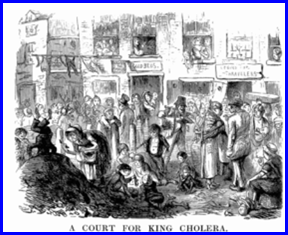
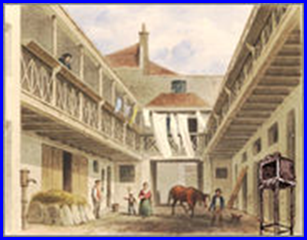
The illustration above indicated that the slum was cholera’s court; thus the poor were cholera’s courtiers. It represented an overcrowded and filthy quarter of the city. The picture shows barefoot children playing on a pile of refuse and of a woman picking scraps from it and stresses the association of the poor with filth. The physical appearance of the figures also marked them as different from the rest of British society. Here, many were shown with pug-noses, pot bellies, hunched backs, and tattered clothing.
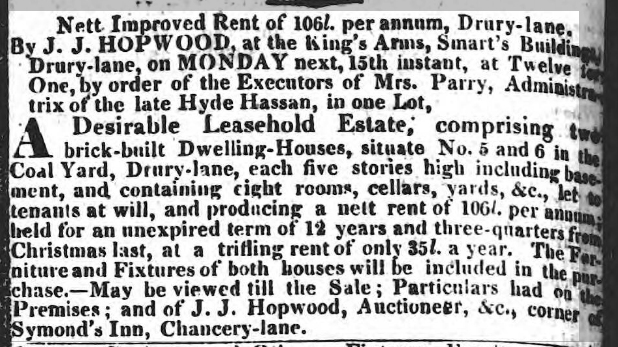
Morning Advertiser 12 January 1827 – 5 and 6 Coal Yard

London Daily News 15 May 1851
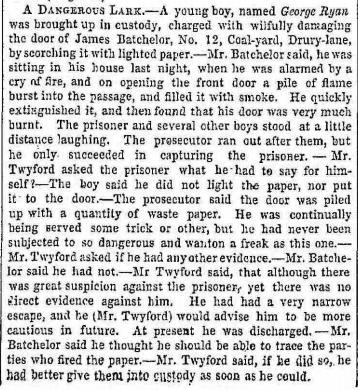
Lloyd's Weekly Newspaper 31 December 1843
Nell Gwynne
The remarkable life of Nell Gwynne, most famous of the many mistresses of 'the Merry Monarch', Charles II, a classical rags-to-riches story, began on 2 February 1650. Nell was was the daughter of Thomas and Ellen Gwynn, her place of birth is disputed, with some sources stating Pipe Well Lane in Hereford, which was renamed Gwynne Street in the nineteenth century, while others state she was born in London. Her father was of Welsh descent, a soldier ruined by the civil war, he is said to have died in a debtors’ prison in Oxford. Nell probably had no memory of him. Her mother 'Madam Gwynn', was born within the parish of St Martin-in-the-Fields, London, and is thought to have lived most of her life in the city, she was by most accounts an alcoholic who ran a bawdy house or brothel, where the young Nell is said to have 'served strong waters to gentlemen.' Nell grew up in squalid Coal Yard Alley, a poor slum off Drury Lane. Her mother was drowned in a pond at Chelsea, probably while drunk, in July 1679.
Because Nell Gwynne had her horoscope cast, we know exactly when she entered the world. She was born on February 2, 1650 at 6:00 am, probably in London. She was the younger daughter of Helena (Ellen) Smith and Captain Thomas Gwynn(e) possibly of the Royalist Army. We don’t know if her parents ever married but we do know Captain Gwynn(e) ended up in debtor’s prison in Oxford. Helena moved back to London, taking her two daughters with her. Neither Rose nor Nell were educated, and couldn’t even write their names. Helena was a drunk and ran a bawdy house near Coal Yard in Drury Lane near Covent Garden where her girls poured drinks for customers and may have even worked as child prostitutes. Nell also worked selling oysters and cinders, becoming a real-life Cinderella. One way or another, Nell's father seems to have been out of the picture by the time of her childhood in Covent Garden, and her mother was left in a low situation. Old Madam Gwynn was by most accounts an obese, brandy-swigging alcoholic whose business was running a bawdy house (a brothel). There, or in the bawdy house of one Madam Ross, Nell would spend at least some time. It is possible she worked herself as a child prostitute and Peter Thomson, in the Oxford Illustrated History of Theatre, says it is "probable". In around 1662, at the age of 12, Nell had an affair with a man named Duncan, which lasted around two years. He provided her with rooms at a tavern in Maypole Alley and may have secured her a job as an orange seller at a nearby theatre, where she worked with her older sister Rose. It must be said that in everything that was external, except her beauty, she fell short of a fastidious taste. She was intensely ignorant even for that time and she spoke in a broad Cockney dialect. She had lived the life of the Coal Yard, and, she could never remember the time when she had known the meaning of chastity. Alexander Smith's 1715 Lives of the Court Beauties says she was born in Coal Yard Alley in Covent Garden and other biographies have since followed suit. She was known to have had at least two other lovers – Charles Hart and aristocrat Charles Sackville, Lord Buckhurst – by 1667 George Villiers, Duke of Buckingham, had decided to bring her to the attention of the king as a possible new mistress and so increase his influence. By 1668 or 1669, Nell is believed to have succeeded in this, joining the growing number of women who could claim the title (Charles II ended up having at least 12 children by his many mistresses). Her acting work gradually decreased and in 1670, she gave birth to Charles, her first son and believed to be the king’s seventh illegitimate child. In February, 1671, Nell moved into a townhouse at 79 Pall Mall (she was granted freehold of the property five years later and the property, which still stands, remains the only one on the south side of Pall Mall not owned by the Crown) and in December, she gave birth to her second child by the king, another son James (he died in Paris while attending school there 10 years later). Unlike Charles' other mistresses, Nell never received a title herself, but she obtained a title for her son. When Charles Beauclerk was six years old, on the arrival of the King, Nell said, "Come here, you little bastard, and say hello to your father." When the King protested, she replied, "Your Majesty has given me no other name by which to call him." On 21 December 1676, Charles II granted to Charles Beauclerk, the titles of Baron of Heddington and Earl of Burford. On 5th January 1684, he was created Duke of St Albans. Shortly afterwards, the King granted a house which was renamed as Burford House, on the edge of the Home Park in Windsor, to Nell and their son, where she lived when the King was in residence at Windsor Castle.Both sons were given titles – Charles was later named Duke of St Albans – and given the surname Beauclerk. In the 1670s, Charles granted Nell Burford House in Windsor where she resided when the king was resident there. When King Charles II died on 6th February, 1685, he left instructions she was to be looked after – his brother King James II paid her debts and continued to pay her an annual pension. King Charles's deathbed request ('Let not poor Nelly starve') meant in 1685, Nell was left with a £1,500-a-year pension (about £150,000 in today's money). He asked in return that she and her son should convert to Catholicism but she refused to. All her debts were paid by James II, Charles's younger brother and heir. In March 1687, Gwynn suffered a stroke that left her paralysed on one side and in May 1687, a second stroke left her confined to the bed in her Pall Mall house. Nell Gwynn died from apoplexy (possibly due to a strain of syphilis) on 14 November 1687 still only aged in her thirties. She was buried with her mother in the church of St Martins-in-the-Fields. A 1667 entry in Samuel Pepys' diary records, second-hand "Here Mrs. Pierce tells me that Nelly and Beck Marshall, falling out the other day, the latter called the other my Lord Buckhurst's whore" Nell answered then "I was but one man's whore, though I was brought up in a bawdy-house to fill strong waters to the guests; and you are a whore to three or four, though a Presbyter's praying daughter!" which was very pretty. Pepys records in his diary under May 1, 1667 – to Westminster; in the way meeting many milkmaids with their garlands upon their pails, dancing with a fiddler before them; and saw pretty Nelly standing at her lodgings door in Drury Lane in her smock sleeves and bodice looking upon one; she seemed a mighty pretty creature.
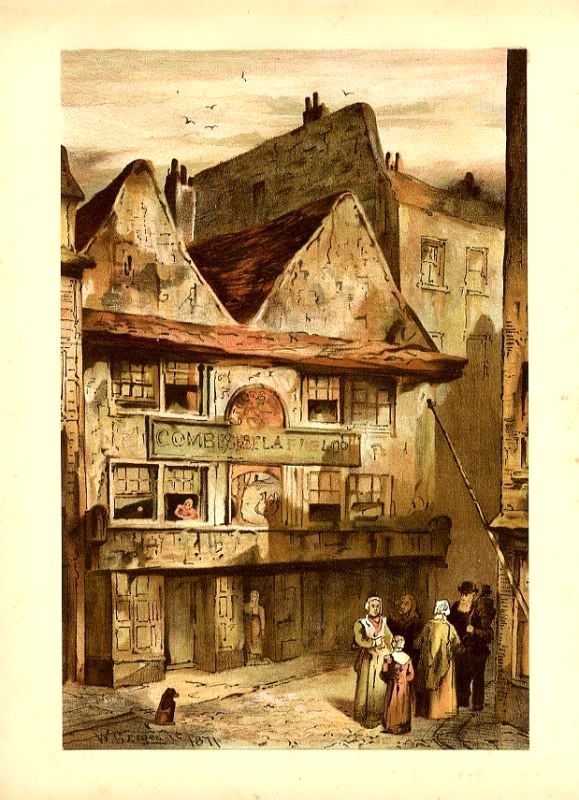
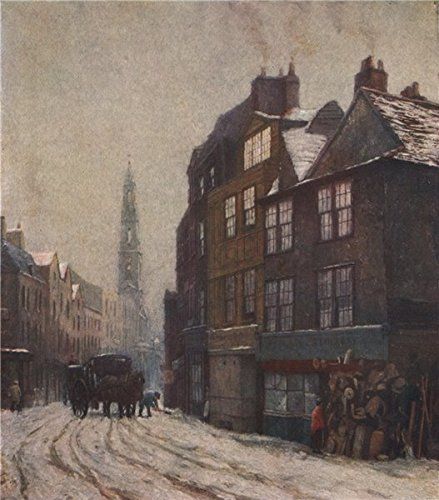
Nell Gwynn’s house in Drury Lane. (There is a sign on the front of the building bearing the name Combes or Combe). 2nd picture by by Philip Norman.
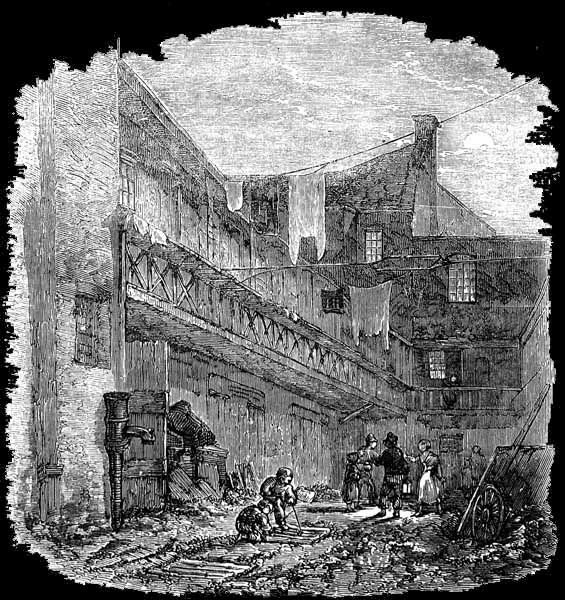
Illustrated London News 1853
Here is a drawing of Coal Yard showing a water pump, drawing drinking water right next to the two gratings where the animal waste - and, no doubt, human waste - would be drained. 185 people died in the Drury Lane area in the 1849 cholera outbreak. By 1841, the average family in Coal Yard is living in a single room just 4 metres by 4 metres; it is home to two adults and four children. This unfortunate building was never intended to be occupied this way.
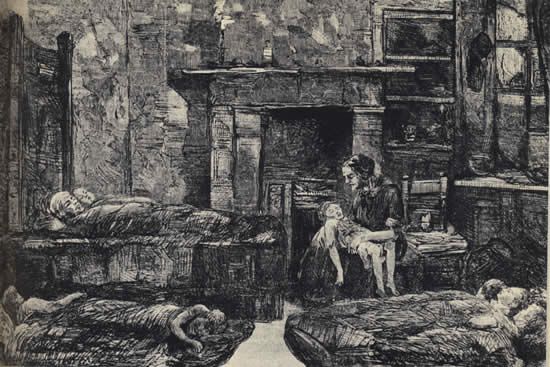
What the houses at Coal Yard would have looked like
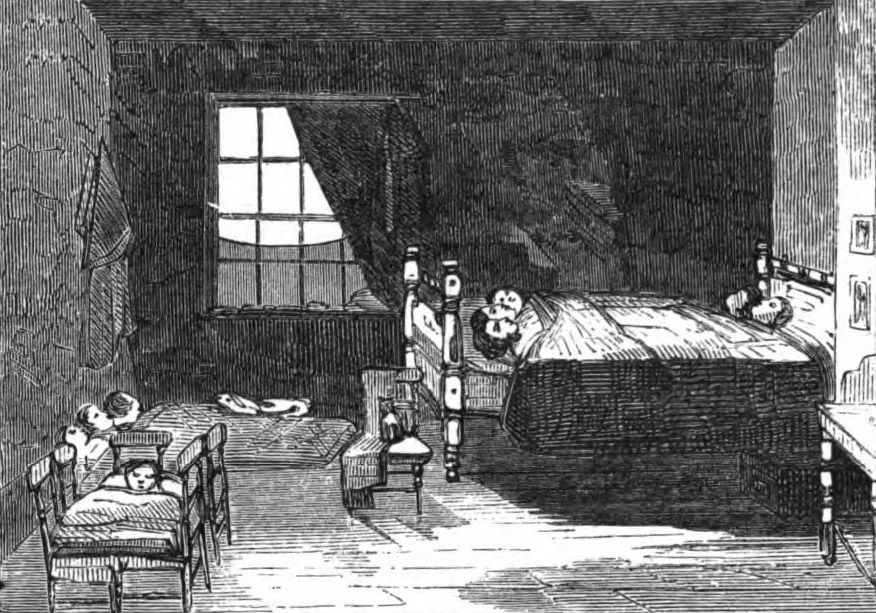
Next, we can envisage the sleeping arrangements, six people sharing the single room. Here, an illustration shows nine, though often it was many, many more.
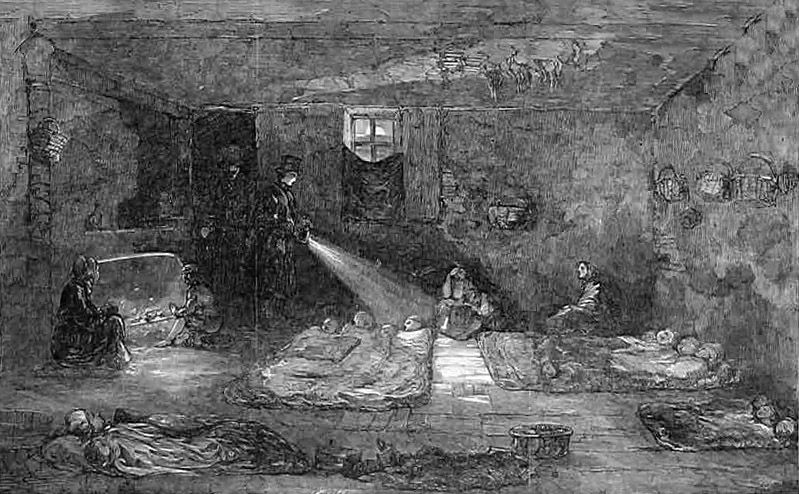
Typical of a room in Coal Yard – Illustrated London News 1853
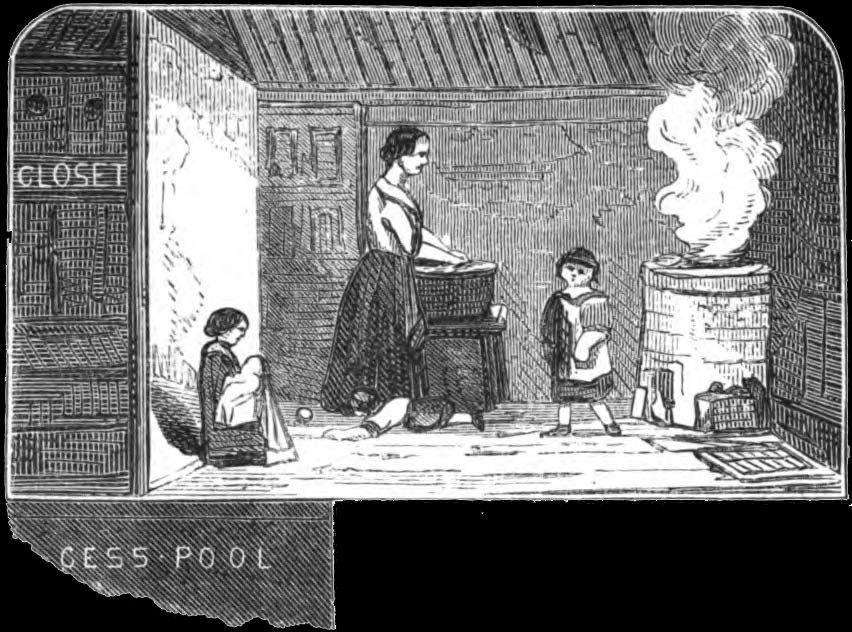
Although flushing toilets had been invented in Britain in the 1770's, in 1841 London, they were still practically non-existent, and in any case, there were no sewers, only cesspools, and when flushing toilets were introduced into such a situation, they only made things worse. Coal Yard was a good example from a report in the Illustrated London News 1853. Cesspits were usually underground brick structures with arched roofs, a bit like a sewer - except that they didn't lead anywhere, and would eventually overflow if not emptied by digging them out with a shovel. Cesspools were in the yard, or under the house. Sometimes there would be a 'closet' or toilet as we would call it now, directly over the cesspool, usually outside the house. This would have no water trap, just a seat built up by bricks directly over a hole into the cistern of waste. One can only imagine the smell. The alternative was to use a chamber pot in your room and empty it into the drain. The Victorians certainly believed that many illnesses, including deadly scarlet fever and cholera, were carried by bad vapours from an unsanitary environment. In the picture above, the children are breathing the bad air seeping up through the floorboards from the cesspool, making them ill and ultimately killing them, whilst mum does the laundry: In reality, it was direct contact by other people for scarlet fever and tuberculosis, or contaminated drinking water in the case of cholera, which was spreading the disease. We know that the houses they lived in were among the absolutely poorest, so perhaps it's not such a stretch to imagine that his living conditions may not have been much better than those revealed by the Illustrated London News in 1853: As people did not understand the basic rules of hygiene, and toilet paper had not been invented, rags or clothes were soaked in vinegar and hung on the back of the toilet door to be used by all.
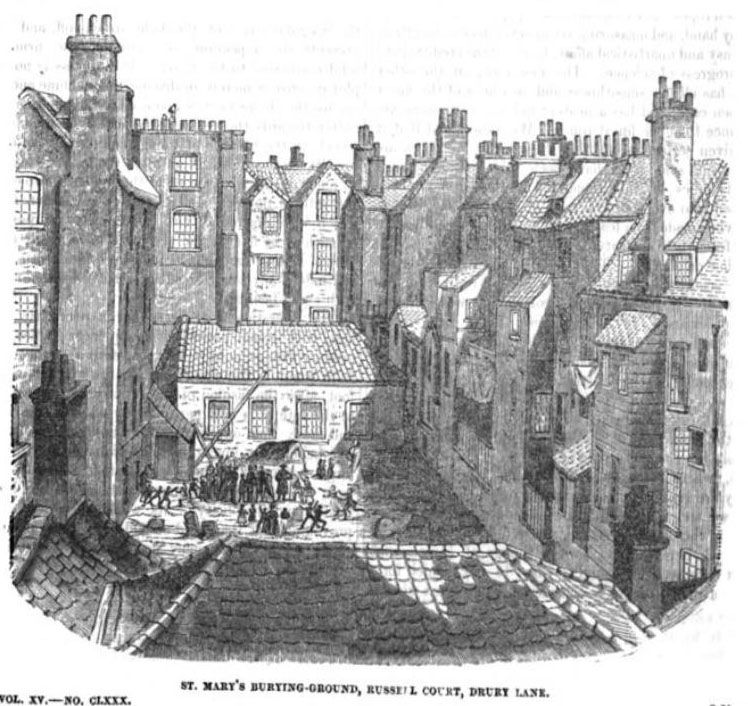
There were numerous small churches around the Coal Yard, Clare Market and Drury Lane area and St. Mary’s Church in Russell Court situated near Coal Yard had its very own tiny medieval cemetery in the courtyard in the middle. The houses around all had a view of the Victorian burials which took place daily, and the experience of the decay emanating from the accumulation of ever-increasing numbers of rotting bodies. Those that lived on the ground floor of Russell Court got a closer look each day because the ground level was rising year on year due to the sheer volume of burials taking place. The burial ground was forced to close in 1849 as they just couldn't get any more bodies in it.
This burying ground belonged to the parish of St. Mary le Strand; and in its original state, it was below the level of the adjoining ground, but eventually the surface became level with the first-floor windows of the houses entirely surrounding this place. In about 1820, a very respectable tradesman in the neighbourhood was employed to make a "cold air drain" at the west end of this ground and for this purpose it was necessary to cut through the wall of an adjoining house. On taking up the ground floor of this house, large quantities of human bones were found scattered about, - it was supposed they had been dragged by the rats, of which vast numbers infested the proximity of this burying ground. On the 20th May, 1832, a man who had committed suicide was buried there and it was reported that when the man was buried it was in the most offensive and decaying condition, and was placed within a very little distance of the surface with the soil just covering most the body. Remains were found showing that the coffins were placed side by side and one above the other from a depth of 12 feet to within 2 feet or even less from the surface. The ground, according to the statement of the sexton, “often feels quite greasy to the touch”. The Times in 1843 reported that a family would not accept a burial in a 2.5 ft deep hole so the diggers pickaxed open a coffin, “exposing the mortal remains of its pale tenant”, tipped out the corpse, “smashing and mixing it up with the clay”, and then dug up two more coffins. Although the area consisted of just 400 square yards, more than 20,000 bodies were interred there in a fifty-year span. Russell Court opened out of Drury Lane at the back and side of the Drury Lane Theatre, and was a network of narrow, flagged passages built up with tall houses. There were rag and bone shops, waste-paper shops, two or three greengrocers' stalls, a pawnbroker's, several cobblers, and in the centre of the place, where the alley widens into the courtyard, the graveyard is found in the very heart of this populous block. Few of the graves were ever marked, and most of the remaining tombstones were set-up on end against the walls of the houses. It was said that “The people of the block, shut the dead in with them when they shut their doors at night.
Remains were found showing that the coffins must have been placed side by side and one above the other from a depth of 12 feet to within 2 feet or even less from the surface.
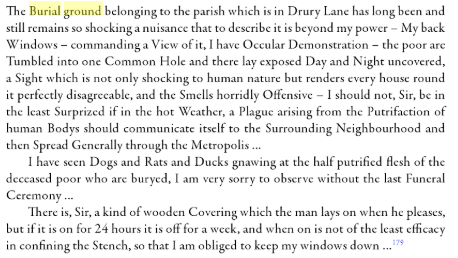
The conditions were described by a parishioner in a letter to the vestry:
Drury Lane Theatre Russell Court Russell Court Burying Ground
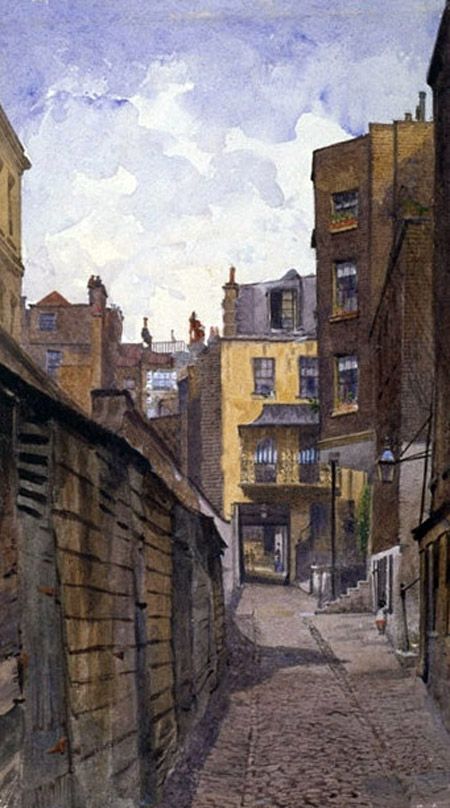
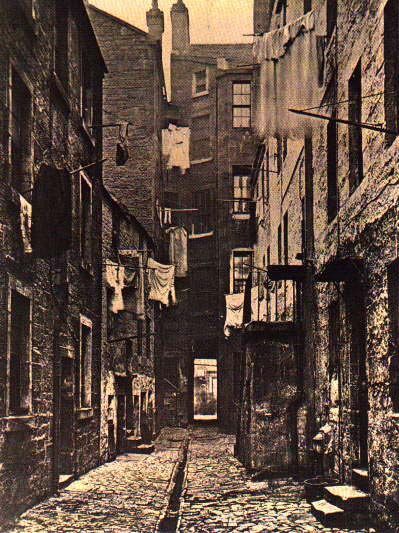
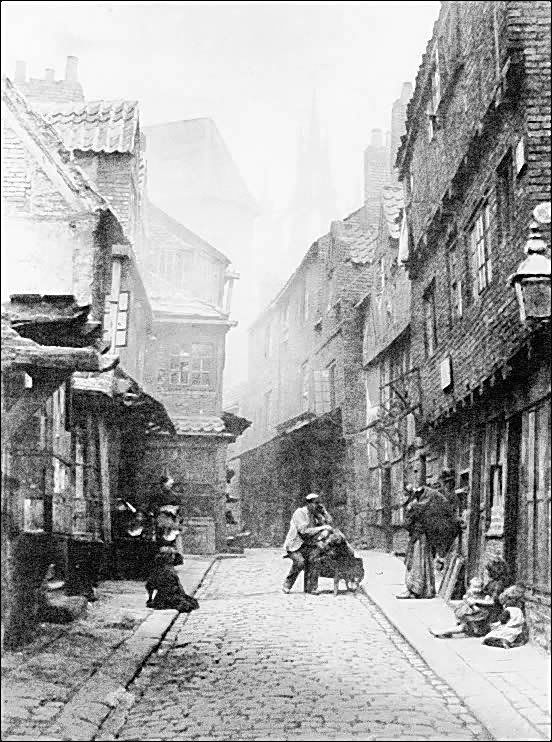
Houses on Drury Lane
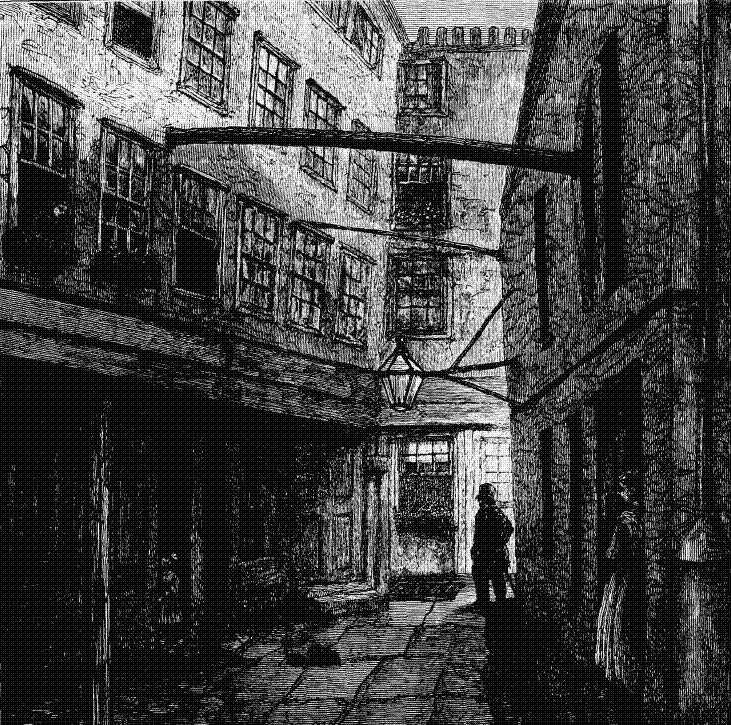
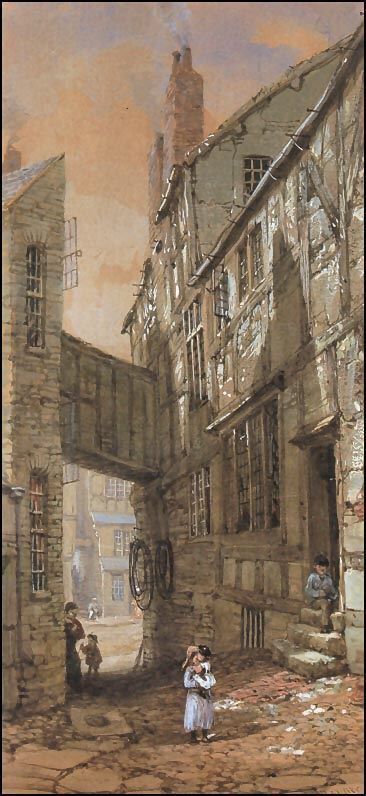
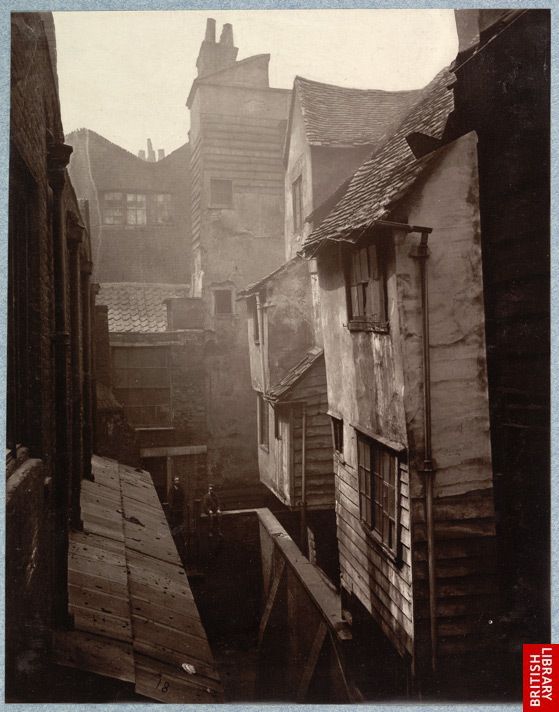
Houses on Drury Lane c1850
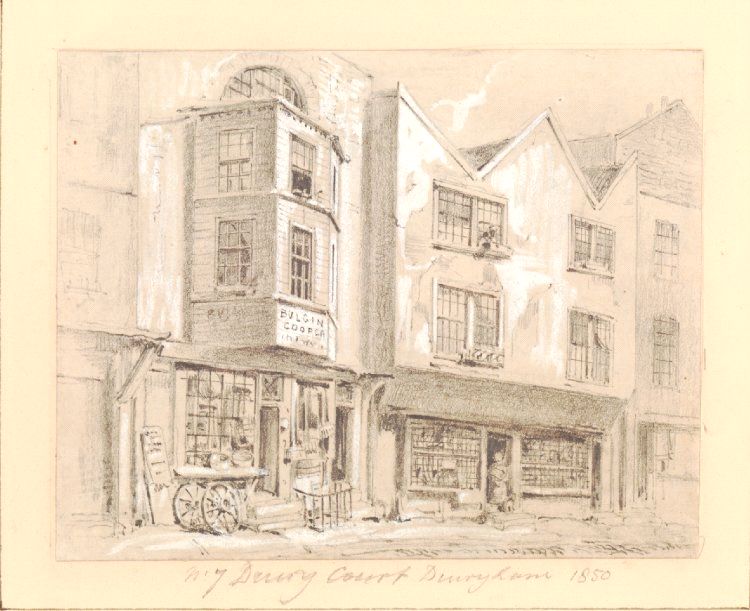
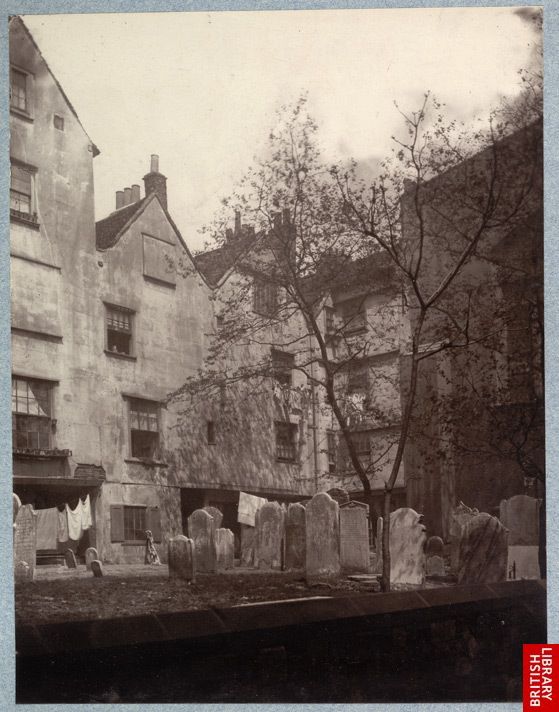
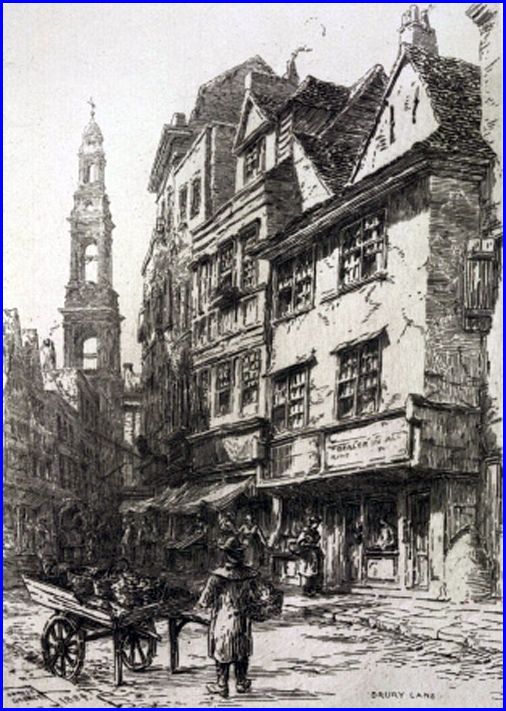
Houses on Drury Lane c1850
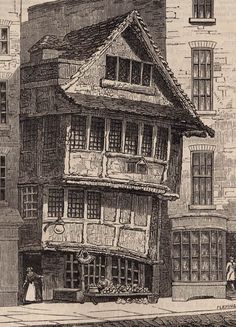
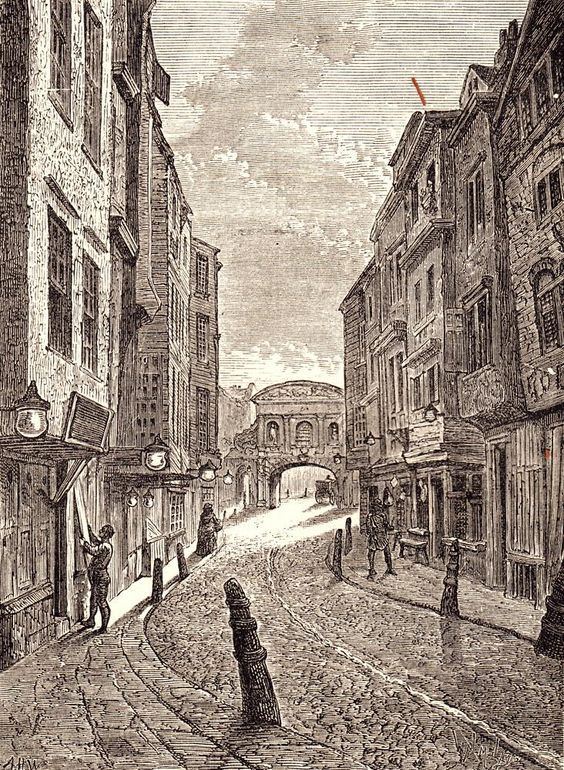
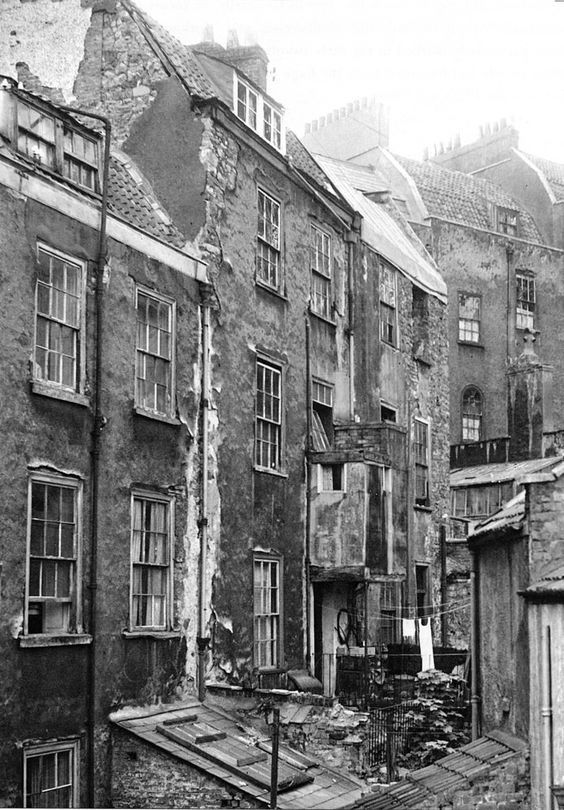
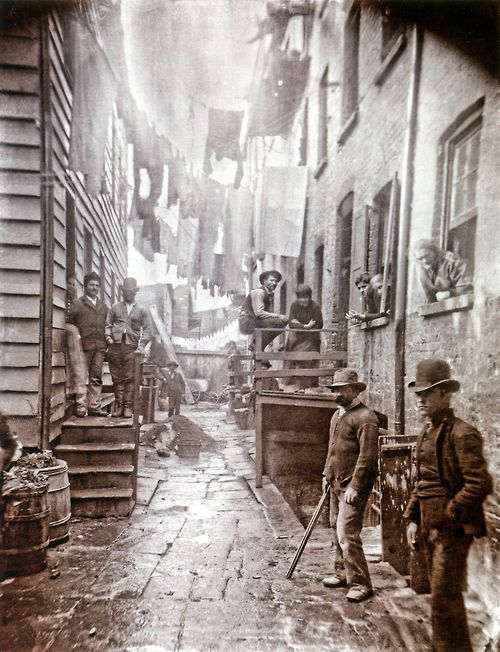
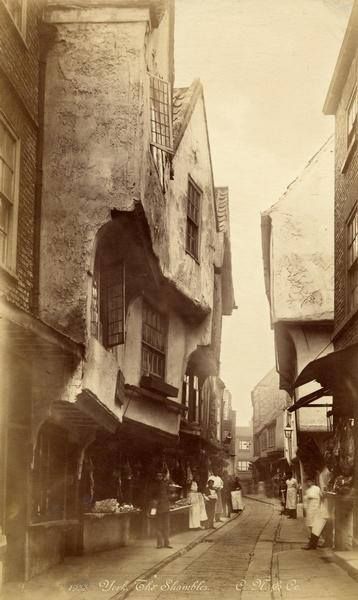
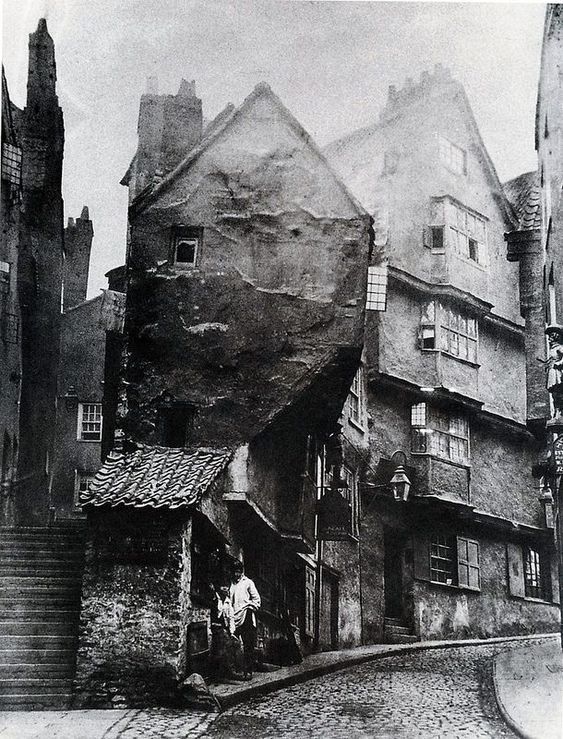
Houses in London
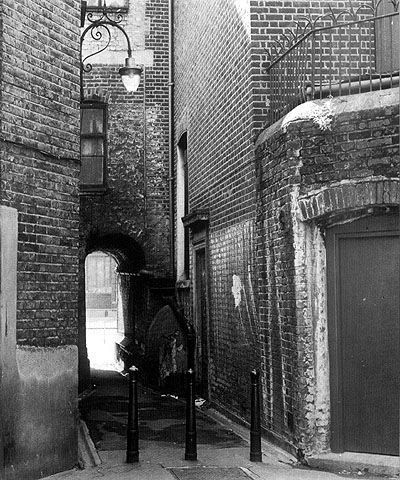
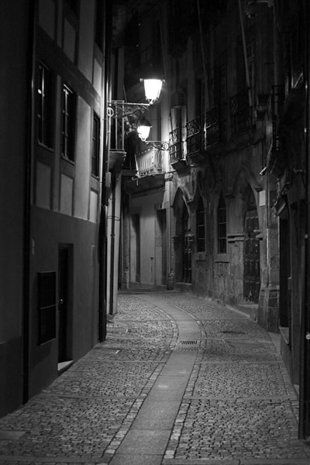
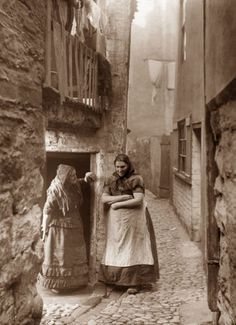
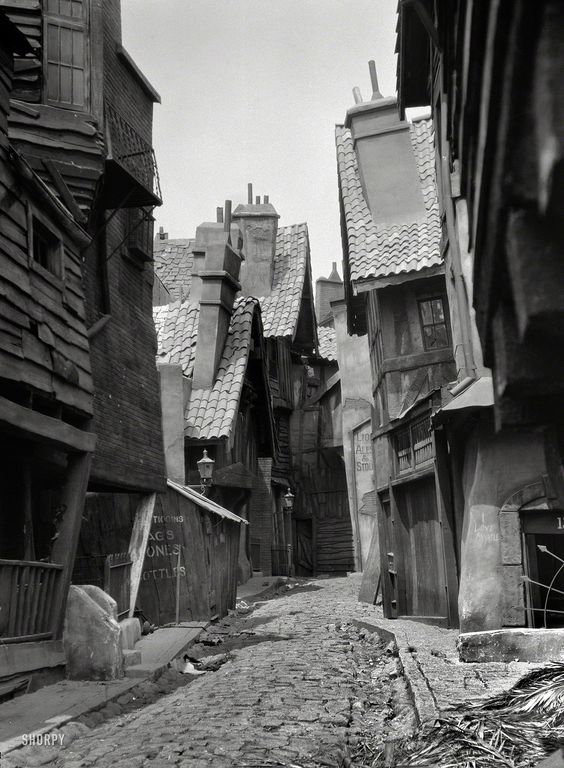
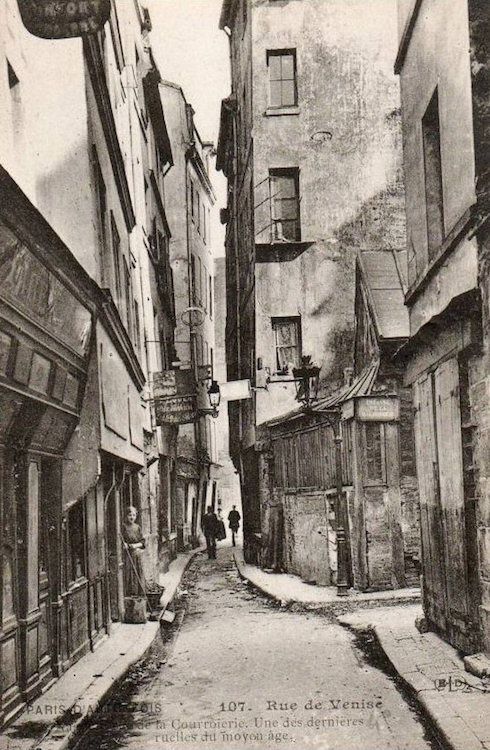
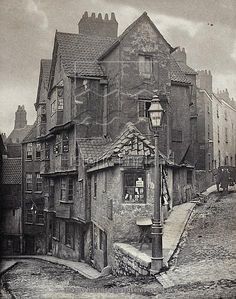
Houses in London
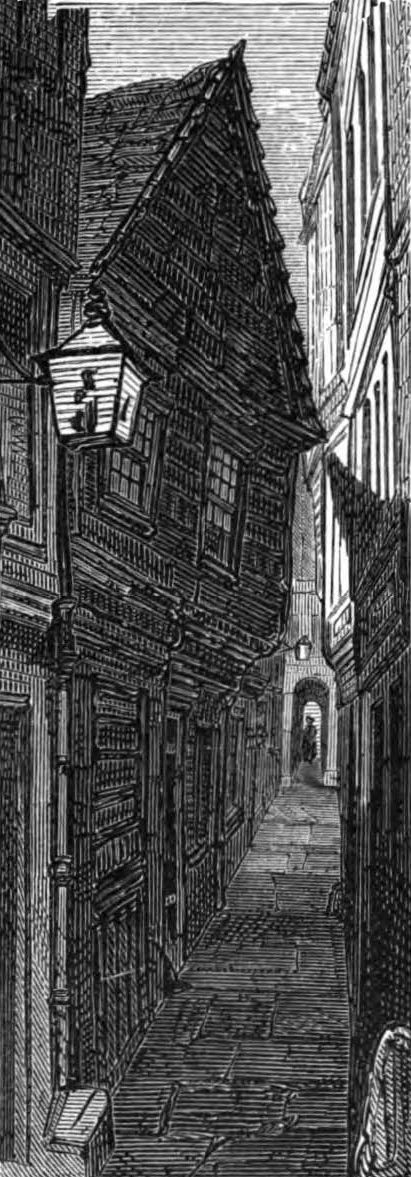
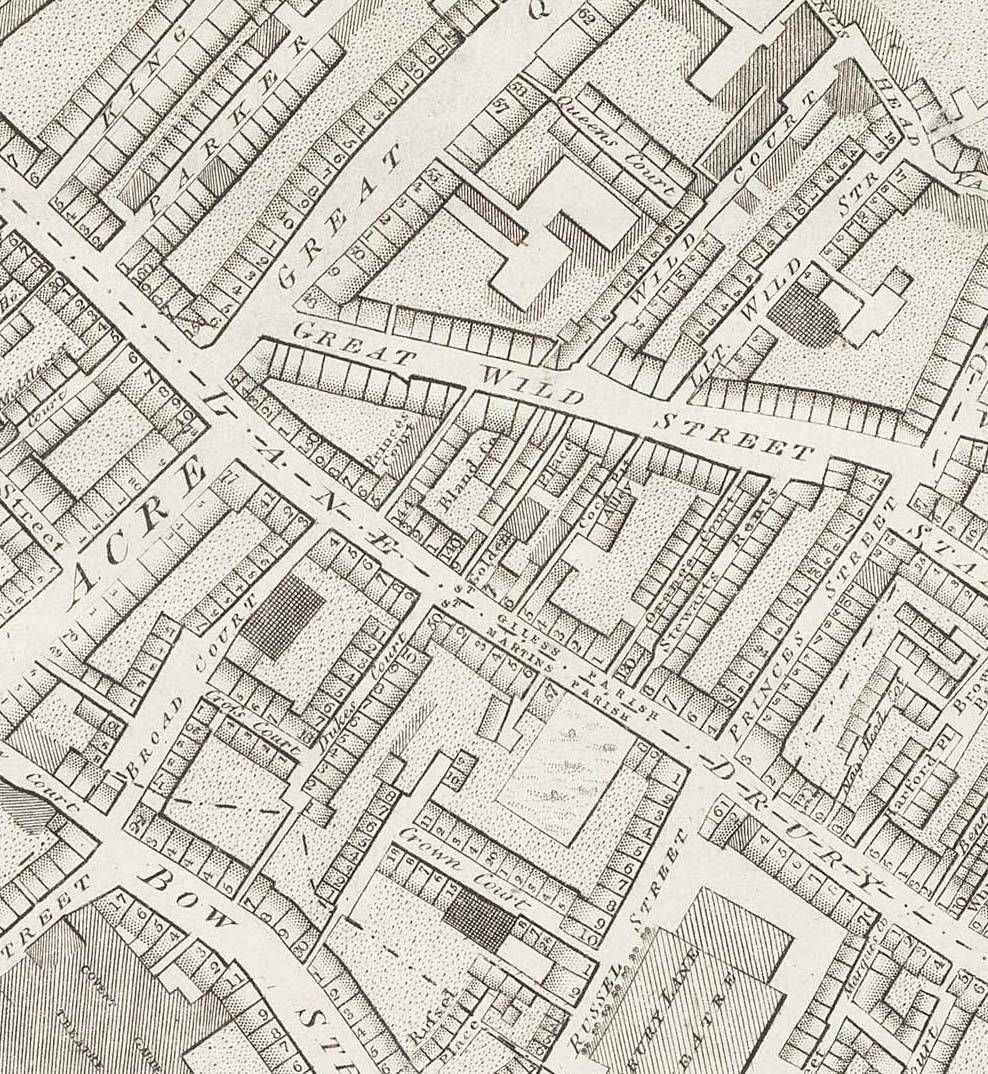
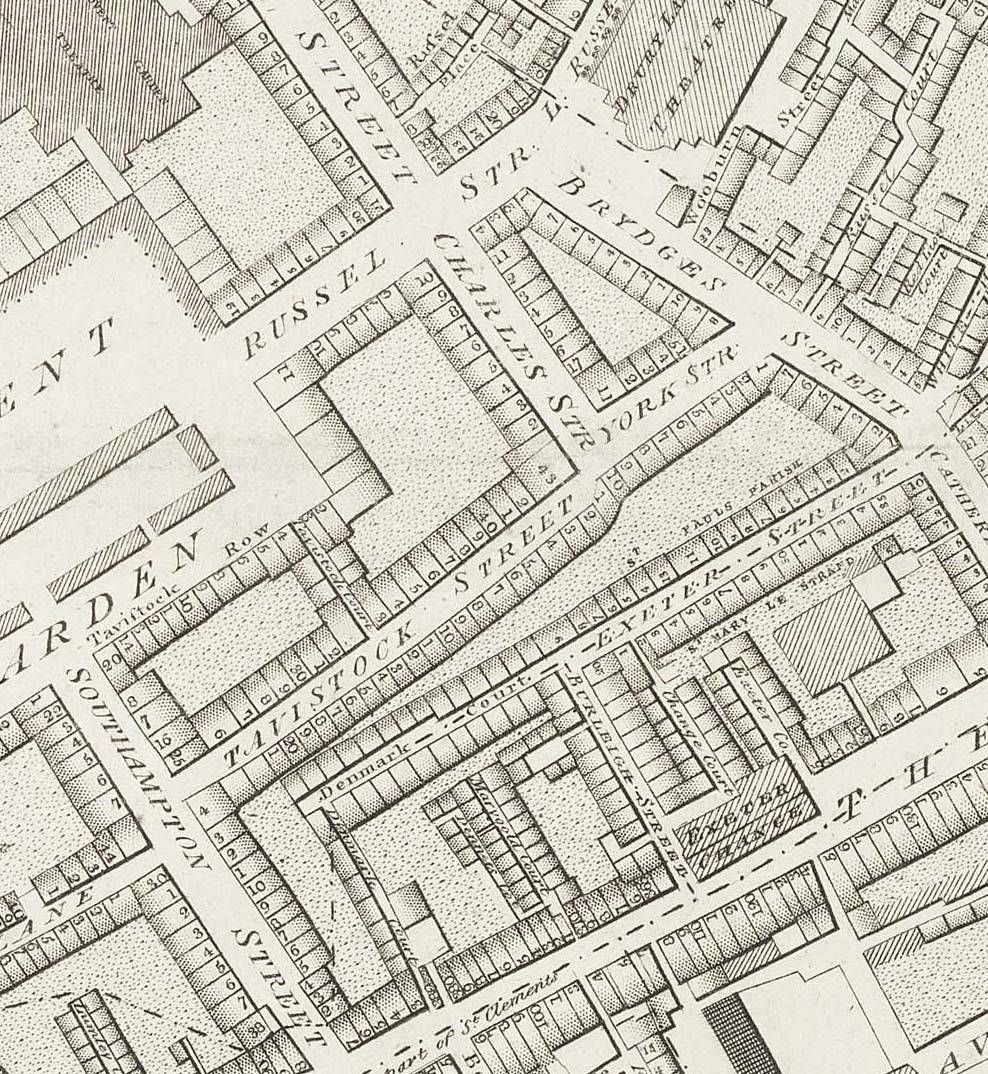
An illustration from “Another Blow for Life”. Shows a court running out of Coal-Yard, and since it's not named, it's not possible to tell which one it is among the maze of alleys and rat-runs. However, because Richard Horwood's map is drawn with a strict eye for scale we are looking for a very narrow alley, and the most likely candidate is Shaw's Court. The width of this court is only about thirty-one inches and in one part the wooden building very nearly touches the opposite side.
Drury Lane was recognised as one of the lowest haunts of the parish of Clement Danes, and consisted entirely of houses of ill-fame of the worst description, stored with the foulest moral pollution. There might be seen in the broad glare of day, sitting at the windows of nearly every house, abandoned women, young and old, decked in tawdry finery, bloated with gin and bauchery, lavishing enticing smiles, and bandying obscene expressions to entrap the unwary passer by. The scenes enacted at night were of the most horrible description; and at last it’s abominable notoriety became so glaring that in 1868, the parish authorities were compelled to expel the occupiers, which they did, and the vicious inhabitants were turned out; but only for some of them to resume their shocking mode of living in nearby Wych Street.
Barley Court, in Coal-Yard.
Barley Court is accessed from Smart's Buildings and the drawing below would be an illustration of Barley Court taken from Smarts Buildings.
In the afternoon, women muddled and tipsy were singing lewd and offensive songs. In some of the rooms three families often sleep together in each room. Here in Barley Court, many thieves could be found. In fact, the houses were noted as being almost entirely occupied by convicts, runaway sailors and prostitutes. No man could enter the court at night with safety. There were frequent rat-catching competitions with dogs and ferrets. Wagers were placed on the number of rats a dog could catch in a certain amount of time. For each rat killed, the winning dogs’ owner would be paid up to 9d each, and very often up to 200 rats could be killed by a good ratting dog. Many children preferred catching rats to cleaning chimneys or working in coal mines. One reason rat catching was popular with the youth was because it was lucrative. De-ratting businesses earned rat-catchers wages that ranged from a shilling to one pound. However, because rat catchers had to make an investment and at least own a terrier or a ferret, many rat catchers were older youths.
There are numerous reports in the newspapers mentioning Barley Court:-
In 1851 a young child was murdered and in 1870 another child was suffocated to death.
In 1856, three women described as "dirty dissipated-looking Irish women living in a low den" giving the names of Margaret Wimpole, Mary Taylor and Elizabeth Sweeny, were charged with prostitution. They also were charged with inviting a youth named Samuel Planter into their den and and extorted money.
In 1862 a young woman was found in a doorway, so drunk that she died. It was mentioned she got her living from working at night.
In 1865, a man, Robert Lord was thrown out of an upstairs window by a woman who turned out to be a prostitute. The upstairs premises were well known as a brothel, or as mentioned "a house of ill fame". The man died and the woman, Anne Smith was charged with murder.
In 1871 a 3 month old baby called Agnes Anderson was murdered.
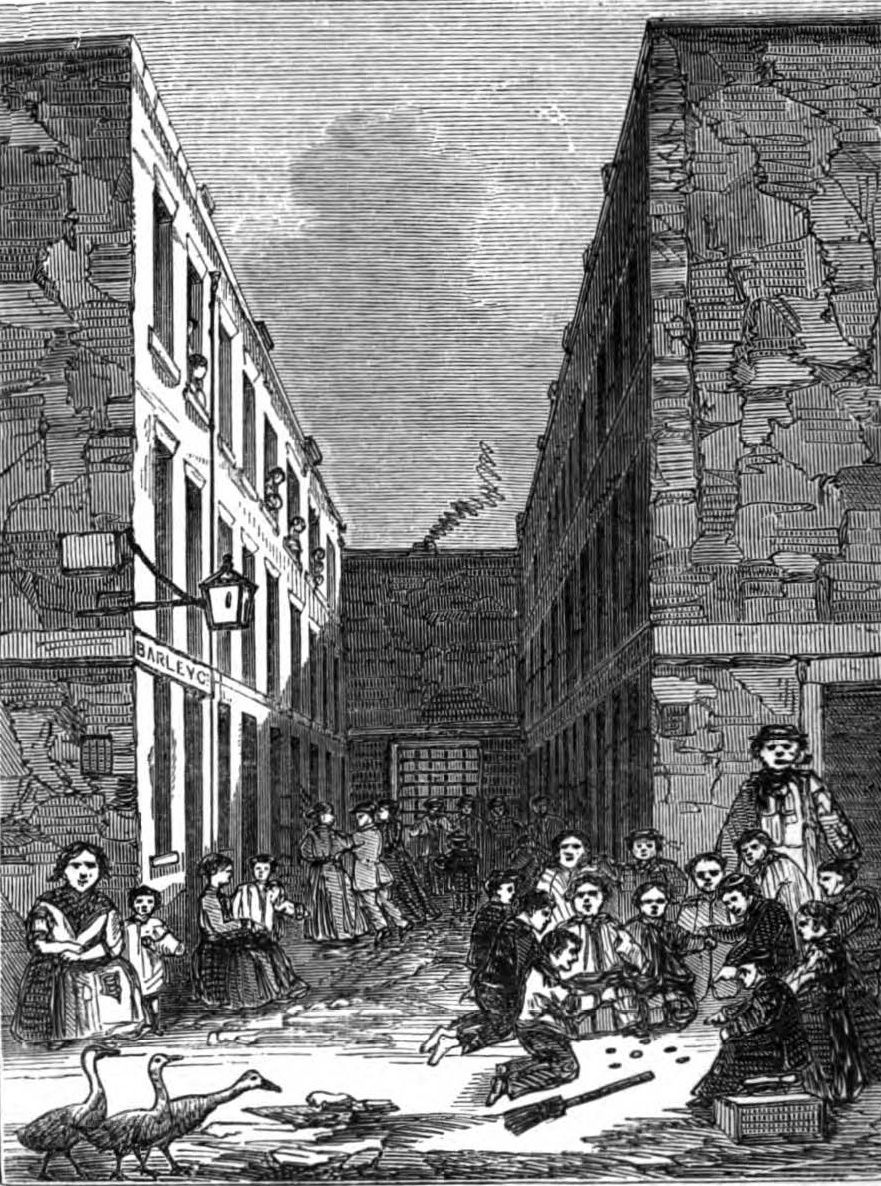
Barley Court, in Coal-Yard. Barley Court is accessed from Smart's Buildings and this would be an illustration of Barley Court taken from Smarts Buildings.
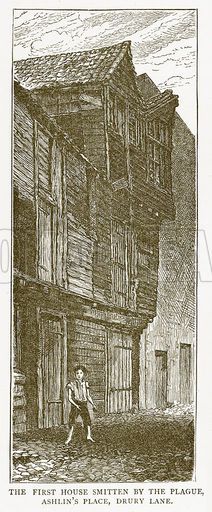
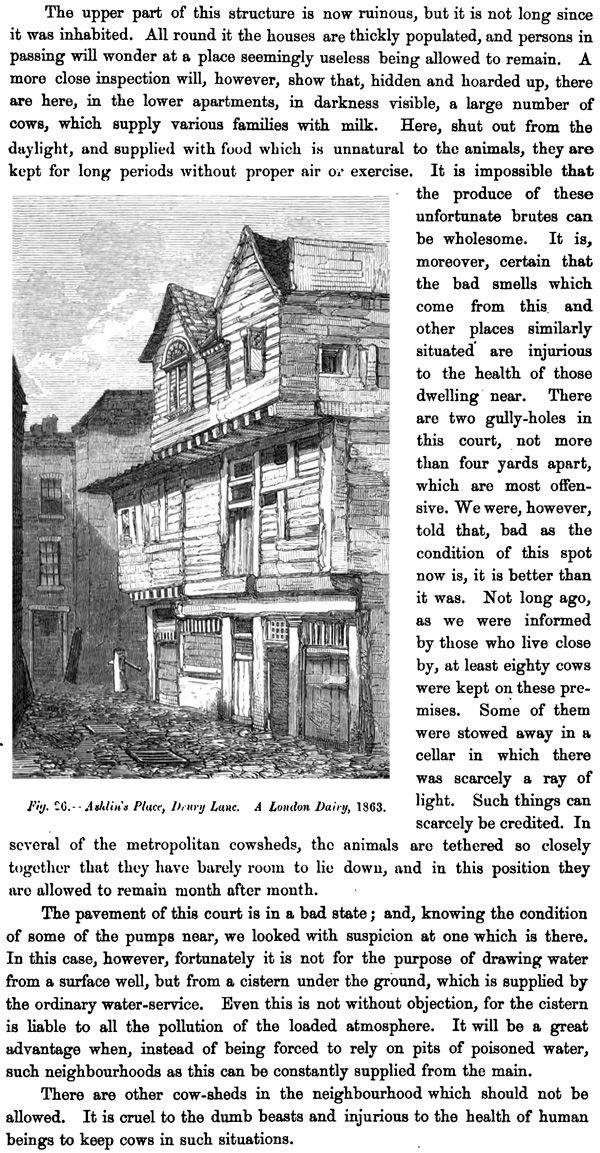
Ashlin's Place was claimed to be the starting-point of the Great Plague of London in 1665. Here's what it looked like in 1863. It was accessed from a turning at No 12 Drury Lane.
| John b 04/11/1752 d 1830 - 1840 Frances bc 1753 d 14/02/1831 = c 1778 William Potter b 1750 d 1818 Thomas bc 1755 d 1810 = 22/06/1781 Susan Cook bc 1752 d 1822 James b 1756 d 1756 Mary b ? d ? = 20/05/1783 John Jones Sarah b 1761 d 1833 James Mather b 1761 d 1823 Mary Turpin b 1732 d 1821 John Barraud b 1728 d c 1765 Re-married in 1772 to William Pether = 12/12/1772 William b 1760 = 29/05/1803 Margaret Callow b 1764 d 1837 = 04/03/1783 = 27/11/1752 Elizabeth b 1763 d 1827 Thomas b 1783 d 1836 Peter Cook b 1785 d 1839 Elizabeth b 1787 Ann b 1789 d ? John b 1791 d 1871 Joseph b 1793 d 1839 Eliza Cook b 1795 = 11/11/1804 Sarah Eliz. Took b 1780 d 1852 = 05/09/1810 Eliz. Corry b 1784 d 1837 = 15/11/1812 John Stead b 1778 d ? Ann Routeledge b 1795 d 1857 = 27/03/1827 Eleanor Page b 1795 d 1845 = 24/08/1815 James Able b 1779 d 1849 William b 1782 d 1835 = 06/04/ 1804 Alice Young b 1774 d 1833 = 29/11/1813 Robert W, b 1815 d 1839 Thomas b 1822 d ? Emigrated = 16/02/1846 Caroline Anderson b 1826 Arthur b 1824 d 1854? (Eliza) b 1826 d 1828 Phoebe b 1828 d 1829 James b 1830 d 1914 Alfred b 1834/36 d 1854 John b 1818 d 1867 Emma Lash b 1829 d 1894 = 09/08/1852 George Richard b 1820 d 1872 Emma Chivers b 1825 d 1890 = 19/05/1844 = 16/03/1841 Eleanor West b 1821 d 1859 Susan b 1817 d 1876 William Baskett b 1818 d 1899 = 09/12/1844 | ||||||||||||
GEORGE BARRAND Male
Event(s):
Birth: 29 JUL 1820
Christening: 20 AUG 1820 Saint Anne Soho, Westminster, London, England
Parents:
Father: JOHN BARRAND
Mother: NANCY ROUTELEDGE
Source Information:
Batch No.: Dates: Source Call No.: Type: Printout Call No.: Type:
C062361 1817 - 1837 0918607 Film NONE
IGI Record of George Barrand’s birth and baptism 1820
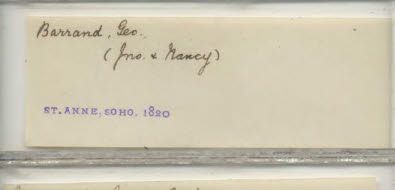
Pallots record of the birth of George Barrand
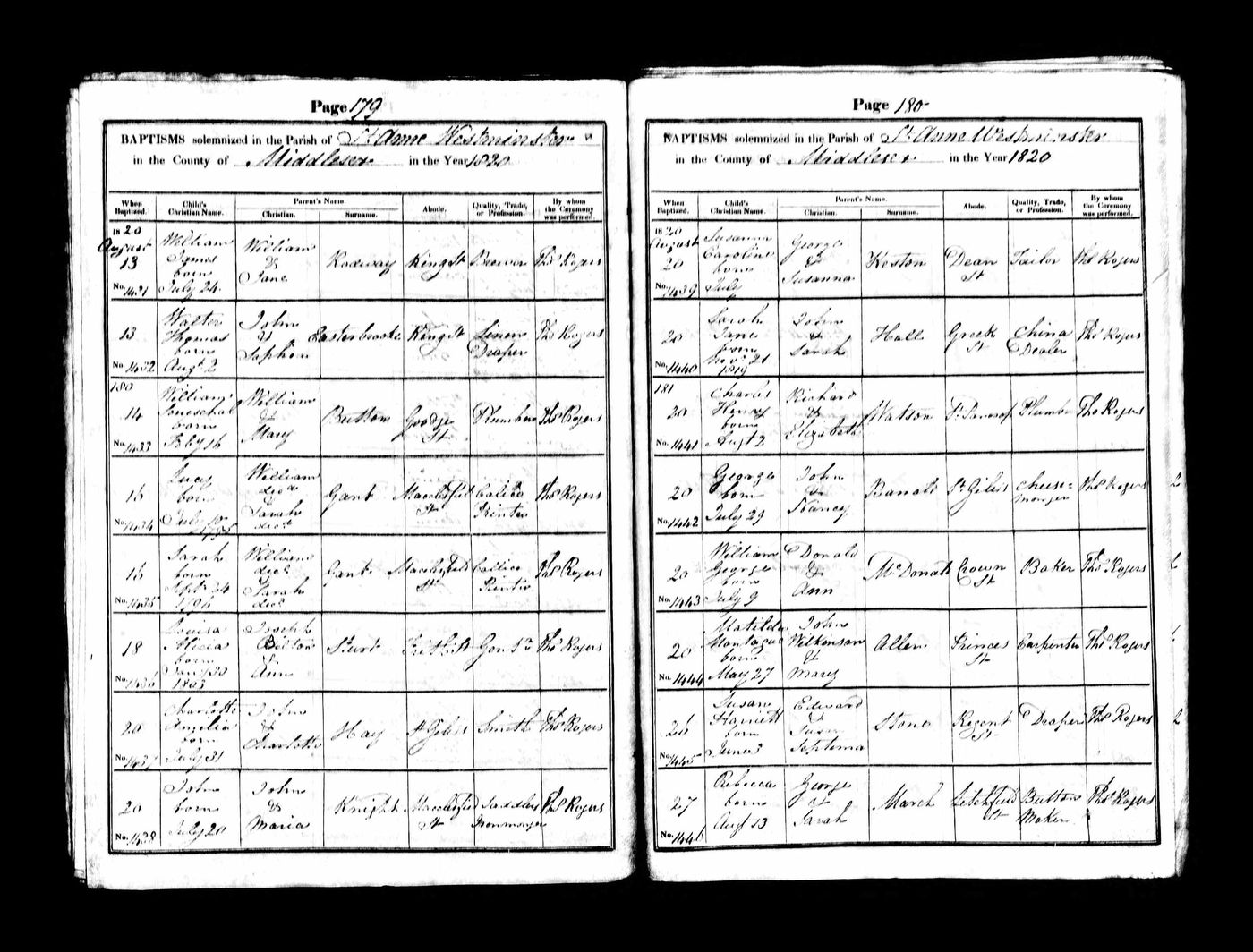
Baptism record of George Barrand
Old Bailey Court Record
WILLIAM WALLACE, Theft simple larceny, 23rd October 1837.
Reference Number: t18371023-2241
Offence: Theft simple larceny
Verdict: Guilty no subcategory
Punishment: Imprisonment no subcategory
WILLIAM WALLACE was indicted for stealing, on the 25th of September, 1 plane, value £l. 4s, the goods of George Barrand.
GEORGE BARRAND. I am a carpenter. I was at work at Mr. Browning's, in Upper North-Place —
the prisoner came there and asked for some things—I told him we had got none—he went away, and when I came back from dinner, I missed my plane from the shed—this is it.
FREDERICK SCOONE. I am a pawnbroker, and live in Turnmill-Street, South. On the 25th of October I was called by the foreman—the prisoner and a deaf and dumb man were there—the prisoner wanted 4s. on this plane—I detained it, and told him to send those who he said it belonged to, as I knew it was worth more than he asked for.
Prisoner. My brother brought it to me.
GUILTY. Aged 20.- Confined One Month.
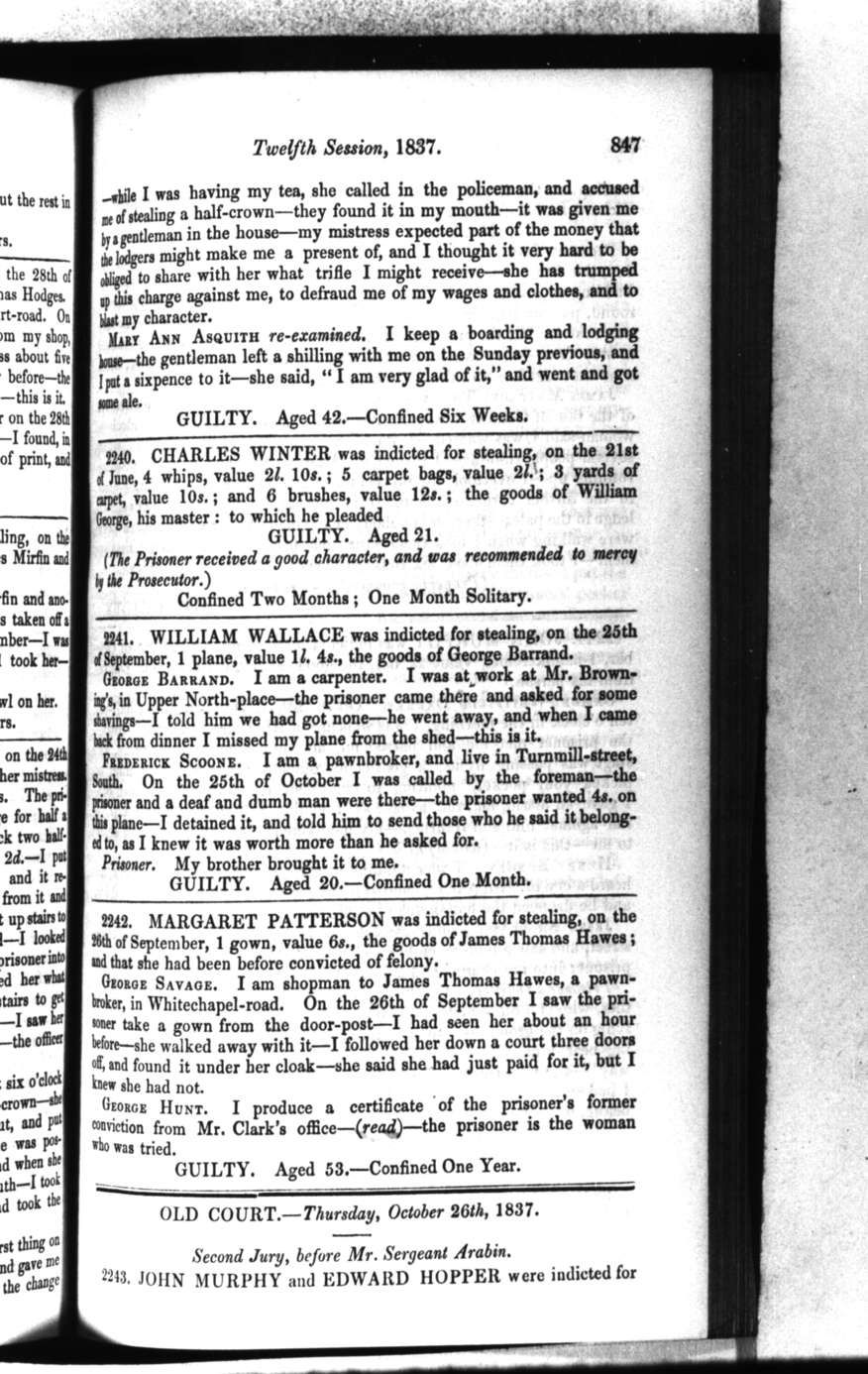
In the above record – Upper North Place is a small part of the bottom of Grays Inn Road and consists of only a few houses and workshops. There were only a few buildings on Grays Inn Road by 1840, and they were surrounded by fields. Mr. Browning who was the owner of the timber yard was William Browning, aged 41 (b 1796) and lived with his wife Ann, but they had no children. In 1862, North Place became part of Grays Inn Road.
Turnmill Street derived its name from the many watermills which existed along the River Fleet (see below) in earlier centuries. Once there were houses with gardens running down to a fast-flowing stream that found its source up in the ponds of Hampstead and carved its way through meadows down to the Thames. This was the Fleet River, the largest of the great watercourse’s tributary streams; the name was Anglo-Saxon and meant tidal inlet. Its water ran mills for the nearby Clerkenwell priories. Clerkenwell was at one time very genteel but deteriorated into a slum area with considerable poverty and overcrowding. It attracted poor people and criminals because of the rich pickings to be made in the city. The story of Oliver Twist is based in the area and some people were so poor that children even had clothes stolen off their bodies. Turnmill Street (leading to Farringdon Station) was a notorious area of ill repute. Turnmill Street was known as the original “slum” of London and symbolised the absolute lowest of low life.
The pawnbroken mentioned, Frederick Scoone, is also given prominence in the newspapers as a dishonest man, having taken pledges of sheets clearly marked "Clerkenwell Workhouse". The Judge told the shopman of the pawnbroker "He ought to be ashamed of himself." In 1832, the pawnbroker also appeared in court and was held on bail for "attempting to take liberties with a young boy"
The River Fleet, before it became an underground sewer, flowed along the western side of Pancras Road (formerly Old St Pancras Road) and then eastward along the south side of the common, to be crossed by the old highway (now Gray’s Inn road) north of St Chad’s Place near the entrance of the now-closed King’s Cross Station on the Metropolitan Line. In May, 1831, The Examiner Newspaper in London mentioned that eels came up the River Fleet with every tide from the Thames. By the mid-18th century, however, it had become the foulest open sewer in London, and was covered over bit by bit. The river, now known as the Fleet Sewer, is now 25ft below street level in some places.
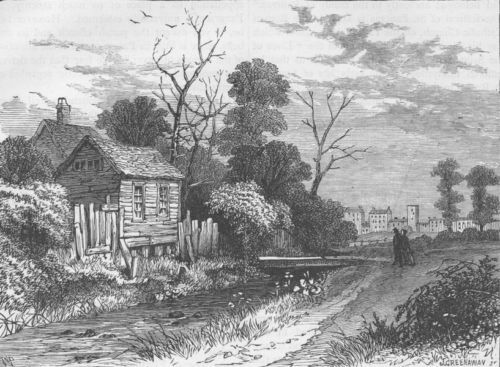
River Fleet St. Pancras 1825
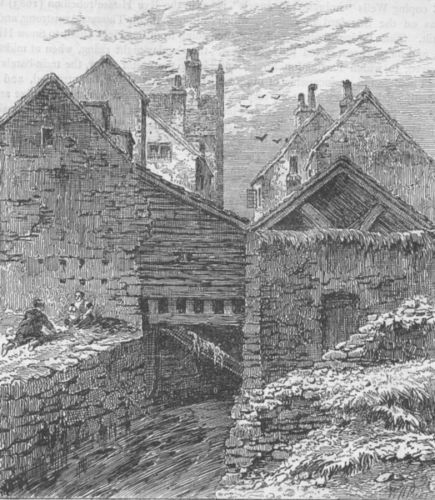
River Fleet ditch 1844 near West Street
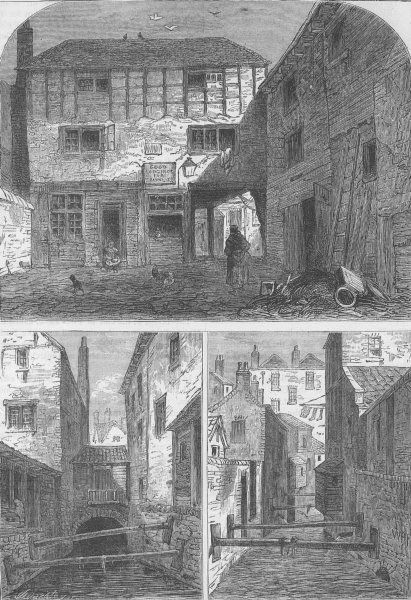
2 images of the fleet ditch
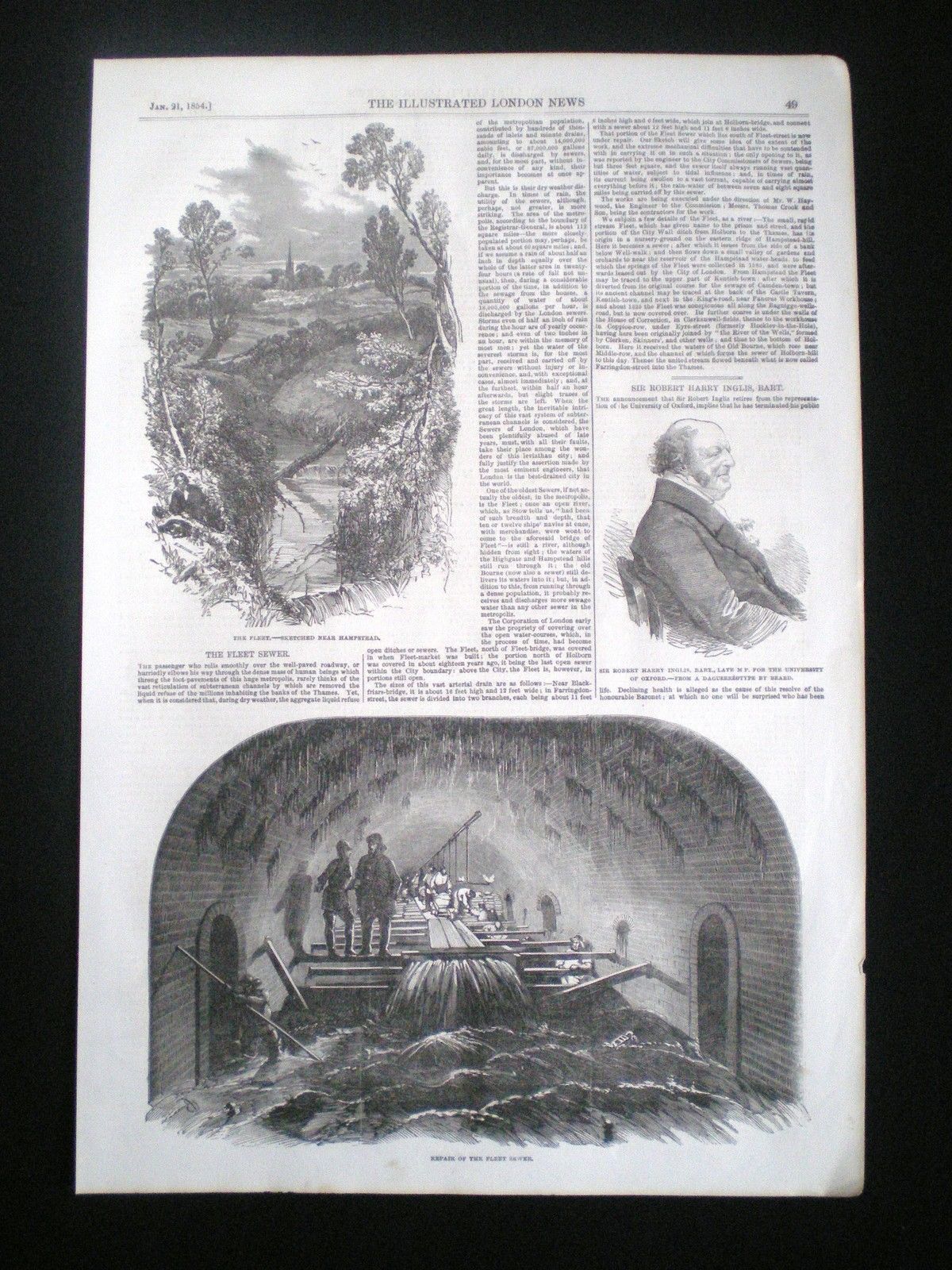
Fleet River when it became a sewer 1854
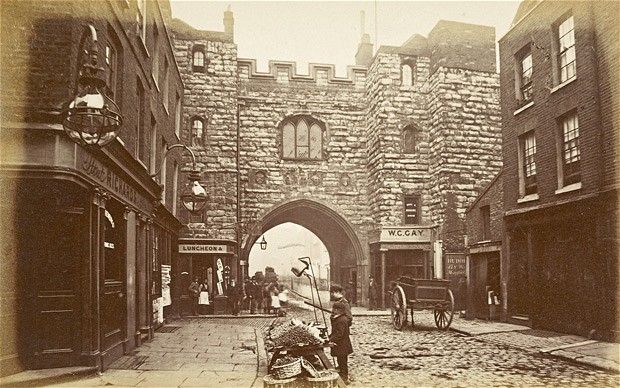
Gray's Inn Lane, 1885.
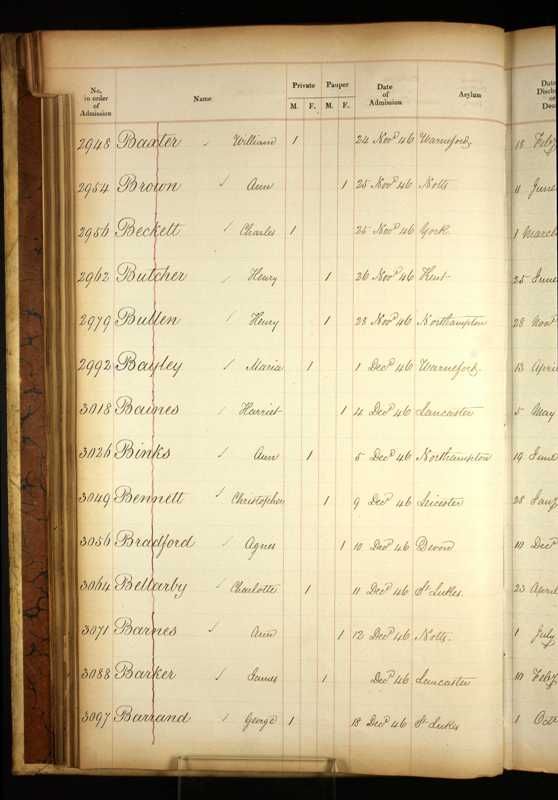
George Barrand's admission to St. Luke's Lunatic Assylum 18th December, 1846
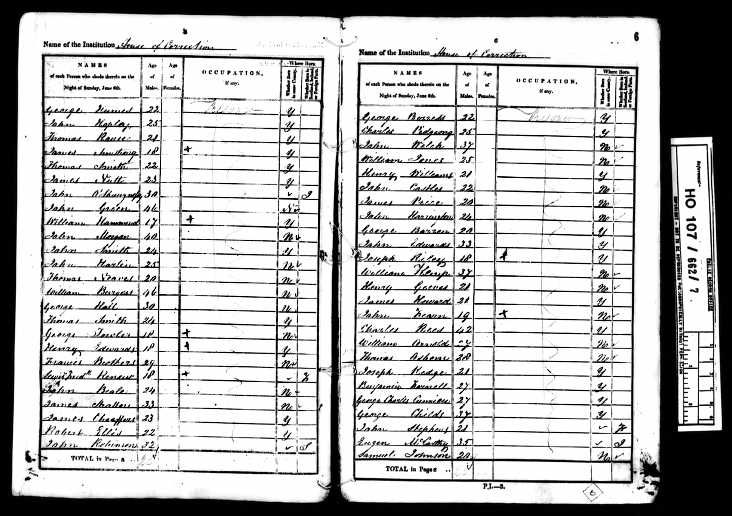
1841 Census George Barrond (House of Correction)
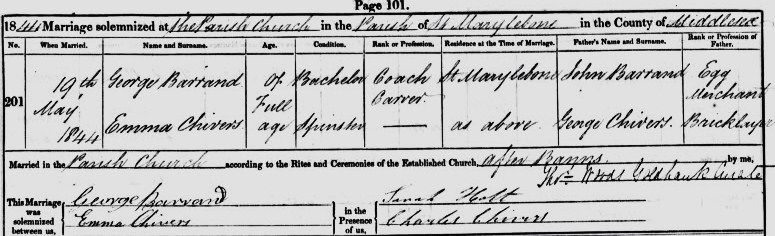
Marriage certificate George Barrand and Emma Chivers
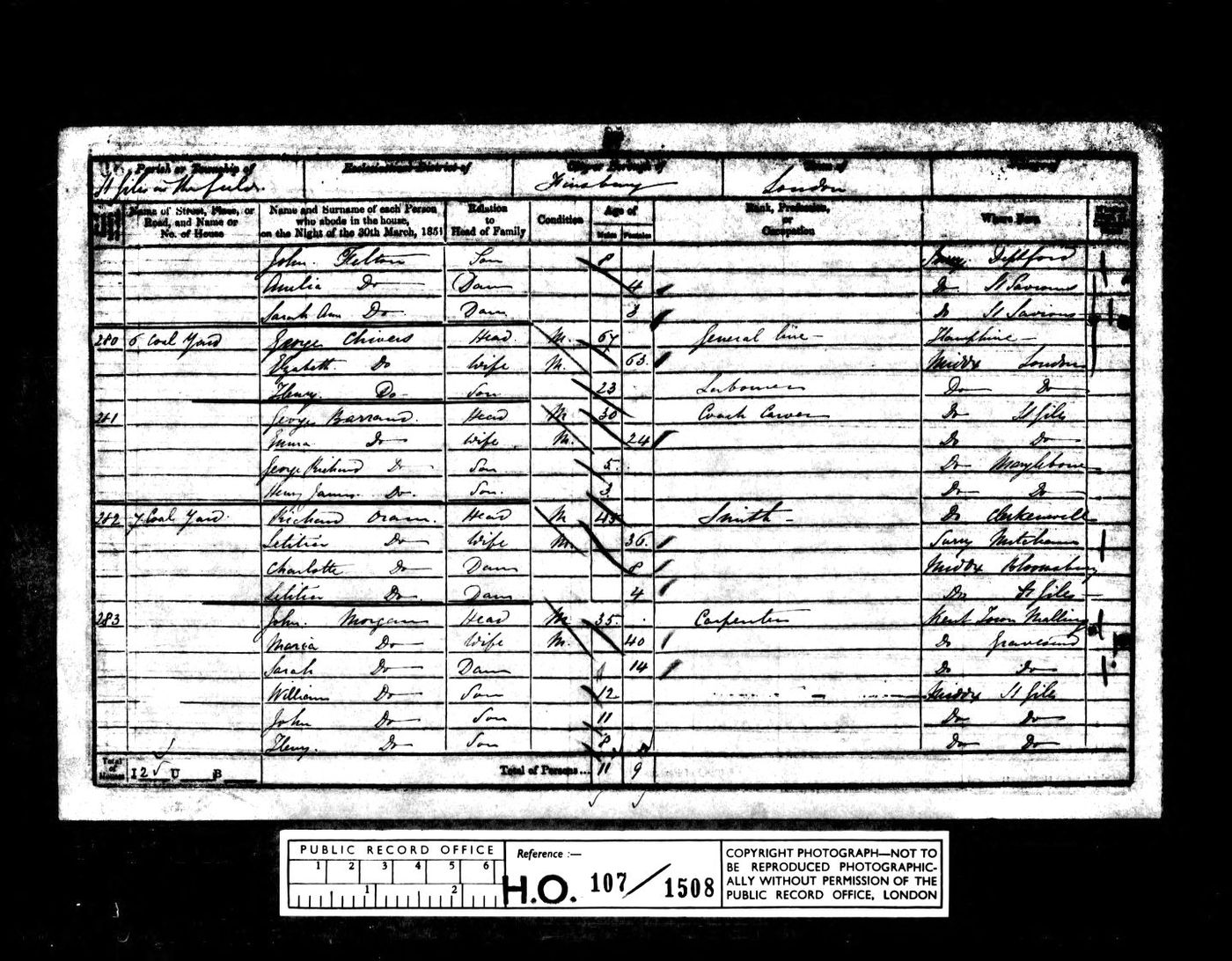
1851 Census, George Barrand + Emma Chivers
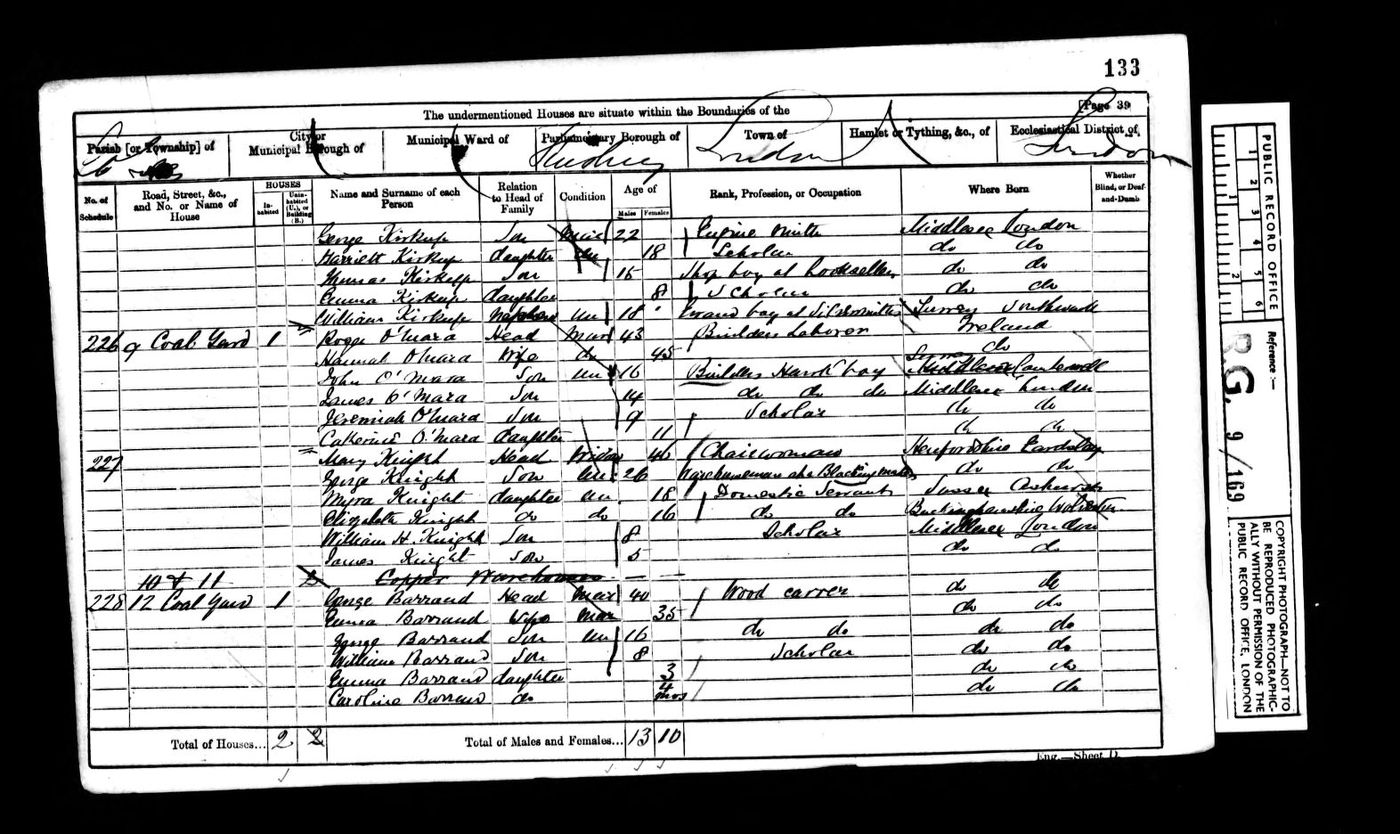
1861 Census, George Barrand + Emma Chivers
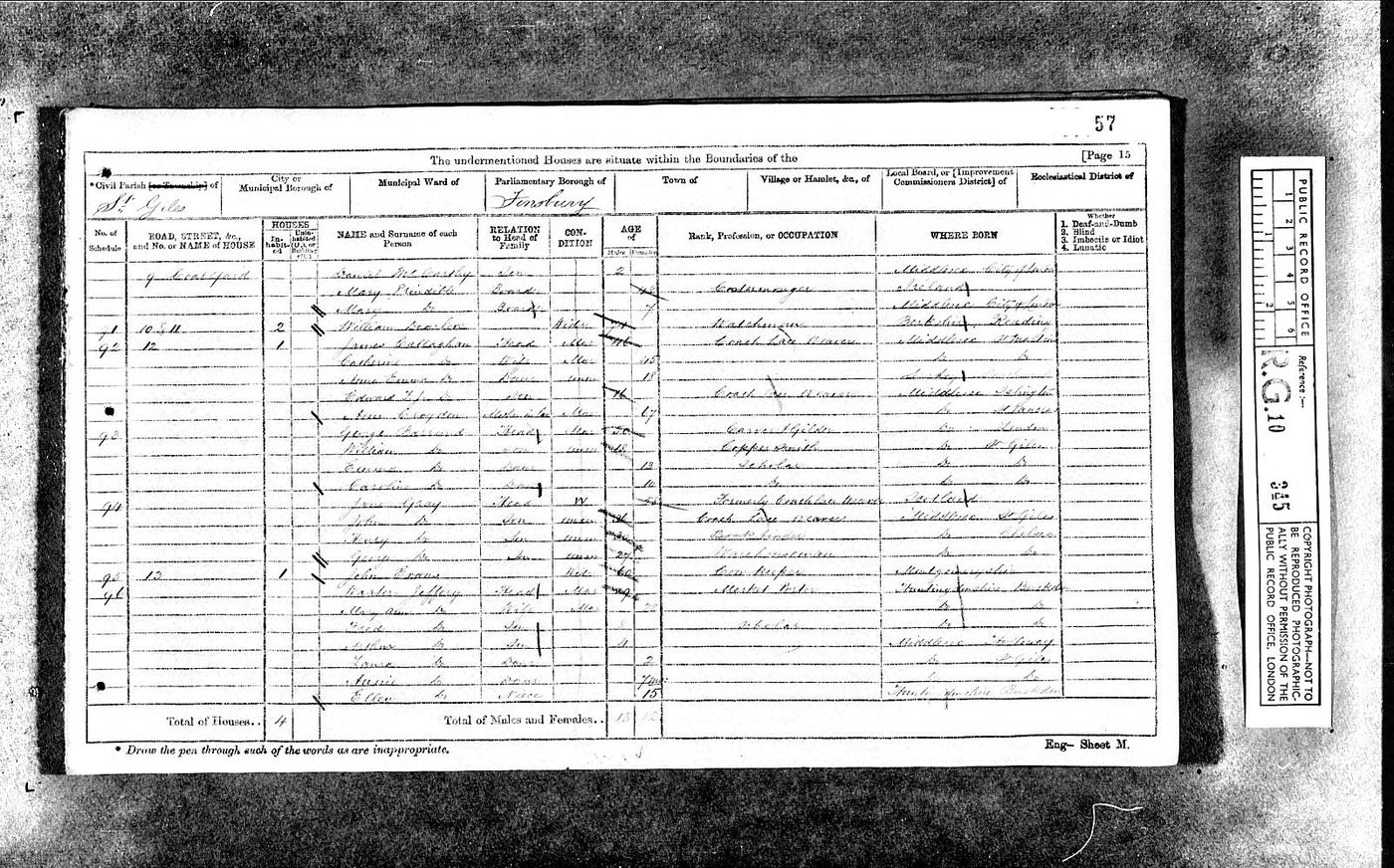
1871 Census George Barrand and Emma Chivers
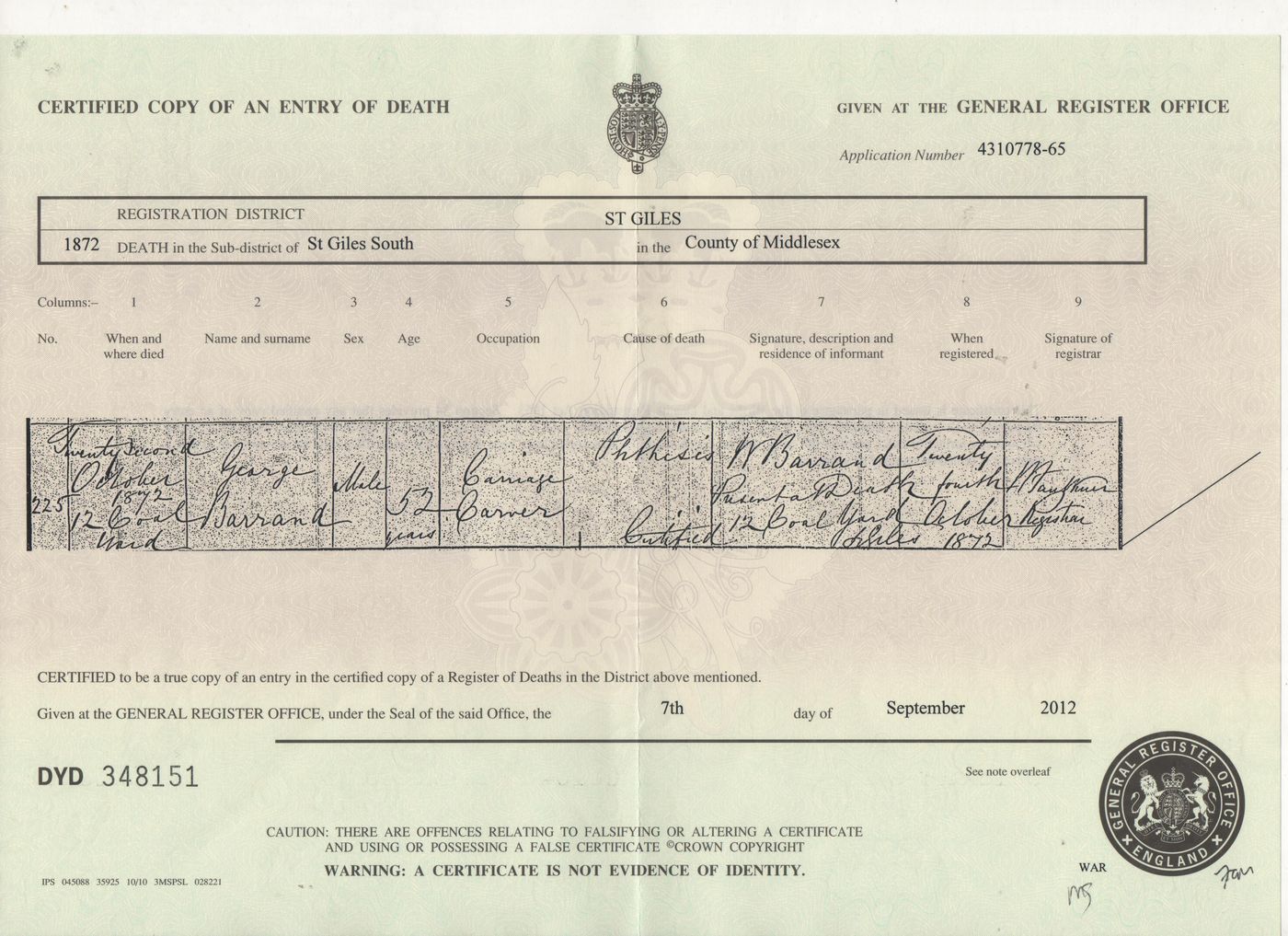
1872 Death Certificate of George Barrand
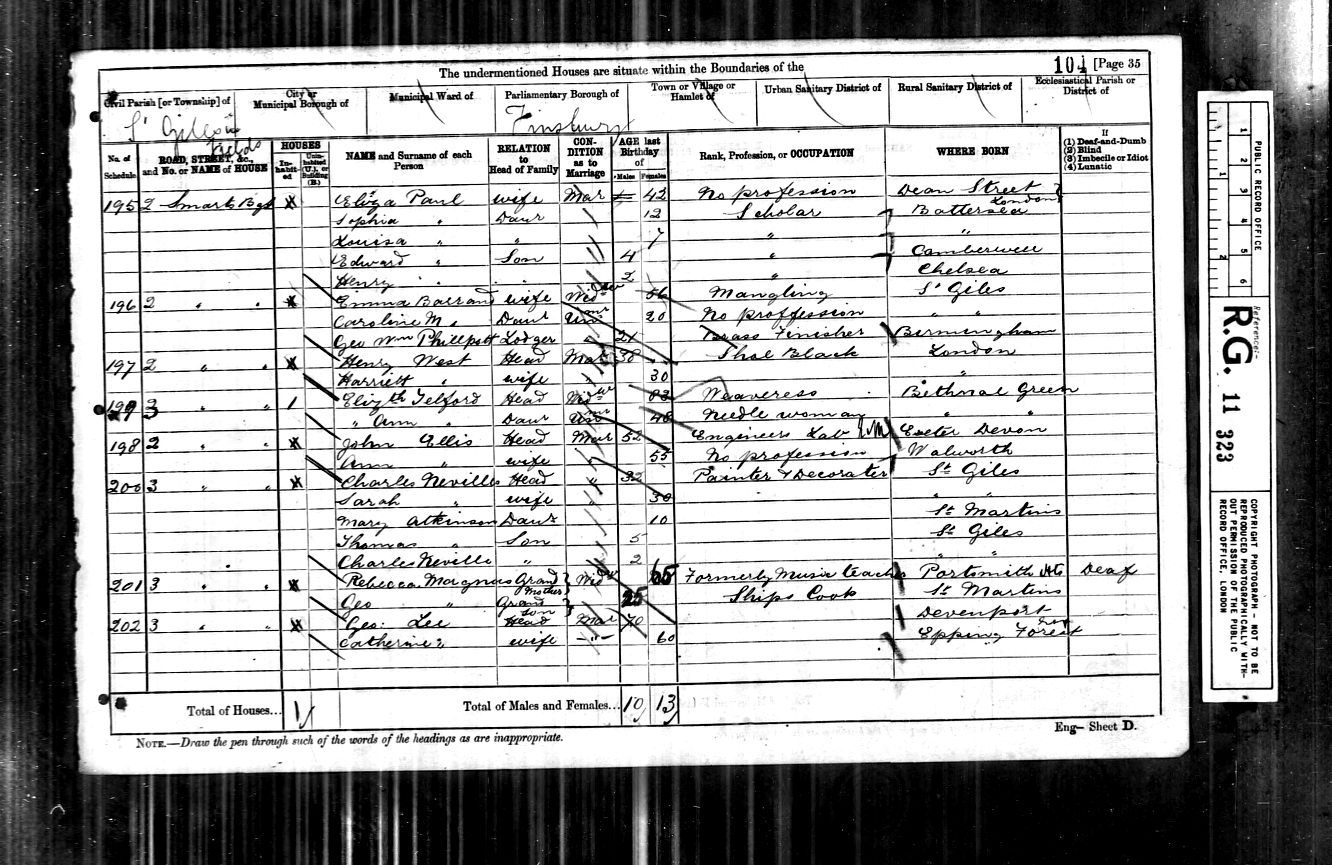
1881 Census – Emma Chivers (2, Smarts Buildings)
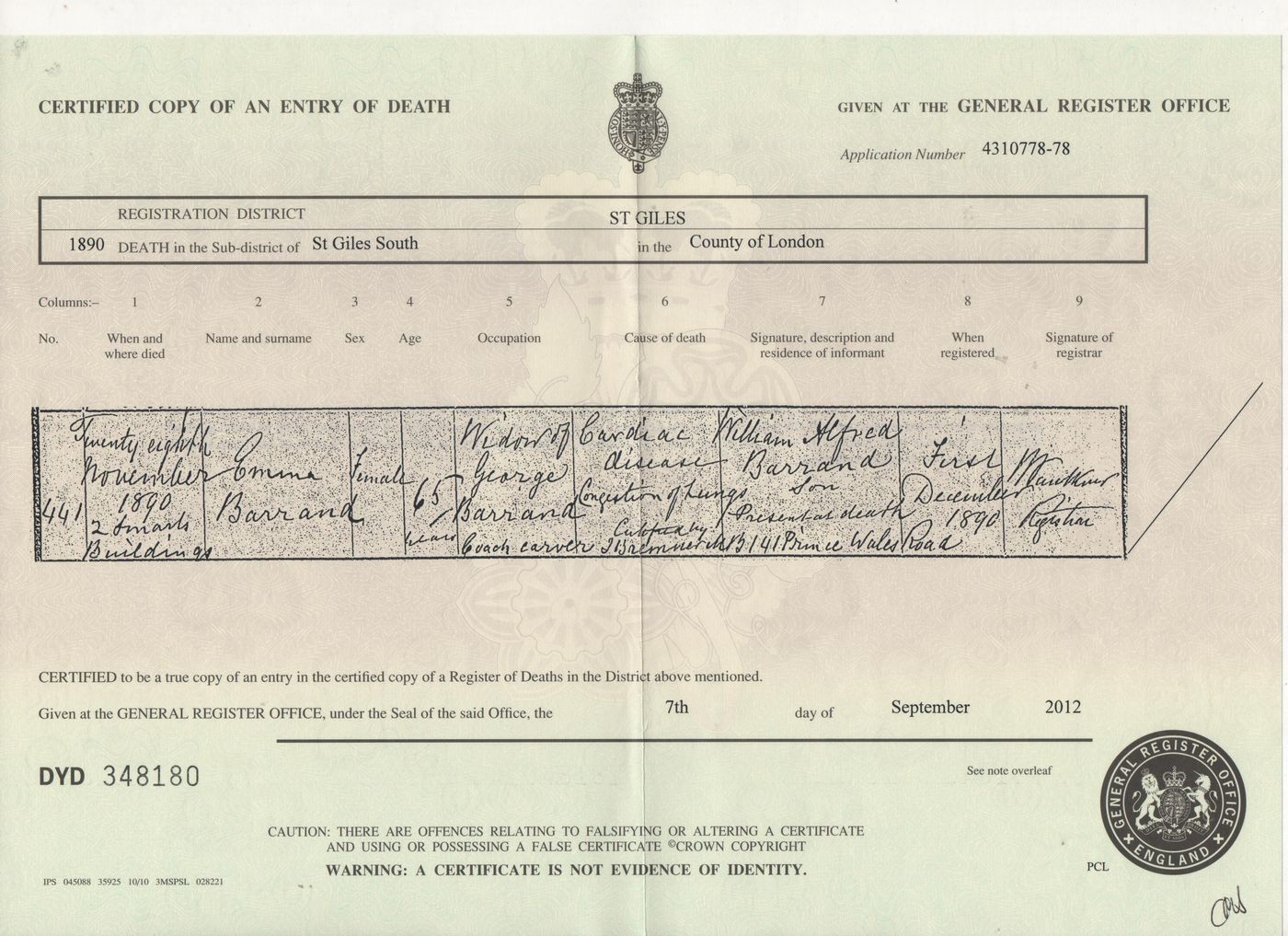
1890 Death Certificate of Emma Barrand (nee Chivers) - 2 Smarts Buildings
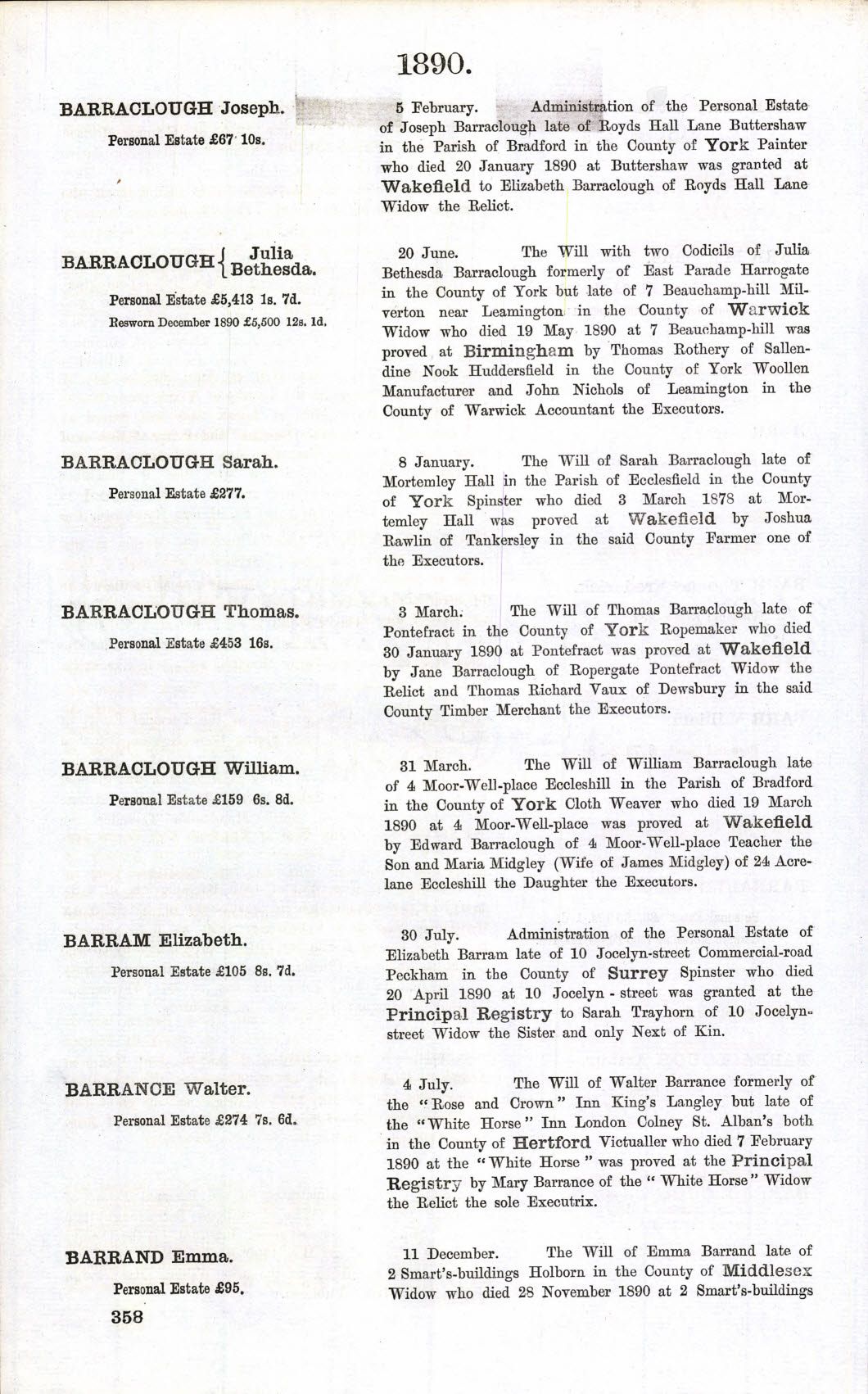
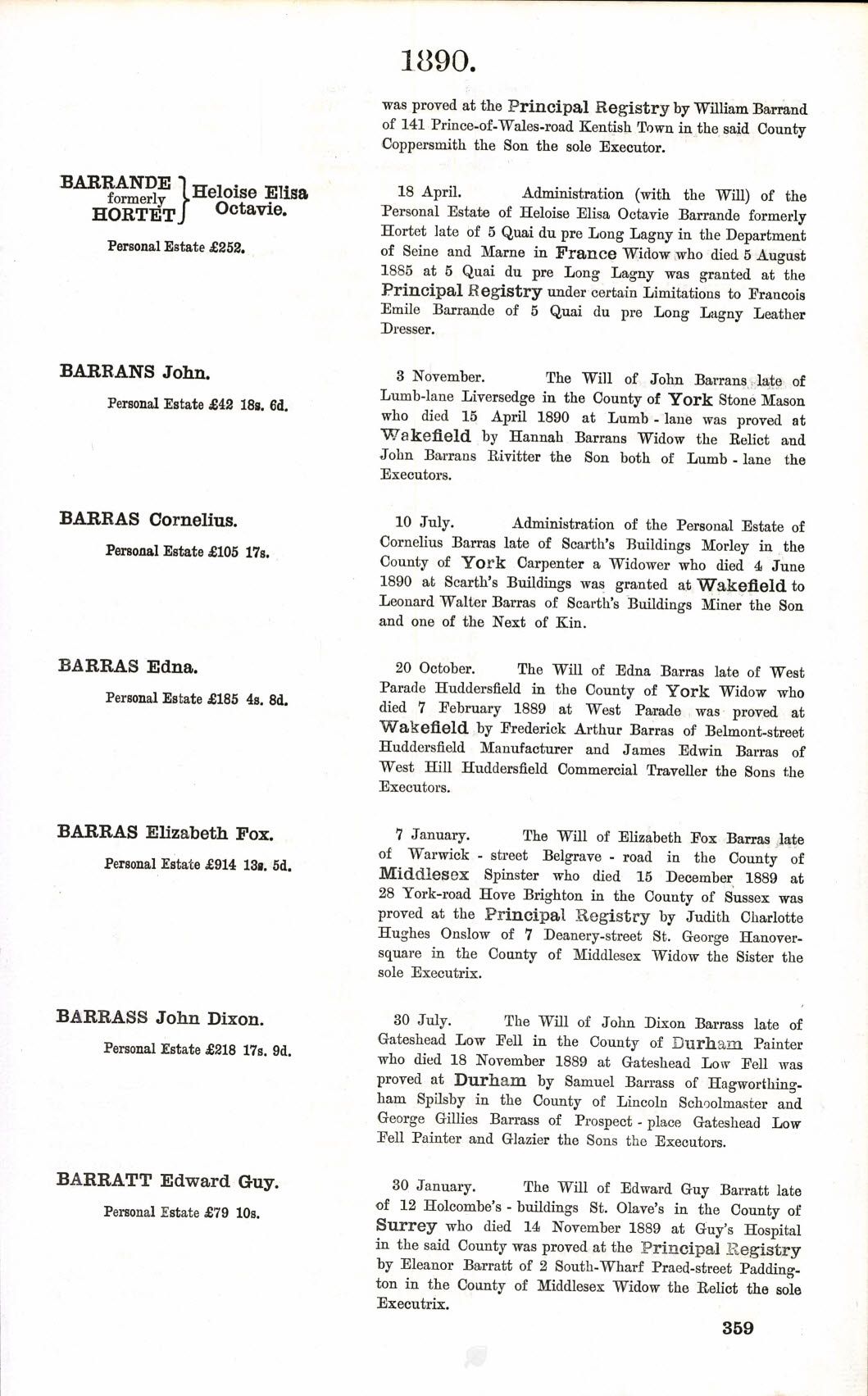
Will of Emma Barrand (nee Chivers)